- Where to see one
- 9 U.S. zoos in our directory hold mandarin duck, confirmed against each zoo's own animal list.
- Native range
- East and Northeast Asia, breeding in eastern Russia, China and Japan
- Size
- 41–49 cm (16–19 in) long, wingspan 65–75 cm (26–30 in), weight 428–693 g (15–24.4 oz)
- Clutch size
- 9–12 eggs, incubated by the female for 28–30 days
- Nest site
- Tree cavities near water, up to about 9 m (30 ft) off the ground
- Closest relative
- The North American [wood duck](/animals/wood-duck/)
Conservation status
Least Concernassessed 2018
IUCN Red List category LC — step 1 of 7.
The mandarin duck is a medium-sized perching duck native to East and Northeast Asia, 41 to 49 cm long, and closely related to the North American wood duck. Males are elaborately coloured, with a red bill, purple crest, white crescent above the eye and two orange sail feathers, while females are greyish brown. Mandarins breed near shallow lakes and wooded rivers, nesting in tree cavities. They dabble and walk on land, eating mainly plants and seeds, especially acorns and beech mast, along with snails, insects and small fish. Feral populations exist in Britain and elsewhere in Europe.
About the mandarin duck
The mandarin duck is a perching duck native to East and Northeast Asia, breeding in eastern Russia, China and Japan. It shares the genus Aix with only one other living species, the North American wood duck. Males are elaborately colored, while females are a subdued grey-brown.
The species measures 41–49 cm (16–19 in) from bill to tail, with a wingspan of 65–75 cm (26–30 in), and weighs roughly 428 to 693 g (15 to 24 oz). It has a shorter, more compact body than most dabbling ducks and is slightly smaller than its wood duck cousin. Its scientific name, Aix galericulata, pairs an Ancient Greek word Aristotle used for an unidentified diving bird with a Latin word meaning "wig."
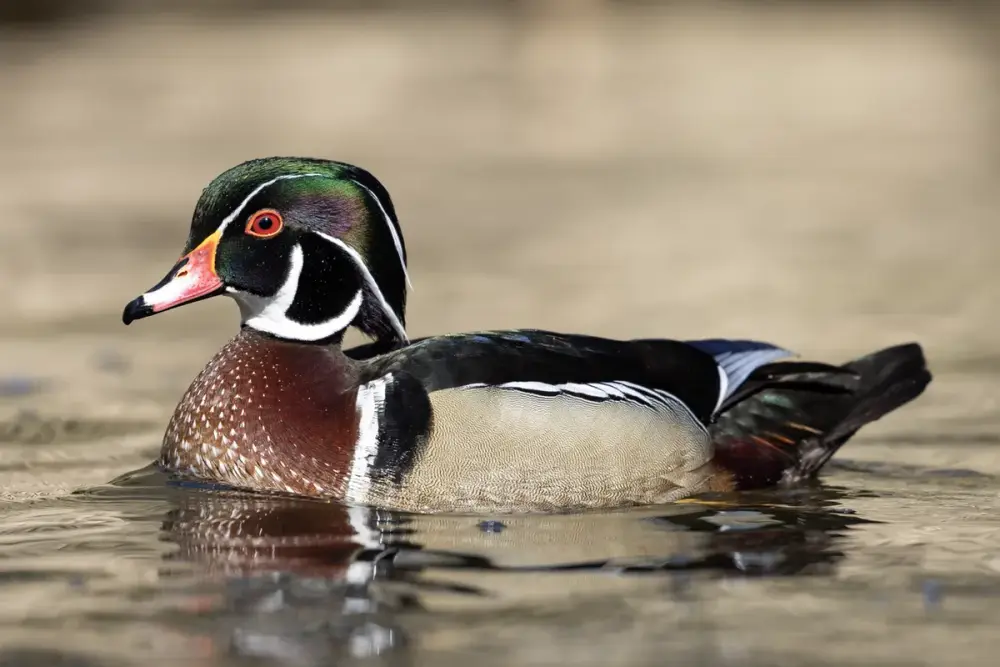
The breeding male is the showpiece. He has a small red bill, a broad white crescent above each eye, a reddish face and reddish "whiskers," and a purple breast crossed by two vertical white bars. His flanks are ruddy, and two upright orange "sail" feathers rise from his back. These sails are modified flight feathers, the 12th secondaries, with an enlarged inner vane that stands up like a boat's sail.
The female is grey-brown with a thin white eye-ring and a white stripe trailing back from the eye, paler underparts, a small white flank stripe and a pale tip to the bill. Both sexes carry a crest, though the male's is fuller. In flight, both show a bluish-green iridescent patch on the wing called the speculum.
After the breeding season the male molts into a drab "eclipse" plumage and looks much like the female. He can still be told apart by his bright yellow-orange or red bill, the missing crest and a fainter eye stripe. Mandarin ducklings are nearly identical to wood duck ducklings. They differ from mallard ducklings in one detail: the dark eye stripe stops at the eye instead of running all the way to the bill.
Behavior and diet
Diet
Seeds, acorns, beech mast, grain and water plants, plus snails, insects and small fish
Mandarin ducks are shy compared with most ducks. They prefer to stay under cover, such as overhanging willows, and gather in smaller flocks, although birds that grow used to people can become bolder. They feed mostly around dawn and dusk, which makes them partly crepuscular, and spend much of the day perched in trees or resting on the ground.
They feed by dabbling at the water's surface or by walking on land. Plants and seeds make up most of the diet, especially acorns and beech mast. The menu shifts with the seasons. In fall and winter it is mostly acorns and grain; in spring, insects, snails, fish and aquatic plants; in summer, small worms, small fish, frogs, mollusks and even small snakes.
Pairs form at the start of winter and may stay together for several seasons. Courtship includes mock-drinking and shaking displays. The female chooses the nest site, but the male goes with her while she searches. Nests are always in tree holes, sometimes as high as 9 m (30 ft), and are lined with down.
The female lays a single clutch of 9 to 12 white eggs, one per day, in April or May, and incubates them alone for 28 to 30 days. The male may guard her during incubation but leaves before the eggs hatch. Once the brood has hatched, the mother flies to the ground and calls. Each duckling climbs out of the cavity and drops to the ground, landing unhurt, then follows her to water. The young can fly at 40 to 45 days old.
Females often slip eggs into other nests, a habit called conspecific brood parasitism. In one reserve in northeast China, 46.1% of mandarin ducks were found doing it. Research there found the extra eggs did not lower the hatching success of the host's own eggs.
Asian populations are migratory, and the birds are strong fliers that have been recorded covering 800 km (500 mi) in 24 hours. Mandarin ducks also have an unusual genetic makeup: 84 chromosomes, compared with about 80 in other ducks. That difference makes hybrids with other ducks very difficult, possibly impossible, though this is disputed.
Range and habitat
Habitat
Dense, shrubby wooded edges of rivers, lakes and ponds
In its native range the mandarin duck breeds in eastern Siberia, China and Japan, and winters in lowland eastern China and southern Japan. It favors the dense, shrubby forested edges of rivers and lakes, usually at low elevations, though it may breed in valleys up to 1,500 m (4,900 ft). In winter it also turns up in marshes, flooded fields, open rivers, and sometimes coastal lagoons and estuaries.
Escaped birds have built introduced populations far from Asia. Great Britain now holds about 7,000 mandarin ducks, a population that grew from escapees during the 20th century. Smaller groups breed in Ireland, mainly in Dublin's parks, and the largest population in mainland Europe is around Berlin. In Britain the species uses a niche native ducks leave empty, so it is generally not considered invasive, though it may compete with the common goldeneye, another tree-nesting duck.
The United States has isolated feral populations too. A small group lives around Black Mountain, North Carolina, and several hundred free-flying birds live in Sonoma County, California, descended from ducks that escaped captivity.
Mandarin duck vs wood duck
The mandarin duck and the wood duck are the only two members of the genus Aix. Females and ducklings of the two are easy to confuse.
| Feature | Mandarin duck | Wood duck |
|---|---|---|
| Native range | East and Northeast Asia | North America |
| Size | 41–49 cm (16–19 in); slightly smaller | Slightly larger |
| Genus | Aix | Aix, the only other living member |
| Female | Grey-brown with a thin white eye-ring and stripe behind the eye | Very similar to the female mandarin |
| Ducklings | Eye stripe stops at the eye | Nearly identical |
Conservation status
The mandarin duck is listed as Least Concern on the IUCN Red List, assessed by BirdLife International in 2018. That rating hides a rough history. Large-scale exports and the clearing of its forest habitat cut the populations in eastern Russia and China to fewer than 1,000 pairs each by the 1980s, while Japan was thought to hold around 5,000 pairs. China has since made the mandarin a protected species, and a 2009 survey estimated 12,000 to 14,000 birds there.
Logging-driven habitat loss remains the greatest threat. Hunters also kill some birds by mistake because the species is hard to identify in flight. Mandarins are not hunted for food, a fact one account links to their poor taste, but they are still poached for their beauty. Predators include mink, raccoon dogs, otters, polecats, Eurasian eagle-owls and grass snakes.
The same striking plumage makes the species popular in waterfowl collections, where breeders have selected pale "silver" and white color forms.
Where to see mandarin duck in the U.S.
9 zoos across 8 states
Find the closest one
Rank the 8 zoos holding mandarin duck by how far they are from you. Your location is used in your browser to sort this list and is never sent to us.
1 more zoo holds mandarin duck but has no coordinates on file yet, so it isn't ranked here. It's in the full list below.
Alabama· 1
Connecticut· 1
Illinois· 1
Indiana· 1
Kentucky· 1
New York· 2
Ohio· 1
Pennsylvania· 1
AZAThe Association of Zoos and Aquariums. Accredited members have passed an independent inspection of animal care and welfare, safety, conservation and education, repeated every five years. Many smaller facilities never apply, so “not accredited” isn't a verdict on its own. What accreditation means · How we check this
Built from each zoo's own published animal list.
Mandarin Duck: common questions
Are mandarin ducks native to the United States?
No. They are native to East and Northeast Asia. Small feral populations descended from escaped captive birds live in places such as Sonoma County, California, and Black Mountain, North Carolina.
How big is a mandarin duck?
About 41–49 cm (16–19 in) long with a 65–75 cm (26–30 in) wingspan. Adults weigh roughly 428–693 g (15–24 oz), slightly smaller than a wood duck.
What do mandarin ducks eat?
Mostly plants and seeds, especially acorns, beech mast and grain. They also eat snails, insects, small fish, frogs, worms and mollusks, with more animal food in spring and summer.
Do mandarin ducks mate for life?
Not strictly. Pairs form at the start of winter and may stay together for many seasons, and Chinese, Korean and Japanese tradition treats them as symbols of lifelong fidelity, but the male leaves before the eggs hatch.
Is the mandarin duck endangered?
No. It is rated Least Concern, though its Asian populations fell sharply in the 20th century because of forest clearing and large-scale exports.
Why do mandarin ducklings jump out of trees?
Because they hatch in tree holes that can be 9 m (30 ft) above the ground. The mother calls from below, and the ducklings drop out of the nest and land unhurt.
What is the difference between a male and female mandarin duck?
The breeding male has orange sail feathers, a white eye crescent, a reddish face and whiskers, a purple breast and a red bill. The female is grey-brown with a white eye-ring and stripe and lacks the bright colors.