- Where to see one
- 11 U.S. zoos in our directory hold baird's tapir, confirmed against each zoo's own animal list.
- Native range
- Mexico, Central America, and northwestern South America
- Size
- Average length about 2 m (6 ft 7 in), height 73–120 cm (29–47 in); body mass 150–300 kg (330–660 lb)
- Lifespan
- Can live for over 30 years
Conservation status
IUCN Red List category EN — step 4 of 7.
Endangered (EN), per the IUCN
About the Baird's tapir
Baird's tapir, also called the Central American tapir, is native to Mexico, Central America, and northwestern South America. It is the largest of the three tapir species found in the Americas and the largest native land mammal in both Central and South America. The animal is named for American naturalist Spencer Fullerton Baird, who traveled to Mexico in 1843 and observed the species, though it was first documented by fellow American naturalist W. T. White. It carries a range of local names — danta across much of its range, anteburro around Oaxaca and Veracruz, macho de monte in Panama and Colombia, and mountain cow in Belize, where it is the national animal.
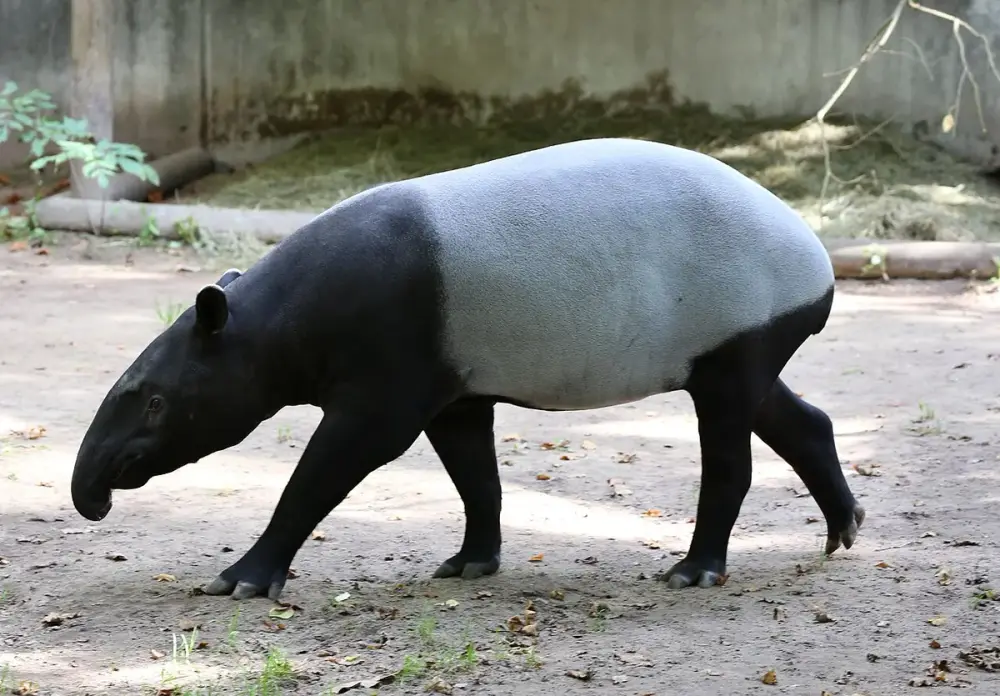
In appearance, the Baird's tapir has a distinctive cream-colored marking across its face, throat, and ear tips, with a dark spot below and behind each eye; the rest of its bristly coat is dark or grayish brown, sometimes with a thin, inconspicuous mane. Built like a muscular, small donkey, it has small oval eyes set flush with the head and large, largely immobile oval ears. Adults average about 2 m (6 ft 7 in) in length, ranging from 1.8 to 2.5 m (5 ft 11 in to 8 ft 2 in), not counting a stubby vestigial tail of 5–13 cm (2.0–5.1 in), and stand 73–120 cm (29–47 in) tall at the shoulder. Body mass runs from 150 to 300 kg (330 to 660 lb). Its most distinctive feature is a flexible, fleshy proboscis formed by an extended snout and upper lip — its strongest sense organ, used both to find food and to detect stimuli around it. The legs are short and slender for moving quickly through underbrush, with four toes on each front foot and three on each back foot.
Behavior and diet
Diet
Herbivorous — leaves, twigs, flowers, grasses, and fruit
Baird's tapirs are active at all hours but are primarily nocturnal, foraging along well-worn zigzag paths through thick undergrowth for leaves and fallen fruit. They stay close to water, enjoy swimming and wading, and on hot days will soak for hours in a watering hole with only their head above the surface; when threatened, they retreat to water. The species is generally solitary, though small feeding groups occur, and animals of different ages — a mother with young, or juveniles with adults — are often seen together. They communicate through shrill whistles and squeaks, and during the mating season males can fight fiercely for access to females, sometimes suffering serious injuries.
Diet is entirely herbivorous, drawn mainly from leaves found from the forest floor up to about 1.5 m (4 ft 11 in), supplemented with twigs, flowers, grasses, and fruit as it becomes available. The animal favors secondary-growth forest and large tree-fall gaps, where dense, digestible understory plants with fewer defensive toxins are concentrated, and it tends to move to a new plant before stripping one bare. Baird's tapirs also form a symbiotic relationship with cleaner birds — the yellow-headed caracara and the black vulture — which remove ticks from their fur; tapirs will lie down and expose tick-infested areas to encourage this. As seed dispersers, they pass hard seeds such as guanacaste, sapodilla, and encina through their digestive tract, which can scarify the seeds and improve germination odds.
Baird's tapirs form long-term monogamous pairs that defend territory together, breeding most commonly ahead of the rainy season though mating can occur year-round. Gestation lasts about 400 days, after which a single calf is born weighing an average of 9.4 kg (21 lb); multiple births are extremely rare, though a Baird's tapir at Boston's Franklin Park Zoo gave birth to twins in September 2020. Newborns have reddish-brown coats with white spots and stripes for camouflage, a pattern that fades into adult coloration over time. Calves are hidden in secluded spots for their first week while the mother forages and returns to nurse, later following her on feeding trips; they can swim by three weeks old, wean at about a year, and reach sexual maturity six to twelve months after that. Both parents take part in raising young, moving and sleeping together as a family unit.
Range and habitat
Habitat
Mangrove forests, marshes, swamps, wet tropical rainforest, riparian woodland, deciduous forest, and mountainous cloud forest, up to 3,600 m (11,800 ft) elevation
Baird's tapir occupies a wide range of vegetation types from Mexico through Central America into northwestern South America, tolerating elevations from sea level up to 3,600 m (11,800 ft). It turns up in wet environments such as mangrove forests, marshes, swamps, and tropical rainforest, as well as drier habitats including riparian woodland, deciduous forest, and mountainous cloud forest. Secondary-growth forest is preferred where available, since it offers denser understory vegetation for both foraging and cover, and habitat selection is driven largely by food and water availability along with protection from danger.
Conservation status
The IUCN classifies Baird's tapir as endangered. Its decline stems from habitat loss to deforestation, forest fires, and large-scale industrial development, along with poaching, disease transmitted from domesticated animals, water pollution, and the growing effects of climate change in parts of its range. Because tapirs reproduce slowly, even limited hunting pressure can meaningfully affect the population.
Hunting is illegal in Mexico, Belize, Guatemala, Costa Rica, and Panama, though enforcement is often weak, and illegal logging continues to threaten protected areas. Conservationists are pushing to strengthen habitat protection through partnerships with indigenous territories, to re-establish habitat corridors such as the Mesoamerican Biological Corridor, and to expand local education on biodiversity. Captive breeding programs exist in North American and Central American zoos, but a study found inbreeding and genetic divergence from the wild population in this captive group, prompting calls for breeding approaches that prioritize genetic diversity.
Where to see baird's tapir in the U.S.
11 zoos across 8 states
Find the closest one
Rank the 10 zoos holding baird's tapir by how far they are from you. Your location is used in your browser to sort this list and is never sent to us.
1 more zoo holds baird's tapir but has no coordinates on file yet, so it isn't ranked here. It's in the full list below.
Arizona· 1
California· 1
Florida· 3
Louisiana· 1
Massachusetts· 2
Tennessee· 1
Texas· 1
Wisconsin· 1
AZAThe Association of Zoos and Aquariums. Accredited members have passed an independent inspection of animal care and welfare, safety, conservation and education, repeated every five years. Many smaller facilities never apply, so “not accredited” isn't a verdict on its own. What accreditation means · How we check this
Built from each zoo's own published animal list.
Baird's Tapir: common questions
Is the Baird's tapir endangered?
Yes. The IUCN lists it as endangered, largely due to habitat loss, poaching, and disease from domestic animals, compounded by the species' slow reproductive rate.
How big does a Baird's tapir get?
It averages about 2 m (6 ft 7 in) in length and stands 73–120 cm (29–47 in) tall, with body mass ranging from 150 to 300 kg (330 to 660 lb) — making it the largest native land mammal in Central and South America.
What does a Baird's tapir eat?
It is herbivorous, feeding mainly on leaves along with twigs, flowers, grasses, and fruit, foraging from the forest floor up to about 1.5 m (4 ft 11 in) off the ground.
How long do Baird's tapirs live?
They can live for over 30 years.
Where do Baird's tapirs live in the wild?
They range through Mexico, Central America, and northwestern South America, in habitats from mangrove swamps and rainforest to drier woodland and mountain cloud forest.
Which U.S. zoos have Baird's tapirs?
Five zoos in the Feather & Fang directory have Baird's tapirs, including the Los Angeles Zoo, Houston Zoo, and Brevard Zoo.