- Where to see one
- 12 U.S. zoos in our directory hold american white pelican, confirmed against each zoo's own animal list.
- Native range
- Breeds in interior North America; winters along the Pacific and Gulf coasts south to Costa Rica
- Size
- Length about 130–180 cm (50–70 in); wingspan about 240–300 cm (95–120 in); weight usually 5.0–9.1 kg (11–20 lb)
- Lifespan
- More than 16 years in the wild (oldest known wild bird 26.4 years); over 34 years in captivity
- Food per day
- More than 1.8 kg (4 lb)
- Clutch size
- Usually two eggs
Conservation status
Least Concernassessed 2025
IUCN Red List category LC — step 1 of 7.
The American white pelican is a large soaring bird that breeds on remote brackish and freshwater lakes in the interior of North America and winters on the Pacific and Gulf coasts south to Costa Rica. It is almost entirely bright white with black flight feathers, a huge flat bill and a large throat pouch. Unlike the brown pelican, it does not dive for food but catches fish while swimming, often in groups of a dozen or more that cooperate to corral prey. Each bird eats more than 1.8 kg of food a day. In the breeding season both sexes grow a flattened horn on the upper bill, which is shed after the eggs are laid.
About the American white pelican
The American white pelican is a very large white waterbird in the pelican family, order Pelecaniformes, native to North America. It breeds on islands in inland lakes of the United States and Canada and winters on the Pacific and Gulf coasts south to Costa Rica. It fishes from the surface instead of diving.
This is one of the longest birds native to North America, rivaling the trumpeter swan in overall length. Its wingspan, about 240–300 cm (95–120 in), is the second largest on average of any North American bird, after the California condor. That broad wingspan lets it soar easily on migration. Weight ranges widely, from 3.5 to 13.6 kg (7.7–30 lb), though most birds weigh 5.0–9.1 kg (11–20 lb).
The plumage is almost all bright white, except for black flight feathers that mostly show only when the wings are open. The bill is huge and flat on top, with a large throat pouch below, and in the breeding season the bill, the bare skin around the eye and the feet all turn vivid orange. The scientific name means "red-billed pelican."
During breeding, both sexes grow a flattened, horny plate on the upper bill about a third of the way back from the tip. No other pelican of the eight species has this bill "horn," and the birds shed it after mating and laying eggs. Males and females look alike apart from size, with males slightly larger. Young birds are light grey with a darker brownish nape.
Behavior and diet
Diet
Mostly fish, plus crayfish and amphibians
Unlike the brown pelican, the American white pelican does not plunge-dive for food. It catches its prey while swimming at the surface. Each bird eats more than 1.8 kg (4 lb) of food a day. Prey ranges from minnows to pickerel weighing about 1.6 kg (3.5 lb), and includes carp, chub, shiners, perch, trout, salmon and catfish, along with crayfish, amphibians and larval salamanders.
These pelicans often feed in groups of a dozen or more, cooperating to corral fish for one another. In deep water, where fish can dive out of reach, they tend to forage alone. They also steal food from other birds, a habit called kleptoparasitism, taking fish from other pelicans, gulls and cormorants.
American white pelicans nest in colonies of several hundred pairs, and up to 10,000 pairs at a single site, on islands in remote lakes. Pairs form after courtship displays that include circular flights, strutting walks, head swaying and bowing. The nest is a shallow scrape with a few twigs or reeds. The female usually lays two or three eggs, and both parents incubate them for about a month, keeping them warm under the webs of their feet.
Usually only one chick per nest survives. Young pelicans leave the nest at 3–4 weeks, gather in a crèche or "pod," and fledge at about 10–11 weeks. They begin breeding at about 3 years old. The species migrates by day in large flocks, often of more than 180 birds, flying in formation.
Range and habitat
Habitat
Inland lakes, rivers and marshes in summer; coastal bays, estuaries and lakes in winter
American white pelicans breed in interior North America, from British Columbia, Alberta, Saskatchewan, Manitoba and southwestern Ontario south through northern California, Nevada and Colorado. About 180,000 birds, some 40% of the world population, breed in Canada each spring, and Manitoba holds half of them. About 10–20% of the population nests on Gunnison Island in the Great Salt Lake.
Breeding colonies sit on islands in shallow freshwater and brackish lakes, rivers and marshes, where they are safer from mammal predators. These islands are often more than 50 km (31 mi) from the birds' feeding areas, and pelicans nesting on salty lakes with little food travel long distances to fish.
In winter, the birds move to the Pacific and Gulf of Mexico coasts, from central California and Florida south to Costa Rica, and along the Mississippi River as far north as St. Paul, Minnesota. They prefer estuaries, bays and lakes to open beaches, and they cross deserts and mountains on migration but avoid open ocean. Small year-round populations live along the Gulf of Mexico and in central Durango, Mexico.
American white pelican vs brown pelican
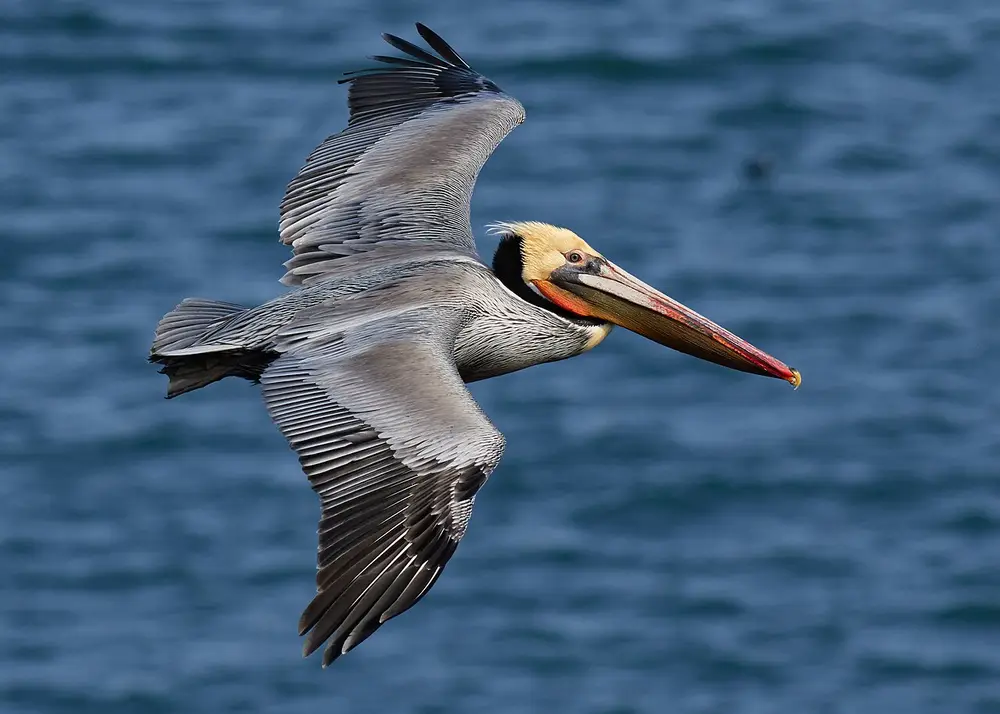
North America has two pelicans, and they are easy to tell apart. There are no similar species to the American white pelican on the continent.
| Feature | American white pelican | Brown pelican |
|---|---|---|
| Plumage | Bright white with black flight feathers | Dark |
| Size | Larger: length about 130–180 cm (50–70 in) | Smaller |
| Feeding | Scoops fish while swimming; does not dive | Dives for food |
| Breeding bill "horn" | Yes | No |
Conservation status
The American white pelican is listed as Least Concern on the IUCN Red List, most recently in BirdLife International's 2025 assessment. It is protected in the United States under the Migratory Bird Treaty Act of 1918, and California lists it as a species of special concern.
Numbers fell sharply in the mid-20th century because of DDT, endrin and other organochlorine pesticides, along with the draining and pollution of wetlands. Populations recovered after stronger environmental laws took effect and are now stable or slightly increasing. In Canada, large increases have been reported across every bird conservation region that hosts the species.
Habitat loss is the largest known cause of nesting failure, and flooding and drought are recurring problems. Other threats include tangling in fishing gear, disturbance from boats, poaching, shoreline erosion at colonies and occasional mass poisonings from pesticides. Red foxes and coyotes raid colonies they can reach, and young birds are taken by gulls, ravens, eagles and great horned owls.
Where to see american white pelican in the U.S.
12 zoos across 9 states
Find the closest one
Rank the 12 zoos holding american white pelican by how far they are from you. Your location is used in your browser to sort this list and is never sent to us.
California· 3
Colorado· 1
Idaho· 1
Illinois· 1
Kansas· 1
Louisiana· 1
Missouri· 1
Texas· 1
Wisconsin· 2
AZAThe Association of Zoos and Aquariums. Accredited members have passed an independent inspection of animal care and welfare, safety, conservation and education, repeated every five years. Many smaller facilities never apply, so “not accredited” isn't a verdict on its own. What accreditation means · How we check this
Built from each zoo's own published animal list.
American White Pelican: common questions
How big is an American white pelican?
Very big. It is about 130–180 cm (50–70 in) long with a wingspan of about 240–300 cm (95–120 in), and most adults weigh 5.0–9.1 kg (11–20 lb).
Do American white pelicans dive for fish?
No. Unlike brown pelicans, they catch fish while swimming, often corralling them together in cooperative groups.
How much does an American white pelican eat?
More than 1.8 kg (4 lb) of food a day, mostly fish, plus crayfish and amphibians.
How long do American white pelicans live?
More than 16 years in the wild; the oldest known wild bird was 26.4 years old. The captive record is over 34 years.
What is the bump on a pelican's bill?
It is a breeding "horn," a flat, horny plate both sexes grow on the upper bill in spring. It falls off after the eggs are laid, and no other pelican has one.
Where do American white pelicans live?
They breed on lake islands in inland North America, from Canada south to northern California, Nevada and Colorado, and winter on the Pacific and Gulf coasts, from California and Florida south to Costa Rica.
Are American white pelicans endangered?
No. They are listed as Least Concern, and populations have recovered from mid-20th-century pesticide declines.