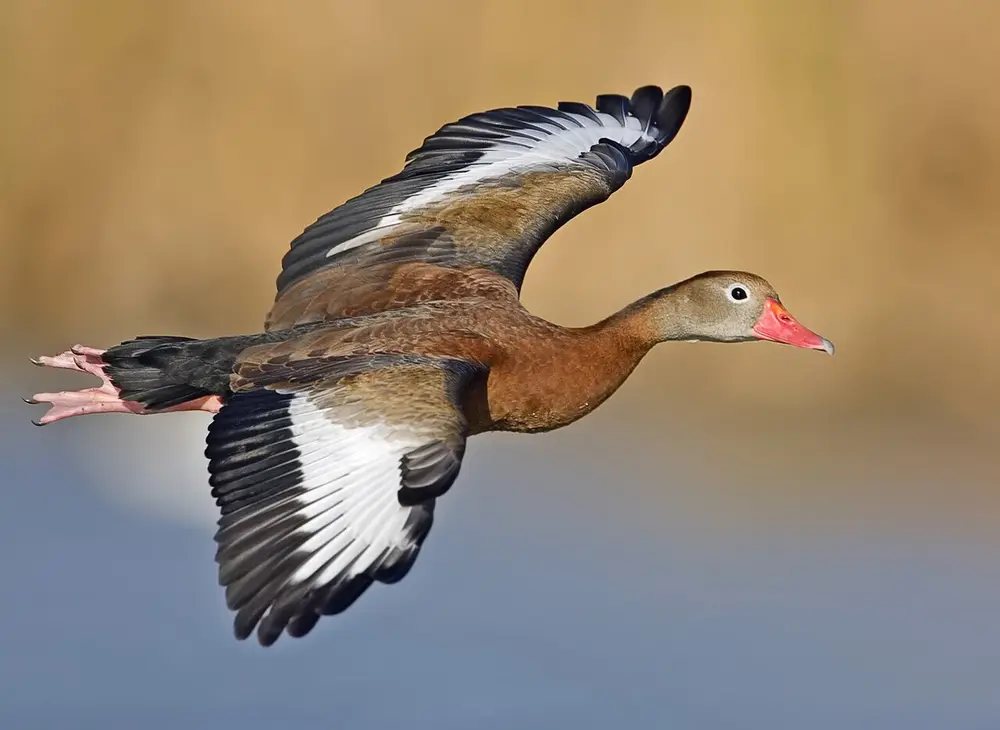
- Where to see one
- 12 U.S. zoos in our directory hold white-faced whistling duck, confirmed against each zoo's own animal list.
- Native range
- Sub-Saharan Africa and much of South America
Conservation status
Least Concernassessed 2016
IUCN Red List category LC — step 1 of 7.
About the white-faced whistling duck
The white-faced whistling duck is a whistling duck that breeds across sub-Saharan Africa and much of South America — an unusual, disjunctive distribution for a single species, occurring naturally on two continents separated by an ocean. It has been suggested that humans may have helped transport the species to some of its far-flung locations. It was formally described by the Swedish naturalist Carl Linnaeus in the 1766 twelfth edition of his Systema Naturae, originally under the name Anas viduata, with a type locality of Cartagena, Colombia. It's now one of eight species in the genus Dendrocygna, a name that combines the Greek dendron ("tree") with the Latin swan genus Cygnus. The species name viduata is Latin for "widowed" or "in mourning," and no subspecies are recognized.
As its name suggests, the bird has a distinctive white face, set off by a black neck and head, a long grey bill, a long head, and longish legs. The back and wings are dark brown to black, the underparts black with fine white barring on the flanks, and the neck chestnut-colored. Males and females look alike. The amount of white on the face varies regionally — birds with more black coloration are typically found in western Africa, where rainfall extends longer through the year and shortens the dry season. Juveniles resemble adults but show a much less contrasted head pattern.
Behavior and diet
Diet
Seeds and other plant food
The white-faced whistling duck is highly gregarious. At favored sites, flocks of a thousand or more birds arriving at dawn make for an impressive sight, and the species lives up to its name with a clear, three-note whistling call that makes it a noisy presence wherever it gathers. It is largely a resident species, though it does make local movements that can cover 100 km or more.
Its diet in the wild consists of seeds and other plant food, taken from the freshwater lakes and reservoirs it favors. For breeding, the nest is a simple depression on the ground or built within reed beds. A clutch numbers 6 to 12 eggs, incubated by both the male and the female, and the eggs hatch after 26 to 28 days. Both parents attend to the ducklings after hatching, typically keeping them hidden within reed cover, and the young fledge after about two months. Chicks are covered in dark down above and yellow down below.
Range and habitat
Habitat
Freshwater lakes or reservoirs with plentiful vegetation
The white-faced whistling duck occupies a broad but disjunctive range spanning sub-Saharan Africa and much of South America. It favors freshwater lakes and reservoirs with plentiful vegetation, where it feeds on seeds and other plant matter. Because of its wide range, the species carries many local common names, including "irere" and "guiriri."
Conservation status
The white-faced whistling duck is rated Least Concern on the IUCN Red List, in a 2016 BirdLife International assessment. It is an abundant species, and it is one of the species covered by the Agreement on the Conservation of African-Eurasian Migratory Waterbirds (AEWA), an international treaty aimed at protecting migratory waterbird populations and their habitats.
Where to see white-faced whistling duck in the U.S.
12 zoos across 10 states
Find the closest one
Rank the 12 zoos holding white-faced whistling duck by how far they are from you. Your location is used in your browser to sort this list and is never sent to us.
California· 3
Delaware· 1
Idaho· 1
Kansas· 1
New York· 1
Oregon· 1
Pennsylvania· 1
Tennessee· 1
Texas· 1
Wisconsin· 1
AZAThe Association of Zoos and Aquariums. Accredited members have passed an independent inspection of animal care and welfare, safety, conservation and education, repeated every five years. Many smaller facilities never apply, so “not accredited” isn't a verdict on its own. What accreditation means · How we check this
Built from each zoo's own published animal list.
White-faced Whistling Duck: common questions
Is the white-faced whistling duck endangered?
No. It's classified as Least Concern by the IUCN and described as an abundant species.
What does a white-faced whistling duck eat?
Seeds and other plant food, found in the freshwater lakes and reservoirs it inhabits.
Where do white-faced whistling ducks live in the wild?
Across sub-Saharan Africa and much of South America — an unusual range split between two continents.
How many eggs does a white-faced whistling duck lay?
A clutch of 6 to 12 eggs, incubated by both parents and hatching after 26 to 28 days.
Which U.S. zoos have white-faced whistling ducks?
Seven U.S. zoos, including the Los Angeles Zoo, Oakland Zoo, and Oregon Zoo.