- Where to see one
- 7 U.S. zoos in our directory hold black-bellied whistling duck, confirmed against each zoo's own animal list.
- Other names
- Black-bellied tree duck, "Mexican squealer"
- Native range
- Southern United States (Texas, Arizona, Louisiana) through Mexico and Central America to northern Argentina
- Size
- 47–56 cm (19–22 in) long; 652–1,020 g (1.4–2.2 lb); wingspan 76–94 cm (30–37 in)
- Clutch size
- 9 to 18 white eggs
- Global population
- 1.1 to 2 million and increasing
Conservation status
Least Concernassessed 2021
IUCN Red List category LC — step 1 of 7.
The black-bellied whistling duck is a mid-sized, noisy waterfowl with a long pink bill, a chestnut-brown back and cap, a black belly and tail, and a thin white eye-ring. Large white wing patches show in flight. It ranges from the southern United States, including Texas, Arizona and Louisiana, through Mexico and Central America to Peru and northern Argentina. Highly social, it forms large flocks outside the breeding season and lives on shallow freshwater ponds, lakes and marshes, feeding mainly at night on seeds and other plants, and also on insects, snails and tadpoles. It usually nests in hollow trees, though it uses chimneys and nest boxes too, and its call is a clear whistling waa-chooo.
About the black-bellied whistling duck
The black-bellied whistling duck is a long-legged, pink-billed waterfowl of the whistling duck group, a branch of the duck, goose and swan family. It lives from the southern United States through Mexico and Central America to South America. It nests in tree cavities, calls with a clear whistle, and is one of only two whistling ducks native to North America.
Its scientific name is Dendrocygna autumnalis. The genus name combines the Greek word for tree with Cygnus, the swan genus, and autumnalis is Latin for "autumnal." Whistling ducks, sometimes called tree ducks, are treated either as their own subfamily within Anatidae or as a separate family, and the genus holds eight living species. In the southern U.S. this bird is sometimes simply called the "whistling duck."
This is a mid-sized duck, 47 to 56 cm (19 to 22 in) long with a wingspan of 76 to 94 cm (30 to 37 in) and a weight of 652 to 1,020 g (1.4 to 2.2 lb). It has a long, bright pink bill, a long head and longish legs. Like other whistling ducks, it has a hunched posture and black underwings in flight.
The coloring is distinctive. The belly and tail are black, while the body, back of the neck and cap are rich chestnut brown. The face and upper neck are gray, with a thin but clear white ring around each eye. A broad white patch on the wing, formed by the secondary flight feathers, is obvious in flight and less so on the ground; no other whistling duck has this wing bar. Males and females look alike. Juveniles are similar but have a gray bill and a less contrasting belly.
Two subspecies are recognized and blend together in Panama. The northern D. a. fulgens, from southeast Texas to Panama, is larger with a brown breast and upper back. The southern D. a. autumnalis, from Panama to Ecuador and northern Argentina, is smaller with a gray breast and upper back.
Behavior and diet
Diet
Mostly seeds and plants, including corn, rice and millet; also insects, snails and tadpoles
Black-bellied whistling ducks are noisy birds, as the name suggests, giving a clear, whistled "waa-chooo." They are highly social and form large flocks outside the breeding season, flying to and from nighttime roosts in groups. They are also described as quite tame, even in the wild.
Most populations stay put apart from local movements. At the heart of the range, flocks tend to wander over the winter months, but this is local dispersal rather than true long-distance migration.
What they eat
These ducks feed mainly at night, although they can be found feeding at any hour. Plants make up most of the diet: seeds of corn, rice, millet, weeds and other grasses, plus submerged vegetation they reach by wading in shallow water. They also eat insects and spiders, snails and other mollusks, and tadpoles when available. They are often seen gleaning freshly harvested fields for leftover grain and for invertebrates turned up by the machinery.
Pairing and nesting
Few ducks pair up the way this one does. Black-bellied whistling ducks form strong, monogamous pair bonds that often last for many years, a trait more typical of geese and swans. Both parents share every job, from incubating the eggs to raising the ducklings.
They are mainly cavity nesters and prefer a hollow tree, often a palm in South America. When needed, they nest on the ground, and they also use chimneys, abandoned buildings and nest boxes. Nest boxes have increasingly been put up for them in recent decades, especially in southeast Texas and Mexico.
A clutch holds 9 to 18 white eggs, each 4.5 to 6.2 cm (1.8 to 2.4 in) long. Within two days of hatching, the ducklings leap from the nest cavity to the ground. They can feed themselves right away and stay with their parents for up to eight weeks.
Range and habitat
Habitat
Shallow freshwater ponds, lakes, marshes, reservoirs and farm fields with plenty of vegetation
The black-bellied whistling duck is widespread in the Americas. In the north it reaches the southern United States, mainly Texas, Arizona and Louisiana, and much of Mexico, including the Pacific and Atlantic slopes, the Yucatán Peninsula and Baja California. Its range continues through Central America into South America, including Venezuela, Colombia, Ecuador and Peru, and south to northern Argentina.
The species has been expanding. Before 2000, it bred mainly from the southernmost U.S. southward. Today it can be found year-round in much of the United States, and in the 21st century small numbers have nested in Midwestern states including Ohio, Missouri, Illinois, Indiana and Wisconsin. It has been recorded in every eastern state and in neighboring Canadian provinces.
It lives around shallow freshwater ponds, lakes and marshes, as well as reservoirs and cultivated land, wherever there is plenty of vegetation.
Black-bellied vs other whistling ducks
Where its range overlaps other whistling ducks, the fulvous whistling duck is the only one that also shows a whitish flank stripe. The wings and belly tell the two apart.
| Feature | Black-bellied whistling duck | Fulvous whistling duck |
|---|---|---|
| Wings | Large white wing patch, unique among whistling ducks | Dark wings |
| Belly | Black | Lighter belly |
| Sides on the ground | Light flanks can be hard to see | Whitish flank stripe |
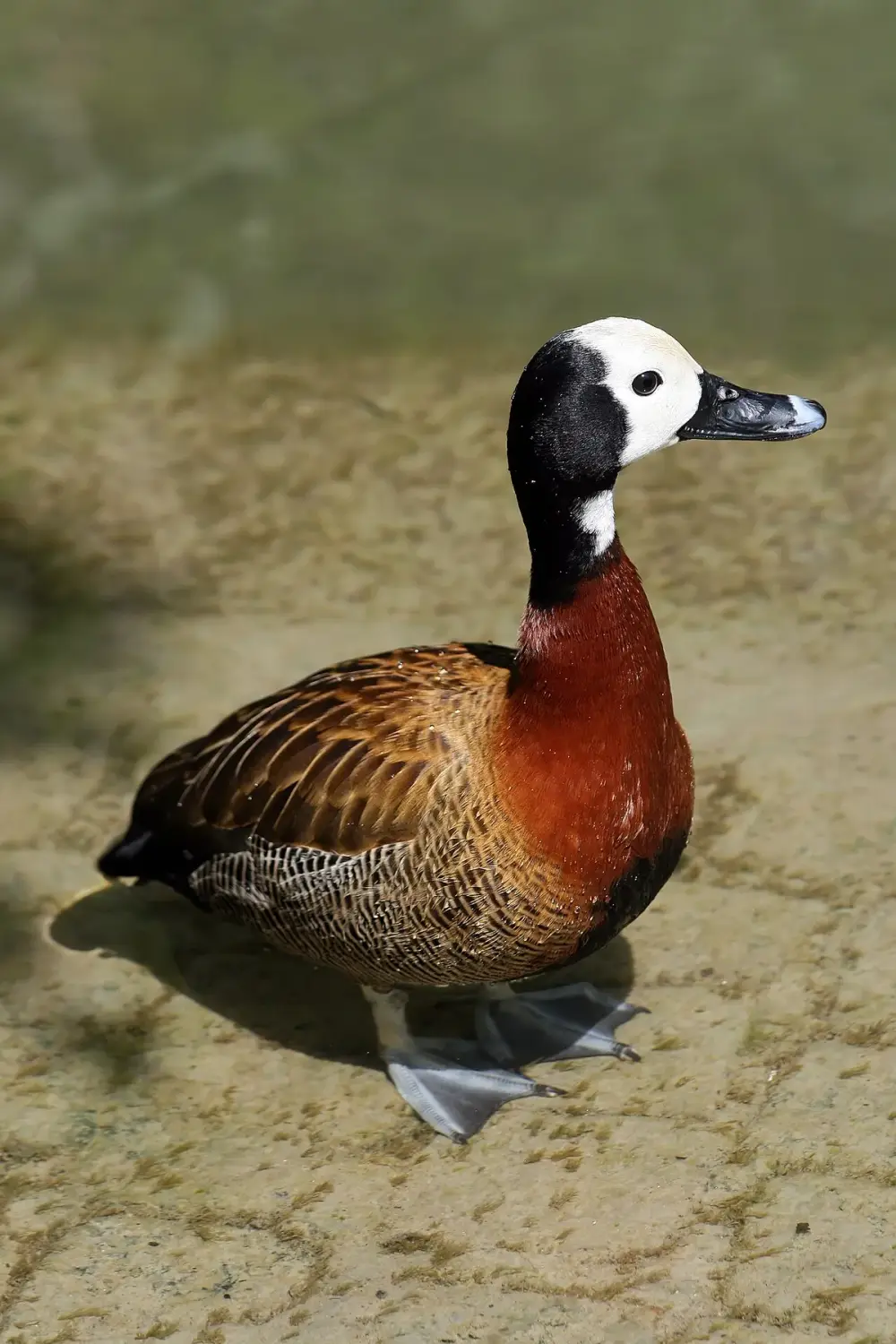
Young black-bellied whistling ducks look quite similar to young white-faced whistling ducks, which have a darker bill than the gray bill of a juvenile black-bellied and no white wing patch. Their thin white barring on black flanks is so faint that, even sitting, they never seem to show white along the sides.
Conservation status
The black-bellied whistling duck is listed as Least Concern on the IUCN Red List, assessed in 2021. Its global population is estimated at 1.1 to 2 million birds and is increasing.
It is listed on Appendix III of CITES at the request of Honduras, and in the United States it is protected under the Migratory Bird Treaty Act. Over recent decades, nest boxes have increasingly been provided for the species, especially in southeast Texas and Mexico.
Where to see black-bellied whistling duck in the U.S.
7 zoos across 5 states
Find the closest one
Rank the 7 zoos holding black-bellied whistling duck by how far they are from you. Your location is used in your browser to sort this list and is never sent to us.
Connecticut· 1
District of Columbia· 1
Florida· 3
Louisiana· 1
Pennsylvania· 1
AZAThe Association of Zoos and Aquariums. Accredited members have passed an independent inspection of animal care and welfare, safety, conservation and education, repeated every five years. Many smaller facilities never apply, so “not accredited” isn't a verdict on its own. What accreditation means · How we check this
Built from each zoo's own published animal list.
Black-bellied Whistling Duck: common questions
Why is it called a whistling duck?
Because of its call. It is a noisy bird that gives a clear, whistled "waa-chooo," and all whistling ducks share distinctive whistling calls.
Do black-bellied whistling ducks nest in trees?
Yes. They prefer hollow trees, but they will also nest on the ground, in chimneys, in abandoned buildings and in nest boxes.
What do black-bellied whistling ducks eat?
Mostly plant food such as seeds, corn, rice, millet and grasses. They also eat insects, spiders, snails and tadpoles.
How big is a black-bellied whistling duck?
It is 47 to 56 cm (19 to 22 in) long, weighs 652 to 1,020 g (1.4 to 2.2 lb), and has a wingspan of 76 to 94 cm (30 to 37 in).
Where do black-bellied whistling ducks live?
From the southern United States, mainly Texas, Arizona and Louisiana, through Mexico and Central America to northern Argentina. They have recently spread north, nesting in small numbers in the Midwest.
Do black-bellied whistling ducks mate for life?
They form strong pair bonds that often last many years, which is unusual among ducks. Both parents incubate the eggs and raise the young.
Are black-bellied whistling ducks nocturnal?
Partly. They feed mainly at night but can be seen feeding at any time of day, so they are not strictly [nocturnal](/learn/nocturnal/).