Russian Tortoise
Agrionemys horsfieldii
Also known as Central Asian Tortoise
- Where to see one
- 11 U.S. zoos in our directory hold russian tortoise, confirmed against each zoo's own animal list.
- Native range
- Central Asia, from the Caspian Sea south through Iran, Pakistan, and Afghanistan, and east across Kazakhstan to Xinjiang, China
- Size
- 5 to 10 inches (13 to 25 cm); females larger than males
- Lifespan
- Up to 50 years
About the Russian tortoise
The animal widely sold in the pet trade as the Russian tortoise is more formally called the Central Asian tortoise (Testudo horsfieldii), and it goes by an unusually long list of other names as well: the Afghan tortoise, steppe tortoise, Horsfield's tortoise, four-clawed tortoise, four-toed tortoise, Russian steppe tortoise, and Soviet tortoise. The species and common name honor the American naturalist Thomas Horsfield, who worked in Java starting in 1796 and later for the East India Company. The "Russian" name reflects the mid-1970s pattern of heavy exports from Central Asia, then part of the Soviet Union, for the international pet trade — "Russia" was often used colloquially in the West for the USSR, and the label stuck in pet contexts.
Its classification has shifted more than once. The species is traditionally placed in the genus Testudo, but in 1966 the monotypic genus Agrionemys was proposed for it based on distinct morphological differences, and that placement held for decades, though not unanimously. DNA analysis broadly supported the split but not conclusively, and in 2021 the Turtle Taxonomy Working Group and the Reptile Database moved it back into Testudo, treating Agrionemys as a subgenus. That group also lists five subspecies — T. h. bogdanovi, T. h. horsfieldii, T. h. kazachstanica, T. h. kuznetzovi, and T. h. rustamovi — though these aren't widely accepted among taxonomists.
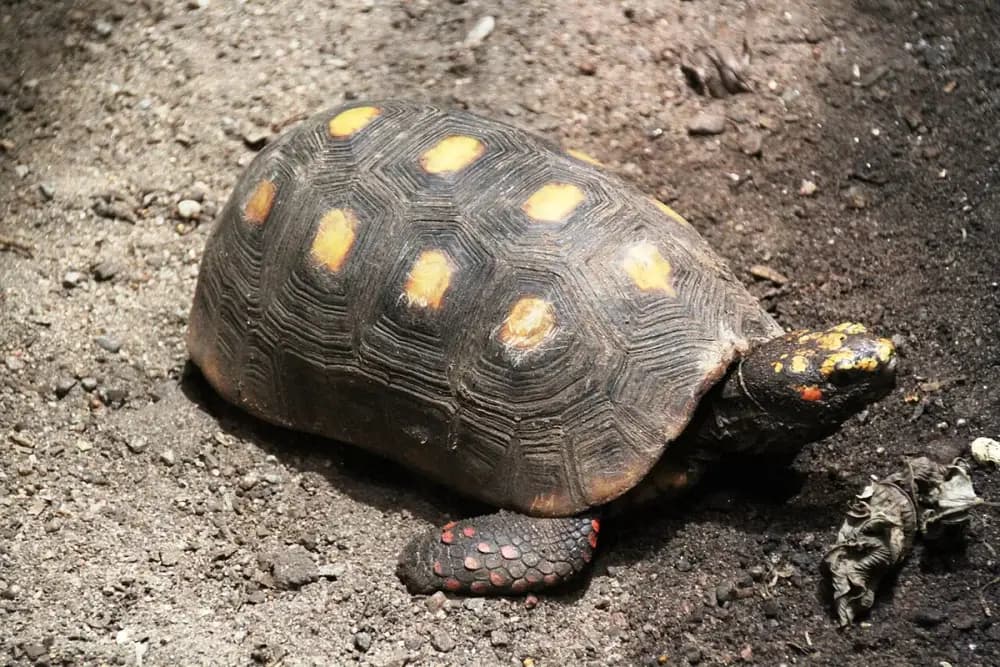
Russian tortoises are small, with a size range of 13 to 25 cm (5 to 10 in). Females grow slightly larger, at 15 to 25 cm (6 to 10 in), to accommodate eggs, while males average 13 to 20 cm (5 to 8 in). The species is sexually dimorphic in several ways beyond size: males have longer tails, usually tucked to the side, and longer claws, while females have a shorter, fatter tail and shorter claws. The male's cloaca is slit-shaped near the tip of the tail; the female's is asterisk-shaped. Unusually for a tortoise, Russian tortoises have only four toes on their front limbs rather than five. Shell color is typically ruddy brown or black, fading to yellow between the scutes, with a straw-yellow and brown body that varies by subspecies.
Behavior and diet
Diet
Grasses, twigs, flowers, and some fruits in the wild; leafy greens like lamb's lettuce and plantains in captivity
Courtship involves the male head-bobbing, circling the female, and biting at her forelegs; once she submits, he mounts her from behind while making high-pitched squeaking noises. Russian tortoises hibernate for roughly 8 weeks to 5 months each year depending on conditions, and can spend as much as 9 months of the year in dormancy overall.
In the wild, the diet consists of herbaceous and succulent vegetation — grasses, twigs, flowers, and some fruit. In captivity, keepers typically offer lamb's lettuce, plantains, and other dark leafy greens, with variety recommended to avoid imbalanced nutrition. As an arid-adapted species, the Russian tortoise gets much of its water from food, though it still needs a constant water supply; young tortoises are typically soaked once or twice weekly in lukewarm water no deeper than their elbows to stay hydrated. Tortoises tend to empty their bowels while in water, an instinct that also helps keep their enclosure clean. With good care, Russian tortoises can live up to 50 years, and they require annual hibernation as part of their normal cycle.
Range and habitat
Habitat
Dry, open, sandy terrain suited to burrowing
The Russian tortoise is endemic to Central Asia, ranging from the Caspian Sea south through Iran, Pakistan, and Afghanistan, and east across Kazakhstan to Xinjiang, China. It thrives in dry, open, sandy areas where it can move easily and dig burrows. While it primarily prefers arid conditions, it can tolerate humidity as high as 70 percent, and actually benefits from some rain, which softens the soil enough for burrowing. Burrows can run as deep as 2 meters (about 6.5 feet), and the tortoise retreats into them during midday heat and at night, emerging to forage at dawn or dusk when temperatures drop. The species is fairly social for a reptile: individuals will visit nearby burrows, and several tortoises sometimes share a single burrow overnight.
Conservation status
The Russian tortoise is listed as Vulnerable (VU). Human activity across its native Central Asian range — including habitat disruption and, historically, heavy collection for the international pet trade in the 1970s — has contributed to its threatened status. The species does not require a CITES Article X certificate.
In a stranger footnote to the species' history, two Russian tortoises were the first Earth creatures to travel to and circle the Moon, riding aboard the Soviet Zond 5 mission in September 1968 alongside fruit fly eggs, plants, and other lifeforms, before returning safely to Earth.
Where to see russian tortoise in the U.S.
11 zoos across 10 states
Find the closest one
Rank the 9 zoos holding russian tortoise by how far they are from you. Your location is used in your browser to sort this list and is never sent to us.
2 more zoos hold russian tortoise but have no coordinates on file yet, so they aren't ranked here. They're in the full list below.
Alaska· 1
Connecticut· 1
Delaware· 1
Georgia· 1
Massachusetts· 2
New York· 1
North Dakota· 1
Utah· 1
Virginia· 1
Wisconsin· 1
AZAThe Association of Zoos and Aquariums. Accredited members have passed an independent inspection of animal care and welfare, safety, conservation and education, repeated every five years. Many smaller facilities never apply, so “not accredited” isn't a verdict on its own. What accreditation means · How we check this
Built from each zoo's own published animal list.
Russian Tortoise: common questions
Is the Russian tortoise endangered?
It is listed as Vulnerable, one step below Endangered, largely due to habitat pressure and historic collection for the pet trade.
How big does a Russian tortoise get?
Adults typically measure 5 to 10 inches, with females growing slightly larger than males.
What does a Russian tortoise eat?
In the wild, grasses, twigs, flowers, and some fruit; in captivity, leafy greens such as lamb's lettuce and plantains.
How long do Russian tortoises live?
Up to 50 years with proper care, including annual hibernation.
Where do Russian tortoises live in the wild?
Across Central Asia, from the Caspian Sea through Iran, Pakistan, and Afghanistan, and east to Kazakhstan and Xinjiang, China, in dry, sandy habitat.
Which U.S. zoos have Russian tortoises?
Five zoos in our directory, including Connecticut's Beardsley Zoo, Buttonwood Park Zoo, and Mill Mountain Zoo.