- Where to see one
- 16 U.S. zoos in our directory hold green iguana, confirmed against each zoo's own animal list.
- Native range
- Southern Brazil and Paraguay north to Mexico, plus several Caribbean islands
- Size
- Grows to 1.7 m (5.6 ft) long from head to tail, with some specimens exceeding 2 m (6.6 ft); adult males weigh around 4 kg (8.8 lbs) and can exceed 8 kg (18 lbs), while females typically weigh 1.2 to 3 kg (2.6–6.6 lbs)
About the green iguana
The green iguana, also called the American iguana or common green iguana, is a large, arboreal, mostly herbivorous lizard of the genus Iguana. Usually simply called "the iguana," it ranges over a large geographic area, stretching from southern Brazil and Paraguay north to Mexico, and it has also become highly invasive in many subtropical and tropical regions worldwide, including parts of the southern United States.
It typically grows to 1.7 m (5.6 ft) in total length from head to tail, though a few individuals exceed 2 m (6.6 ft) with body weights upward of 9 kg (20 lbs). Most adults measure 1.2 to 1.7 m, with a snout-to-vent length of 30 to 42 cm; the tail makes up much of the total length. A typical adult male weighs around 4 kg, with large males occasionally reaching or exceeding 8 kg, while the smaller adult female usually weighs 1.2 to 3 kg.
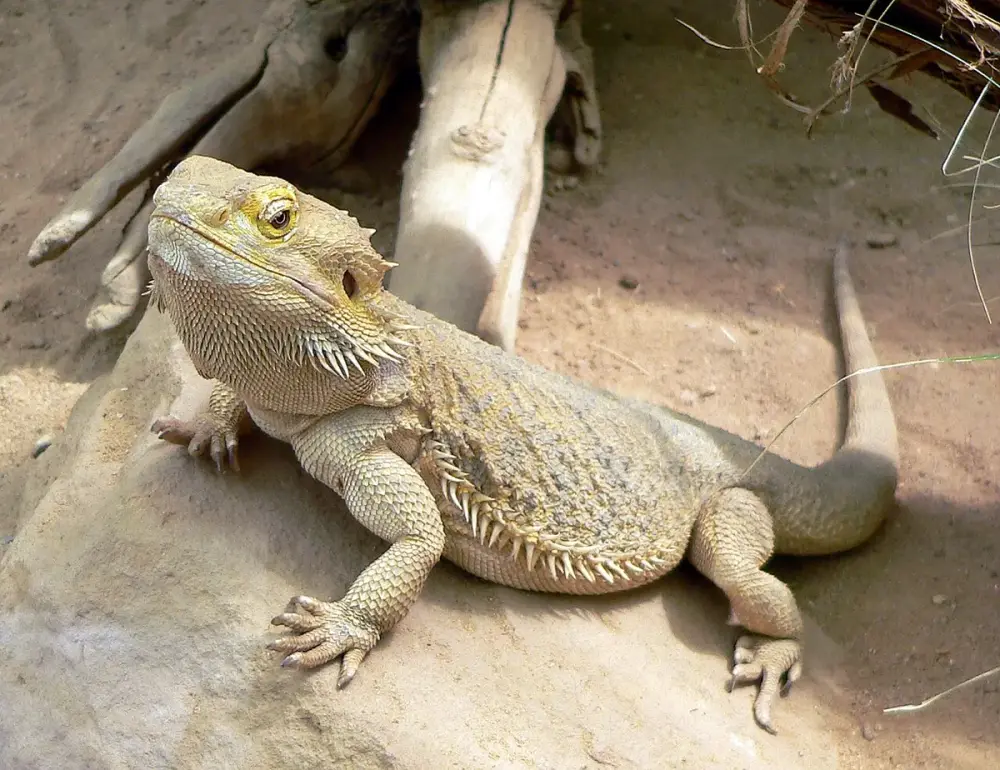
A row of spines runs along the green iguana's back and tail, offering some protection from predators, and its whip-like tail can deliver a painful strike in defense. Like many lizards, it can shed its tail when grabbed, later regenerating a new one. A well-developed dewlap under the chin helps regulate body temperature and plays a role in courtship and territorial displays. Its teeth are broad, flat, and leaf-shaped with serrated edges — sharp enough to shred both leaves and human skin — and their resemblance to the teeth of an early dinosaur discovery led to that dinosaur being named Iguanodon. Despite the common name, green iguanas vary widely in color across their range: bluish in Peru, ranging from green to lavender, black, or reddish-brown on islands such as Bonaire and Curaçao, red in western Costa Rica, and orange in Mexico.
Behavior and diet
Diet
Primarily herbivorous, eating leaves, flowers, fruit, and growing shoots of more than 100 plant species
Green iguanas are diurnal and arboreal, often found near water, and are agile climbers capable of falling up to 15 m (50 ft) and landing unhurt by using their hind claws to catch branches and leaves on the way down. During cold, wet weather they tend to stay on the ground for warmth, and when swimming they let their legs hang limply and propel themselves with powerful tail strokes. They are also accomplished burrowers, digging burrows 0.3 to 2.4 m deep, and in southern Florida they have been observed burrowing into canals, levees, dikes, and seawalls, sometimes taking over gopher tortoise or Florida burrowing owl burrows instead of digging their own.
When threatened, a green iguana will typically try to flee, diving into water and swimming away if one is nearby. If cornered, it extends its dewlap, stiffens and puffs up its body, hisses, and bobs its head at the threat; if pressed further, it may lash with its tail, bite, or use its claws. Head bobs and dewlap displays are also used in social interactions, such as greeting other iguanas or courting a mate, with the frequency and pattern of bobs carrying specific meaning.
As a primarily herbivorous species, the green iguana feeds on leaves, flowers, fruit, and the growing shoots of more than 100 plant species, along with items such as turnip and mustard greens in captivity. Wild adults have also been observed eating birds' eggs and chicks, and occasionally a small amount of carrion or invertebrates, though there is debate among researchers about whether animal protein is healthy for iguanas in captivity. Juveniles often eat feces from adults to acquire the gut microflora needed to digest their tough, low-quality plant diet.
Green iguanas are oviparous, with females laying clutches of 20 to 71 eggs once a year during a synchronized nesting period; hatchlings emerge after 10 to 15 weeks of incubation. Females give no parental protection after laying eggs beyond defending the nest burrow during excavation, and in Panama and Honduras they have even been observed sharing nest sites with American crocodiles and spectacled caimans. Juveniles stay in family groups for their first year, during which males have been observed using their own bodies to shield females from predators — a behavior noted as unique among reptiles.
Range and habitat
Habitat
Arboreal, herbivorous, often found near water
The green iguana's native range extends from southern Mexico through Central America to central Brazil, Paraguay, and Bolivia, and across a number of Caribbean islands including Grenada, Aruba, Curaçao, Bonaire, Trinidad and Tobago, St. Lucia, St. Vincent, Montserrat, Saba, and Útila.
The species has also been introduced well beyond this range, establishing populations in Grand Cayman, Puerto Rico, Hispaniola, Saint Martin, Guadeloupe, Martinique, Singapore, Thailand, Taiwan, and several parts of the United States, including Texas, Florida, and Hawaii. In the U.S., feral populations exist in South Florida (including the Florida Keys), Hawaii, the U.S. Virgin Islands, and the Rio Grande Valley of Texas. In Puerto Rico it is considered widespread and invasive. Green iguanas even colonized Anguilla in 1995 after being washed ashore by a hurricane — evidence of how ocean rafting can carry the species to new islands.
Conservation status
The green iguana is rated Least Concern (LC) by the IUCN. Range-wide population threats are not detailed here; instead, most of the conservation-relevant information concerns the species' status as invasive outside its native range, where it competes with native species in places such as Florida, Puerto Rico, and several Caribbean islands.
Where to see green iguana in the U.S.
16 zoos across 13 states
Find the closest one
Rank the 12 zoos holding green iguana by how far they are from you. Your location is used in your browser to sort this list and is never sent to us.
4 more zoos hold green iguana but have no coordinates on file yet, so they aren't ranked here. They're in the full list below.
Alabama· 1
Delaware· 2
Florida· 1
Hawaii· 1
Indiana· 1
Kansas· 3
Louisiana· 1
Massachusetts· 1
Missouri· 1
North Carolina· 1
Oklahoma· 1
Pennsylvania· 1
Texas· 1
AZAThe Association of Zoos and Aquariums. Accredited members have passed an independent inspection of animal care and welfare, safety, conservation and education, repeated every five years. Many smaller facilities never apply, so “not accredited” isn't a verdict on its own. What accreditation means · How we check this
Built from each zoo's own published animal list.
Green Iguana: common questions
Is the green iguana endangered?
No. It is rated Least Concern (LC) by the IUCN, and it is considered invasive in many places outside its native range.
How big does a green iguana get?
It typically reaches 1.7 m (5.6 ft) in total length, with some individuals exceeding 2 m (6.6 ft). Adult males average about 4 kg and can exceed 8 kg, while females typically weigh 1.2 to 3 kg.
What does a green iguana eat?
It is primarily herbivorous, eating leaves, flowers, fruit, and shoots from more than 100 plant species; wild adults occasionally eat birds' eggs, chicks, or carrion.
Where do green iguanas live in the wild?
Their native range runs from southern Mexico to central Brazil, Paraguay, and Bolivia, plus several Caribbean islands, though they have also become established well beyond this range, including in parts of the southern United States.
Which U.S. zoos have green iguanas?
Six zoos in our directory keep the species, including the Alabama Gulf Coast Zoo, the Louisiana Purchase Gardens and Zoo, and the Tulsa Zoo and Living Museum.