- Where to see one
- 8 U.S. zoos in our directory hold dumeril's boa, confirmed against each zoo's own animal list.
- Native range
- Western and southwestern Madagascar only
- Size
- Usually about 2 m (6.5 ft); maximum reported 259 cm (8 ft 6 in)
- Venom
- None; kills by constriction
- Reproduction
- Live birth of 6–28 young after 6–8 months
- Newborn length
- 30–46 cm (12–18 in)
Conservation status
Least Concernassessed 2011
IUCN Red List category LC — step 1 of 7.
Least Concern (LC); CITES Appendix I
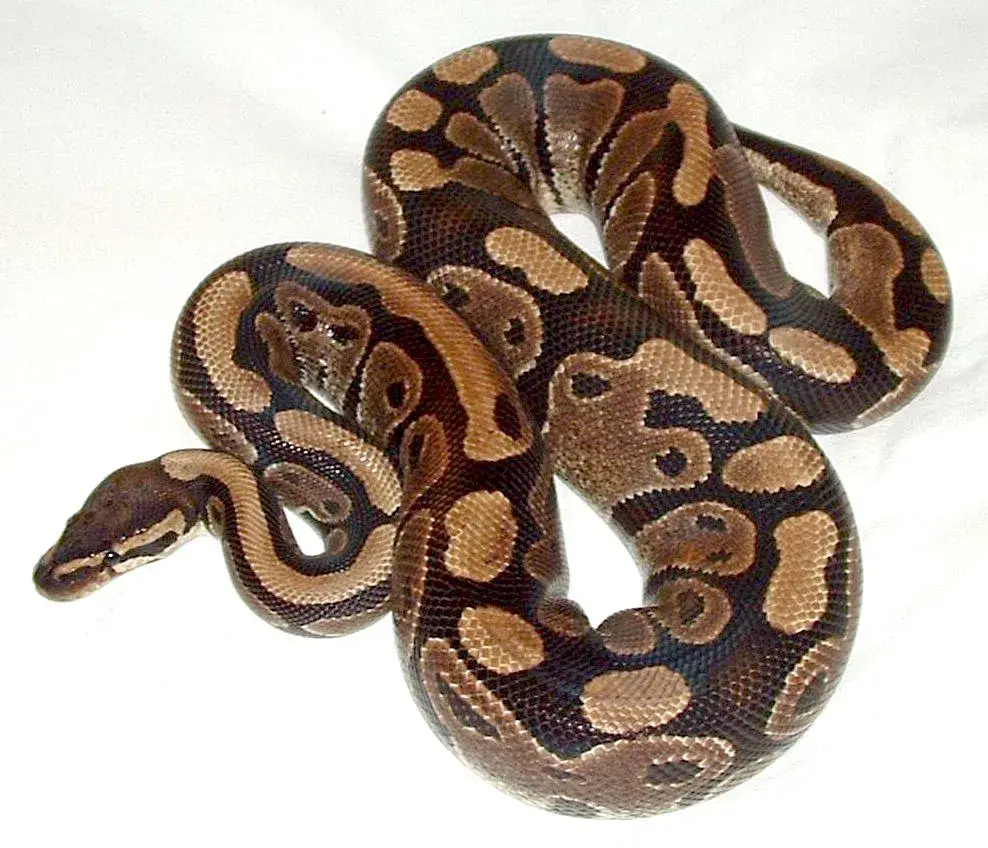
Dumeril's boa is a non-venomous snake endemic to Madagascar, where it lives in semi-arid forest along the western and southwestern parts of the island. Its gray-brown body with darker patches blends into the leaf litter, loose dirt and rocky ground of its habitat, and it shelters in burrows made by other animals. Adults usually reach about 6.5 feet (2 m) in total length. It is an opportunistic feeder that hunts by day or night, on the ground or in trees, and constricts birds, lizards, small mammals including juvenile lemurs, and even other snakes. Females give birth to live young rather than laying eggs.
About the Dumeril's boa
Dumeril's boa is a large, nonvenomous constrictor in the boa family, Boidae, found only on Madagascar. It is one of two species in the genus Acrantophis, alongside the Madagascar ground boa. It lives in the semi-arid forests of the island's west and southwest, where its patterned skin blends into the leaf litter.
Its scientific name, Acrantophis dumerili, honors the French herpetologist André Marie Constant Duméril. No subspecies are recognized. Like other boas, it is a relative of the boa constrictor and the green anaconda of the Americas, and part of a family that also reaches Africa, Asia and some Pacific islands.
Adults usually grow to about 2 m (6.5 ft) in total length, and the largest reported was 259 cm (8 ft 6 in). Females tend to be larger overall, while males usually have longer, skinnier tails. The body is muscular, as befits a constrictor.
The color pattern is a gray-brown base with darker patches. On the forest floor this works as camouflage, breaking up the snake's outline among dead leaves. The markings along the sides are sometimes read as faces, which plays a part in how some people on Madagascar regard the snake.
Boa anatomy
Dumeril's boa shares the traits that define its family. Boas keep a vestigial pelvic girdle, and the remains of hind limbs show as a pair of small spurs, one on each side of the vent. In males these spurs are larger and more conspicuous than in females, and male Dumeril's boas use them during courtship. Boas also have a long row of teeth on the palate, and most have a working left lung that can reach up to 75% of the size of the right one.
Boas differ from pythons, which they resemble, in a few ways. Boas lack certain skull bones and front teeth that pythons have, and, most visibly, boas give birth to live young while pythons lay eggs.
Behavior and diet
Diet
Birds, lizards, small mammals including young lemurs, and other snakes
Dumeril's boas are opportunistic hunters that may be active by day or by night. They mostly hunt on the ground, but they also climb into trees after prey. When they need shelter, they use burrows dug by other animals.
The diet is made up of small animals: birds, lizards and small mammals, including young lemurs. They also eat other snakes. Researchers have found toads, insects, plant matter and debris in their stomachs too, but these were most likely swallowed by accident while catching other prey, or were already inside the animal the boa ate.
Like all boas, Dumeril's boa kills by constriction. It seizes the prey, quickly throws coils around it and tightens them so the animal cannot breathe. Contrary to popular belief, boas do not crush prey; the victim dies because it cannot move its ribs to inhale. The meal is then swallowed whole and can take days or weeks to digest. Despite reaching 2 m (6.5 ft) or more, Dumeril's boas are generally docile and stick to fairly small prey.
Breeding
Dumeril's boas mature at 3 to 5 years old. The mating season runs from March through May, and males court females using their spurs. Like most boas, the species is ovoviviparous: the eggs develop inside the mother and she gives birth to live young, some 6 to 8 months after mating.
Litters range from 6 to 28 babies, each about 30 to 46 cm (12 to 18 in) long at birth. That is a large litter compared with the Madagascar ground boa, which has only 2 to 4 much larger young.
Range and habitat
Habitat
Semi-arid forest with leaf litter, loose soil and rocky ground
Dumeril's boa lives only in Madagascar. It occurs along the western coast and in the southwest of the island, in semi-arid forest that receives fairly little rain. Within that forest it favors leaf litter, loose soil and rocky ground, all places where its camouflage works well. Its close relative, the Madagascar ground boa, lives in the central, northern and western parts of the island, in sparse open woodland such as the dry deciduous forests.
Dumeril's boa vs Madagascar ground boa
Madagascar has two boas in the genus Acrantophis, and both live in the west of the island.
| Feature | Dumeril's boa | Madagascar ground boa |
|---|---|---|
| Scientific name | Acrantophis dumerili | Acrantophis madagascariensis |
| Typical length | About 2 m (6.5 ft); max 259 cm (8.5 ft) | Average 2.4 m (8 ft); females up to 3 m (10 ft) |
| Color | Gray-brown with darker patches | Reddish-brown and gray with dark-outlined diamonds along the back |
| Range in Madagascar | West and southwest | Central, north and west |
| Litter size | 6–28 young | 2–4 large young |
| Newborn length | 30–46 cm (12–18 in) | 48–61 cm (19–24 in) |
Conservation status
Dumeril's boa is listed as Least Concern on the IUCN Red List, last assessed in 2011. It is also on Appendix I of CITES, which prohibits international trade except for non-commercial purposes such as scientific research.
The species faces two main threats: deforestation and persecution by people. In some areas it is feared and often killed on sight. In other communities, though, the face-like patterns on its sides are linked to stories of ancestors' souls, and the snake is treated as sacred.
Large numbers were once exported from Madagascar for the pet trade, but that trade has since been heavily restricted. Dumeril's boas breed readily in captivity, and captive-bred animals now supply the exotic pet market.
Where to see dumeril's boa in the U.S.
8 zoos across 6 states
Find the closest one
Rank the 6 zoos holding dumeril's boa by how far they are from you. Your location is used in your browser to sort this list and is never sent to us.
2 more zoos hold dumeril's boa but have no coordinates on file yet, so they aren't ranked here. They're in the full list below.
California· 3
Florida· 1
Illinois· 1
Kansas· 1
Massachusetts· 1
Ohio· 1
AZAThe Association of Zoos and Aquariums. Accredited members have passed an independent inspection of animal care and welfare, safety, conservation and education, repeated every five years. Many smaller facilities never apply, so “not accredited” isn't a verdict on its own. What accreditation means · How we check this
Built from each zoo's own published animal list.
Dumeril's Boa: common questions
Is Dumeril's boa venomous?
No. It has no venom and kills its prey by constriction. It is generally a docile snake.
How big do Dumeril's boas get?
Usually about 2 m (6.5 ft) long, with a maximum reported length of 259 cm (8 ft 6 in). Females are typically larger than males.
What do Dumeril's boas eat?
Birds, lizards, small mammals including young lemurs, and other snakes. In captivity they readily eat rats.
Where do Dumeril's boas live?
Only on Madagascar, in the semi-arid forests of the western and southwestern parts of the island.
Do Dumeril's boas lay eggs?
No. They give birth to live young, 6 to 28 at a time, about 6 to 8 months after mating.
Is Dumeril's boa endangered?
No. It is listed as Least Concern, though it is on CITES Appendix I and is threatened locally by deforestation and by people who kill it out of fear.
How can you tell a Dumeril's boa from a Madagascar ground boa?
Look at color and size. Dumeril's boa is gray-brown with darker patches and usually about 2 m (6.5 ft) long, while the Madagascar ground boa is reddish-brown and gray with dark-edged diamonds and averages 2.4 m (8 ft).
Can you keep a Dumeril's boa as a pet?
Yes, and captive-bred animals are easy to find. Their size suits keepers experienced with large constrictors, and they are prone to stress, which can make them stop eating.