- Where to see one
- 14 U.S. zoos in our directory hold cow, confirmed against each zoo's own animal list.
- Origin
- Domesticated from the wild aurochs about 10,500 years ago in central Anatolia, the Levant and western Iran, with a separate domestication in the Indian subcontinent
- Size
- Varies by breed; Hereford cows weigh 600–800 kg (1,300–1,800 lb) and bulls 1,000–1,200 kg (2,200–2,600 lb)
- Lifespan
- A natural life of about 25–30 years
- Gestation
- About nine months
- World population
- About 942.6 million cattle in 2023
Conservation status
Not Evaluated
This species has not been assessed for the IUCN Red List, so it sits outside the threat scale entirely.
Not Evaluated (NE); domestic cattle are not assessed on the IUCN Red List
Cattle are large, domesticated bovid ungulates kept as livestock across Europe, temperate Asia, the Americas and Australia, with zebus in tropical regions and sanga cattle in sub-Saharan Africa. They are ruminants with a four-compartment stomach and chew the cud, regurgitating food to grind it with the molars. Cattle graze mixed diets, preferring roughly 70% clover and 30% grass. Their eyes sit on the sides of the head, giving a 330-degree field of view. Raised for meat, dairy and leather and used as draft animals, they were domesticated from wild aurochs about 10,500 years ago.
About the cow
A cow is a domestic bovine, Bos taurus, kept worldwide for meat, milk, leather and draft work. Cattle are cloven-hoofed ruminants in the family Bovidae, descended from the extinct wild aurochs, and they come in three broad types: taurine cattle, zebu and African sanga, split into more than 1,000 recognized breeds.
Bulls are the males and cows the females, and cattle trained as draft animals are called oxen. The word "cow" comes from Old English cū. "Cattle" came into English through Anglo-Norman from Medieval Latin capitāle and originally meant movable property; it is a variant of "chattel" and closely related to "capital."
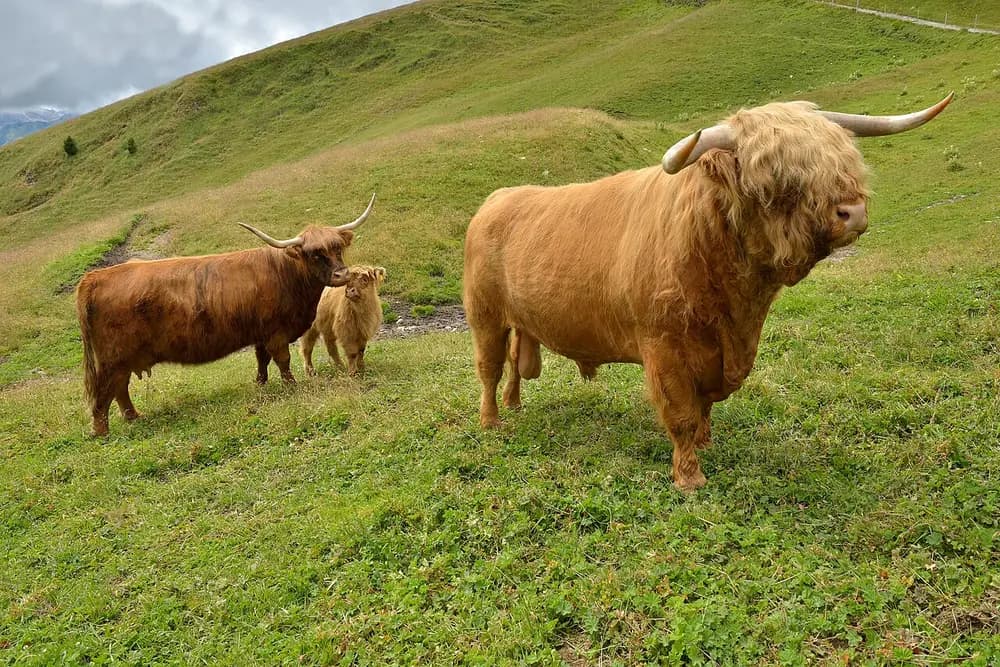
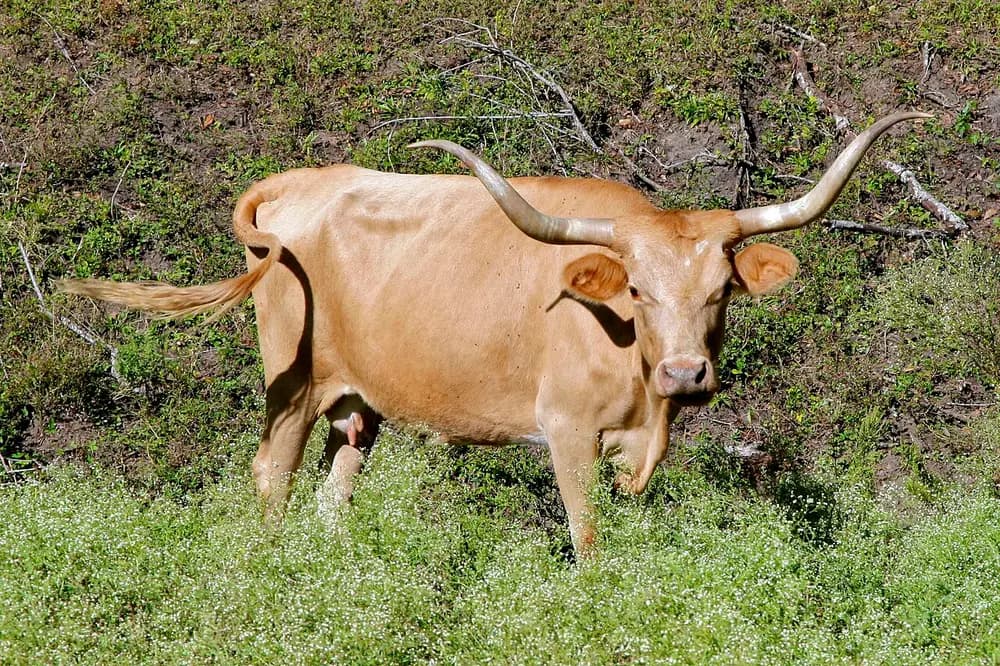
Cattle walk on two toes, the third and fourth digits of each foot. Like all bovids they can grow horns that are unbranched and never shed. Coat colors are most often black, white or red-brown, and some breeds are spotted or mixed. Bulls can outweigh cows of the same breed by a few hundred kilograms.
Size depends heavily on breed. The tallest and heaviest is the Chianina, whose mature bulls can stand 1.8 m (5 ft 11 in) at the shoulder and weigh up to 1,280 kg (2,820 lb). At the other end of the scale, small breeds such as the miniature zebu are kept as pets.
A four-part stomach
Cattle are ruminants. Their single large stomach has four compartments: the rumen, the reticulum, the omasum and the abomasum. The rumen is the largest and holds a community of bacteria, fungi and protozoa that break down cellulose, the tough plant material most animals cannot digest. The reticulum, the smallest, is nicknamed the "honeycomb," the omasum absorbs water and nutrients, and the abomasum works much like a human stomach.
A grazing cow swallows food without chewing it much. Later it brings the food back up a mouthful at a time and chews it as cud, grinding coarse plants into small pieces before swallowing them again.
Behavior and diet
Diet
Grass, clover and other plants, digested in a four-compartment stomach
Cattle are social herd animals, and even short spells alone stress them: isolated heifers call more and show higher heart rates and cortisol levels. Herds run on a dominance hierarchy, kept up partly through non-aggressive mock fights. In semi-wild herds, older animals usually outrank younger ones and males outrank females, young bulls rise above adult cows at around two years old, and most disputes are settled without physical contact.
Given a choice, cattle prefer a diet of about 70% clover and 30% grass, leaning toward clover in the morning and grass by evening. They change how they bite depending on the plants in front of them, using the sweep of the tongue to gather each mouthful. They avoid grazing near the dung of other cattle, seek out salty foods and steer clear of bitter ones.
Senses and intelligence
Sight is the dominant sense, supplying almost half of what a cow learns about its surroundings. With eyes on the sides of the head, cattle have a field of view of about 330°, but binocular vision covers only 30° to 50°, compared with about 140° in people. Like most mammals they see two primary colors. Their hearing is better than a horse's but poorer than a dog's, and smell probably plays a large part in social life: cattle can detect stress chemicals in another animal's urine.
Cattle can remember the locations of several food sources for at least 48 days, and calves can tell familiar animals and people apart and prefer their own mother's voice. Individuals show distinct personalities, such as boldness or sociability. One documented cow, named Veronika, used different ends of a deck brush to scratch different parts of her body.
Sleep and calves
A domestic cow sleeps about 4 hours a day. Although cattle can lock their legs to rest while standing, they lie down for deep sleep.
Pregnancy lasts about nine months, and cows look for a secluded spot to give birth. Under natural conditions calves stay with their mothers until weaning at 8 to 11 months, and beef calves nurse about five times a day.
Range and habitat
Habitat
Farms, pasture and rangeland worldwide
Domestic cattle descend from the aurochs, Bos primigenius, which once ranged across Europe, North Africa and much of Asia. The last known aurochs died in Poland around 1627. Taurine cattle were domesticated roughly 10,500 years ago in central Anatolia, the Levant and western Iran, possibly from as few as 80 wild animals. A second domestication in what is now Pakistan produced the humped zebu.
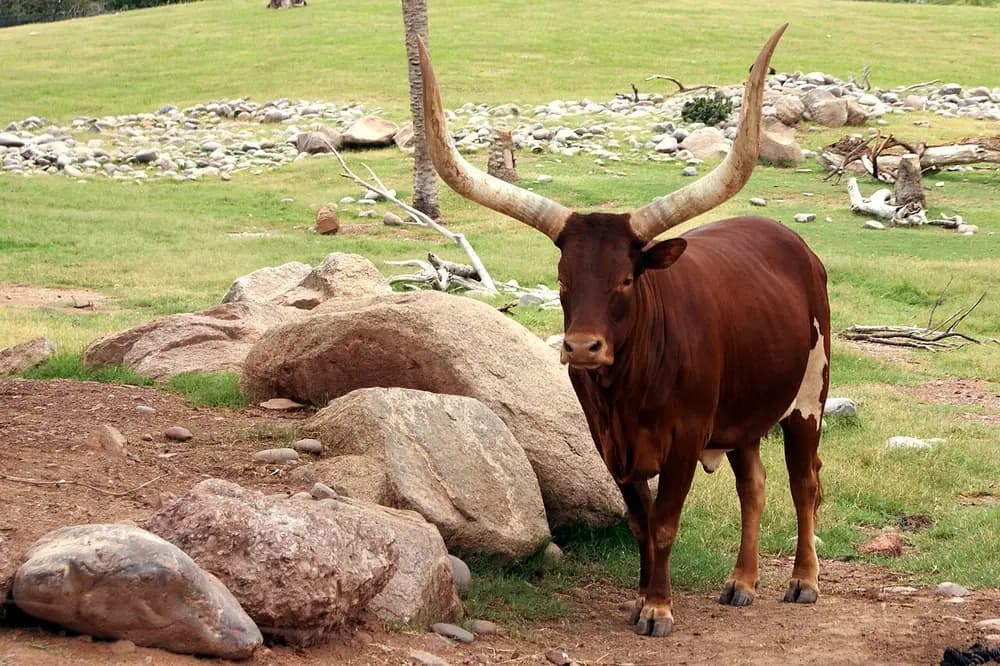
Today cattle are kept as livestock worldwide. Taurine breeds dominate Europe and the temperate parts of Asia, the Americas and Australia. Zebu are found mainly in India and tropical regions, and sanga cattle mostly in sub-Saharan Africa; the big-horned Watusi is a modern American breed derived from the Ankole group of sanga cattle. India had the most cattle in 2023, about 307.5 million, followed by Brazil and China. Cattle make up the largest biomass of any animal species on Earth, roughly 650 million tonnes.
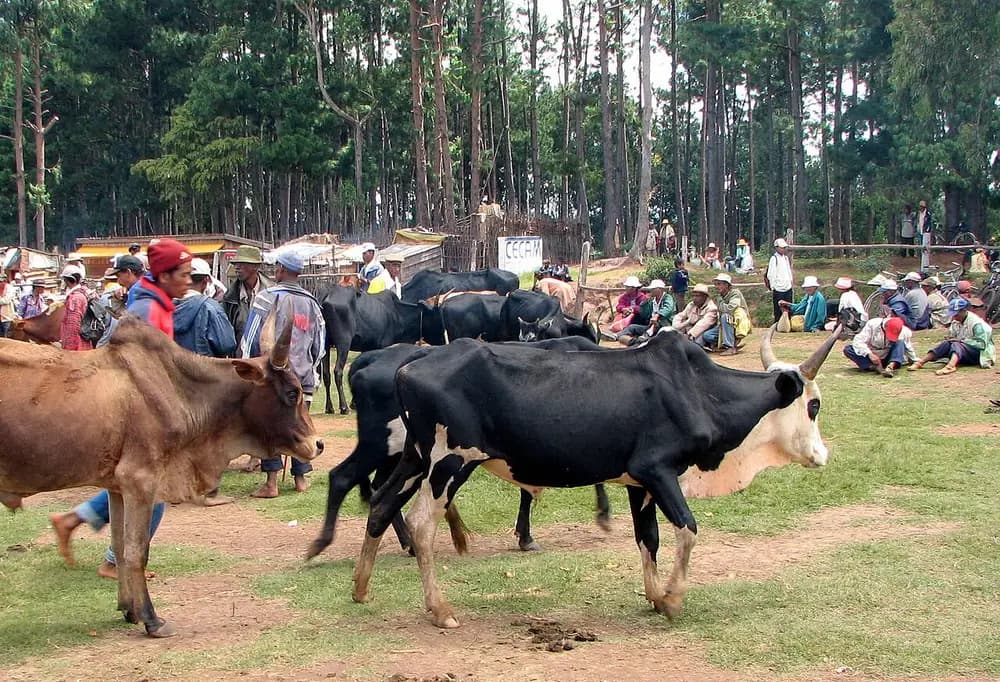
Many herds graze open rangeland, which puts land unsuited to crops to use. In the United States many cattle are also kept intensively in feedlots. Feral herds live in several parts of the world, and a few, such as Chillingham cattle in England, are distinct enough to count as breeds.
Taurine cattle vs zebu vs sanga
The three main types of cattle are sometimes classed as separate species or subspecies, and authorities still disagree. They also interbreed freely, and cattle can even hybridize with yaks, gaur and both species of bison; the beefalo is a cattle and American bison cross.
| Type | Origin | Where mainly found | Example |
|---|---|---|---|
| Taurine | Domesticated in Anatolia, the Levant and western Iran | Europe and temperate Asia, the Americas and Australia | N'Dama, Kuri (African taurine breeds) |
| Zebu (indicine) | Domesticated in the Indian subcontinent | India and tropical Asia, the Americas and Australia | Miniature zebu |
| Sanga | Taurine and zebu hybrid | Sub-Saharan Africa | Ankole cattle |
Conservation status
Domestic cattle are not assessed on the IUCN Red List, so their status is Not Evaluated. There were roughly 942.6 million cattle worldwide in 2023. Its wild ancestor, the aurochs, is extinct; breeders have tried to recreate its look by crossing traditional cattle, producing the Heck breed.
Cattle farming does raise other concerns. Methane from cattle digestion and manure is a powerful greenhouse gas, and cattle farming accounted for about 7% of global greenhouse gas emissions in 2015 by an FAO estimate. Overgrazing has reduced plant and animal diversity in many regions, and practices such as dehorning, branding, tail docking and early calf separation in dairies have drawn animal welfare criticism. Climate change is also expected to increase heat stress in cattle and the spread of ticks.
Where to see cow in the U.S.
14 zoos across 10 states
Find the closest one
Rank the 12 zoos holding cow by how far they are from you. Your location is used in your browser to sort this list and is never sent to us.
2 more zoos hold cow but have no coordinates on file yet, so they aren't ranked here. They're in the full list below.
District of Columbia· 1
Florida· 2
Georgia· 1
Idaho· 1
Illinois· 3
Kentucky· 1
Minnesota· 1
North Dakota· 1
Virginia· 2
Wisconsin· 1
AZAThe Association of Zoos and Aquariums. Accredited members have passed an independent inspection of animal care and welfare, safety, conservation and education, repeated every five years. Many smaller facilities never apply, so “not accredited” isn't a verdict on its own. What accreditation means · How we check this
Built from each zoo's own published animal list.
Cow: common questions
How many cows are there in the world?
About 942.6 million in 2023. India had the most, about 307.5 million, followed by Brazil and China.
How big do cows get?
It depends on the breed. Hereford cows weigh 600–800 kg (1,300–1,800 lb), while the largest breed, the Chianina, has bulls up to 1.8 m (5 ft 11 in) tall and 1,280 kg (2,820 lb).
How long do cows live?
About 25 to 30 years naturally. On farms, beef cattle are usually slaughtered at about 18 months and dairy cows at about five years.
What do cows eat?
Grass, clover and other plants. Given a choice they pick about 70% clover and 30% grass, and they chew cud to break down tough plant fiber.
Why do cows have four stomachs?
They actually have one stomach with four compartments. The largest, the rumen, holds microbes that break down cellulose, letting cattle live on grass.
Do cows sleep standing up?
No. They can rest on their feet, but they lie down to sleep deeply, for about 4 hours a day in total.
Can cows see in color?
Yes, partly. Like most mammals, cattle are dichromatic, seeing two primary colors rather than the three people see.
Can you keep a cow as a pet?
Yes, in some cases. Small breeds such as the miniature zebu are kept as pets, though most cattle are farm livestock.