Highland Cattle
Bos taurus
Also known as Highland Cow, Miniature Highland Cows, Scottish Highland Cow
- Where to see one
- 20 U.S. zoos in our directory hold highland cattle, confirmed against each zoo's own animal list.
- Native range
- Domestic breed from the Scottish Highlands and the Western Islands of Scotland
- Size
- Bulls up to about 800 kg (1,800 lb) and 106–120 cm (42–47 in) tall; heifers up to about 500 kg (1,100 lb); cows 90–106 cm (35–42 in) tall
- Lifespan
- Up to 20 years
- Group name
- A fold
- Gestation
- About 277–290 days, usually a single calf
Conservation status
Not Evaluated
This species has not been assessed for the IUCN Red List, so it sits outside the threat scale entirely.
Not Evaluated (NE); a domestic breed, not assessed by the IUCN
Highland cattle are a Scottish breed that originated in the Scottish Highlands and the Western Islands, recognisable by long, wide horns and a long, wavy, woolly coat. The coat is usually reddish brown, seen in about 60% of cattle, with others yellow, pale silver, black or dun. The unusual double coat has an oily outer layer, the longest of any cattle breed, over a downy undercoat, which suits the high rainfall and strong winds of the Highlands. Mature bulls can weigh up to 800 kg and heifers up to 500 kg. The breed is hardy, reared mainly for beef, and has been exported to countries including Argentina, Australia, Canada and the United States.
About the Highland cattle
Highland cattle are a Scottish breed of domestic cattle, the same species, Bos taurus, as other taurine cattle descended from the wild aurochs. The breed comes from the Scottish Highlands and Western Islands, is known for long horns and a long, shaggy double coat, and is reared mainly for beef. It has been exported from Scotland to several other countries.
The breed is famously hardy, often described as "rustic," and was shaped largely by natural selection in a harsh landscape of high rainfall and strong winds. The Livestock Conservancy notes that it was improved through selection alone, with no introductions from other breeds. That background gave it a reputation for survival traits: hardiness, good mothering, efficient breeding and long working lives.
The coat is the breed's signature. Highland cattle have an unusual double coat: a downy undercoat covered by oily outer hair that is the longest of any cattle breed. About 60% of animals are reddish brown and about 22% are yellow, with the rest silver, black, or brindle and dun. The colors are controlled by variants of two genes, MC1R and PMEL. Because the coat, rather than a layer of fat under the skin, does most of the insulating, Highland beef tends to be leaner than most beef.
The horns are long and wide. On cows they sweep outward and up, while on bulls they run more horizontally with upturned tips. Like all cattle, Highlands are cloven-hoofed, walking on two toes, and their horns are not shed each year. Bulls are clearly larger than cows. Mature bulls can weigh up to about 800 kg (1,800 lb) and heifers up to 500 kg (1,100 lb), while the Livestock Conservancy puts bulls at 1,500–2,000 lb (680–910 kg) and cows at 900–1,300 lb (410–590 kg), a medium size for cattle.
Historically there were two types. The Kyloe of the Hebrides was small and often black, and the mainland cattle were larger and very variable in color, often brown or red. When the first herd-book was published in 1885, both were recorded simply as "Highland." The name Kyloe comes from the practice of swimming cattle across the narrow straits, or kyles, between the islands and the mainland on the way to market.
Behavior and diet
Diet
Grass and a wide range of rough forage, including weedy pest plants
Highland cattle are grazers, and good ones. They eat grass but also take a wide variety of weedy pest plants, which makes them useful for improving rough pastures. In Europe the breed is considered a "light grazer," able to manage marginal land without the damage heavier breeds can cause. Like all cattle they are ruminants, with a four-compartment stomach. Food is swallowed quickly, stored in the rumen, then brought back up and chewed as cud before microbes finish breaking down the tough plant fiber.
Social life is orderly. A four-year study of a semi-wild fold found a clear dominance hierarchy that keeps fighting to a minimum. Older animals rank above younger ones and males above females, and young bulls begin to outrank adult cows at around two years old. Most disputes are settled by posturing with no physical contact, and play-fighting, licking and mounting are friendly contact. Calves of the top-ranking cow were given higher status even though their mother rarely stepped in.
Breeding can happen year-round, though in the semi-wild study it was concentrated in May and June. Gestation lasts about 277–290 days. A cow usually has one calf, although twins do occur. Animals reach sexual maturity at about 18 months, and in the semi-wild fold heifers first calved at two to three years old.
Cattle in general rely heavily on sight. Eyes set on the sides of the head give them a field of view of about 330 degrees, an adaptation of a prey animal that needs to watch for danger in almost every direction. A domestic cow sleeps only about four hours a day, and cattle lie down to sleep deeply rather than sleeping standing up.
Range and habitat
Habitat
Rough upland pasture and marginal grazing land in cold, wet climates
The breed's homeland is western Scotland, where it was a traditional part of the rural economy. In the 18th century, drovers bought Highland cattle at markets such as Falkirk and Crieff and walked them south into England to be fattened, and more than 30,000 Scottish cattle were sold into England in 1723 alone. A breed society was founded in 1884. The word "fold" for a group of Highlands comes from the open stone shelters, called folds, where the cattle were kept on winter nights.
From the late 19th century the breed was exported to Argentina, Australia, Canada, the Falkland Islands, the former Soviet Union and the United States, and later to much of Europe. The first recorded U.S. imports came in the late 1890s, and the American Highland Cattle Association, founded in 1948, now claims about 1,100 members. The breed is especially popular in the northern United States, Canada and Scandinavia. In 2022, 23 countries reported Highland cattle to the FAO's DAD-IS database, with a world total just over 40,000 and the largest numbers in France and Finland.
Cold is where the breed shines. Highland cattle have been described as "almost as cold-tolerant as the arctic-dwelling caribou and reindeer," and they do well in places with harsher winters than Scotland, such as Norway and Canada. Heat is another matter: the thick coat makes them far less heat-tolerant than zebu cattle.
Today Highland cattle are raised for beef on poor pasture, crossed with breeds such as Shorthorn or Limousin for a more commercial carcass, and used for conservation grazing. In Sweden, Borlänge Municipality keeps a herd of 105 Highlands to graze restored lakeshore meadows.
Highland cattle vs zebu
Both are domestic cattle descended from the aurochs, but they come from separate domestications and suit opposite climates.
| Feature | Highland cattle | Zebu |
|---|---|---|
| Lineage | Taurine cattle, domesticated in the Near East | Indicine cattle, domesticated separately in the Indian subcontinent |
| Origin of breed or type | Scottish Highlands and Western Islands | South Asia |
| Climate | Cold, wet and windy | Hot climates |
| Heat tolerance | Low, because of the thick coat | High |
| Where found today | Europe, North America, Australia and other temperate areas | Mainly India and tropical Asia, the Americas and Australia |
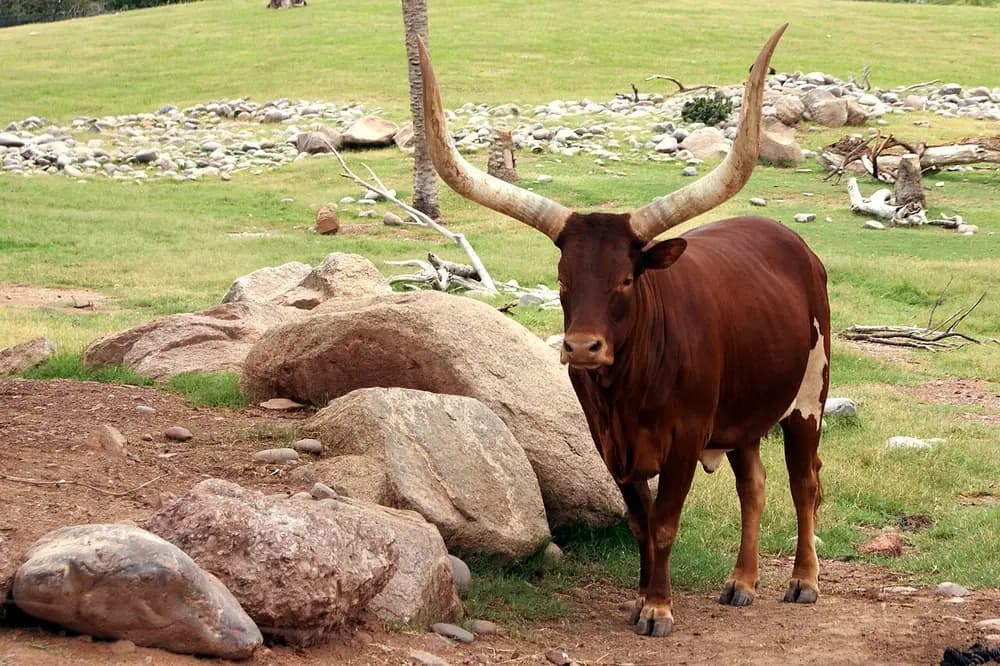
Other domestic breeds such as Watusi cattle show just how different cattle can look, while wild relatives like the American bison can even hybridize with domestic cattle.
Conservation status
As a domestic breed, Highland cattle are not assessed on the IUCN Red List, and neither is domestic cattle as a whole. Breed-level status comes from livestock bodies instead, and the picture differs by country.
In the United Kingdom, registered breeding cows rose from about 2,500 in 2002 to some 6,000 in 2012, then stood at 3,161 in 2021. DAD-IS lists the breed's UK status as endangered/at risk, although the number of unregistered cattle is unknown. In the United States the outlook is better: in 2019 Highland cattle became numerous enough to graduate from the Livestock Conservancy's Conservation Priority List, which means more than 1,000 annual U.S. registrations and more than 25,000 animals worldwide.
The breed has benefited from promotion and registration by breed associations, and it has found a secure niche in beef production on marginal land and in conservation grazing.
Where to see highland cattle in the U.S.
20 zoos across 15 states
Find the closest one
Rank the 15 zoos holding highland cattle by how far they are from you. Your location is used in your browser to sort this list and is never sent to us.
5 more zoos hold highland cattle but have no coordinates on file yet, so they aren't ranked here. They're in the full list below.
Alaska· 1
Arizona· 1
California· 1
Colorado· 1
Illinois· 2
Kansas· 1
Maryland· 1
Massachusetts· 1
Michigan· 2
New York· 1
Ohio· 1
Pennsylvania· 1
Tennessee· 3
Texas· 2
Virginia· 1
AZAThe Association of Zoos and Aquariums. Accredited members have passed an independent inspection of animal care and welfare, safety, conservation and education, repeated every five years. Many smaller facilities never apply, so “not accredited” isn't a verdict on its own. What accreditation means · How we check this
Built from each zoo's own published animal list.
Highland Cattle: common questions
How big do Highland cattle get?
Bulls reach up to about 800 kg (1,800 lb) and typically stand 106–120 cm (42–47 in) tall. Cows are smaller, typically 90–106 cm (35–42 in) tall.
Why do Highland cattle have long hair?
For insulation. Their double coat, with the longest outer hair of any cattle breed over a downy undercoat, protects them from the rain and strong winds of the Scottish Highlands.
How long do Highland cattle live?
Up to about 20 years, which is longer than most other cattle breeds.
What is a group of Highland cattle called?
A fold. The name comes from the open stone shelters, called folds, that kept the cattle out of winter weather at night.
Can Highland cattle live in hot climates?
Not well. Their thick coats make them much less heat-tolerant than zebu cattle, though they thrive in places colder than Scotland, such as Canada and Norway.
What do Highland cattle eat?
Grass and rough forage, including a wide variety of pest plants. They can produce beef from land that would otherwise be unsuitable for farming.
Are Highland cattle endangered?
Not in the U.S. They left the Livestock Conservancy's priority list in 2019, but the breed's status in the United Kingdom is listed by DAD-IS as endangered/at risk.