- Where to see one
- 16 U.S. zoos in our directory hold boa constrictor, confirmed against each zoo's own animal list.
- Native range
- Tropical South America (Colombia, Ecuador, Peru, Venezuela, Trinidad and Tobago, Guyana, Suriname, French Guiana, Brazil, Bolivia, Uruguay, Argentina); introduced populations in Cozumel, southern Florida, and St. Croix
- Size
- 3 to 13 ft (0.91-3.96 m) long; large specimens up to 27 kg (60 lb), some exceeding that
- Lifespan
- 20 to 30 years in captivity, with rare accounts of over 40 years
About the boa constrictor
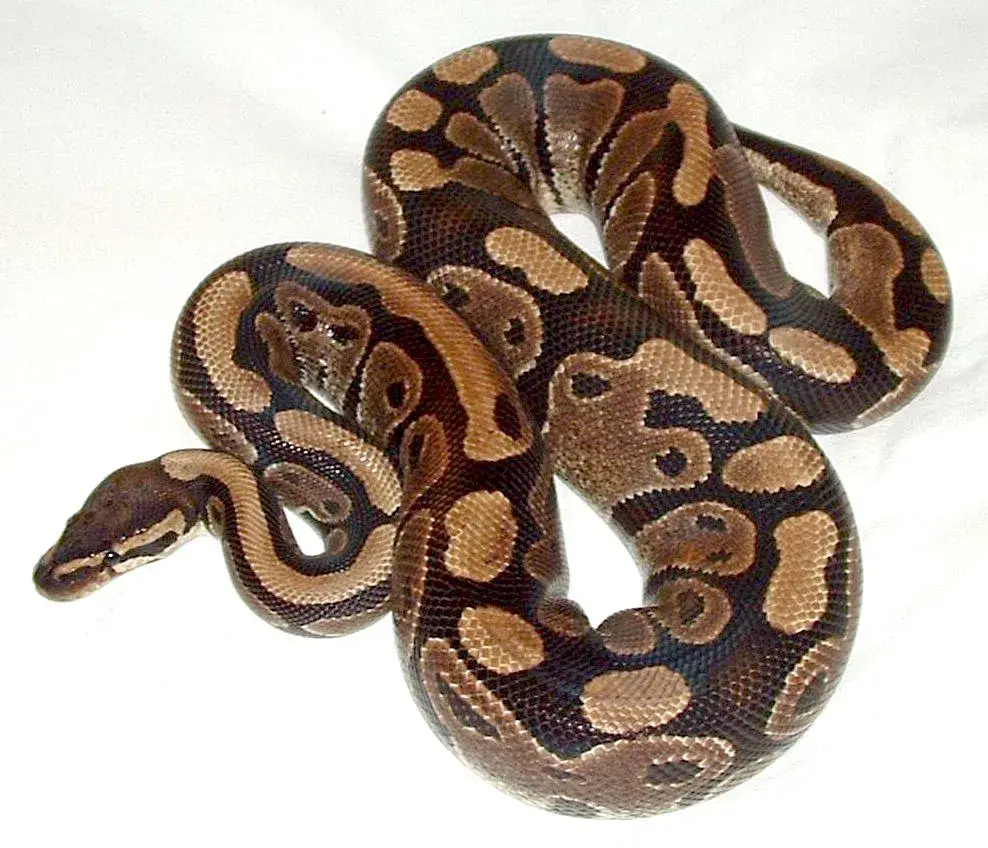
The boa constrictor, also called the common boa, is a large, non-venomous, heavy-bodied snake native to tropical South America and a member of the family Boidae. It is widely kept and bred in captivity, and its scientific name doubles as its common name — an unusual case of an animal referred to colloquially by its own Latin binomial. Four subspecies are recognized today, after several formerly classified subspecies, including Boa imperator, were elevated to full species status of their own.
Size varies substantially by locality and by the availability of prey, with total length ranging from 3 to 13 feet (0.91 to 3.96 meters). The species shows clear sexual dimorphism: mature females typically run 7 to 10 feet (2.1 to 3.0 meters) long, while males are usually 6 to 8 feet (1.8 to 2.4 meters), and females commonly exceed 10 feet in captivity, occasionally reaching 12 to 14 feet. The largest documented dry skin, held at a museum collection in Munich, measures 14.6 feet without the head. Large specimens can weigh up to 27 kilograms (60 pounds), with females — the larger sex — more commonly weighing 10 to 15 kilograms (22 to 33 pounds); some individuals may reach or exceed 45 kilograms (100 pounds), though that's unusual. Males also tend to have longer tails and pelvic spurs than females, features used to grip and stimulate a mate during breeding.
Coloring generally runs brown, gray, or cream, patterned with brown or reddish-brown "saddle" markings that intensify toward the tail, which is why the species and its close relatives are nicknamed "red-tailed boas." That pattern provides effective camouflage in its jungle and forest habitat. The head is arrow-shaped, marked with distinctive stripes running from the snout to the back of the head and from the snout through the eyes to the jaw. Boa constrictors can sense heat through specialized cells in their lips, though they lack the labial pits seen in some other boid species, and they have two lungs — a small, non-functional left lung and an enlarged, functional right one — an adaptation to their elongated body shape.
Behavior and diet
Diet
Small to medium-sized mammals and birds, including rodents, frogs, larger lizards, and occasionally monkeys or domestic animals
Boa constrictors are largely solitary, coming together only to mate, and they are primarily nocturnal, though they will bask during the day when nighttime temperatures drop too low. Young boas are semi-arboreal and will climb into trees and shrubs to forage, but they become increasingly terrestrial as they grow larger and heavier. They strike when they sense a threat, and while the bite can be painful — especially from a large snake — it's rarely dangerous to a person. Snakes from Central America tend to be more defensive, hissing and striking repeatedly when disturbed, while South American individuals generally tame down more readily. Like all snakes, boas going through a shed cycle become more unpredictable, since the fluid that separates old skin from new gives their eyes a milky or opaque look that impairs their vision.
Their diet is built around small to medium mammals and birds — rodents such as squirrels, mice, rats, and agoutis make up the bulk of it — but they also take frogs, larger lizards, and occasionally animals as large as monkeys, opossums, mongooses, armadillos, wild pigs, young deer, and even ocelots. In areas near people, they will take domestic animals including dogs, cats, rabbits, ducks, and chickens. Boas are ambush predators that typically lie in wait for prey to pass, though they will actively hunt, particularly at night in areas where prey is scarce. Once a strike connects, the snake wraps its coils around the prey and constricts until death, likely by cutting off blood flow to the heart and brain rather than by simple suffocation; the process typically kills within a few minutes. Digestion takes about 4 to 6 days depending on prey size and temperature, after which the snake may go without eating again for a week to several months.
Boa constrictors are ovoviviparous, giving birth to live young rather than laying eggs, generally during the dry season between April and August. Females hold onto sperm internally for as long as a year after mating before ovulating, and the gestation period, counted from the post-ovulation shed, runs about 100 to 120 days. Litter size ranges from 10 to 65 young, averaging around 25, with newborns measuring 15 to 20 inches (38 to 51 centimeters). Young boas grow quickly and shed every one to two months at first, reaching sexual maturity at 3 to 4 years old and an adult length of 6 to 10 feet, after which shedding slows to roughly every 2 to 4 months.
Range and habitat
Habitat
Rainforest and arid semidesert country; often near rivers and streams
Depending on subspecies, the boa constrictor's native range covers much of South America north of 35 degrees south latitude, including Colombia, Ecuador, Peru, Venezuela, Trinidad and Tobago, Guyana, Suriname, French Guiana, Brazil, Bolivia, Uruguay, and Argentina, along with a number of coastal islands. Introduced populations have also become established in Cozumel, extreme southern Florida, and St. Croix in the U.S. Virgin Islands. The species can thrive across a wide range of conditions, from tropical rainforest to arid semidesert, though it prefers rainforest for its humidity, temperature, cover from predators, and abundant prey. Boas are strong swimmers and are frequently found in or along rivers and streams, and they will make use of the burrows of medium-sized mammals as shelter from predators.
Conservation status
The boa constrictor is listed as Least Concern by the IUCN. All boa constrictors are covered under CITES Appendix II, with the sole exception of the subspecies B. c. occidentalis, which is protected under the stricter Appendix I. In parts of its range, populations have been significantly affected by hunting from humans and other animals as well as over-collection for the exotic pet and snakeskin trades — between 1977 and 1983 alone, 113,000 live boa constrictors were imported into the United States. Boas are also killed for meat and skins and are commonly sold at markets within their range; after the reticulated python, they are the snake most often killed for snakeskin products such as shoes and bags. Even so, most populations are not considered at immediate risk of extinction, which is why the species sits in Appendix II rather than the more restrictive Appendix I. In some regions, boa constrictors play a useful ecological role by helping regulate opossum populations, which in turn can limit the spread of leishmaniasis to people.
Where to see boa constrictor in the U.S.
16 zoos across 15 states
Find the closest one
Rank the 14 zoos holding boa constrictor by how far they are from you. Your location is used in your browser to sort this list and is never sent to us.
2 more zoos hold boa constrictor but have no coordinates on file yet, so they aren't ranked here. They're in the full list below.
California· 1
Connecticut· 1
Florida· 1
Georgia· 1
Hawaii· 1
Illinois· 1
Kansas· 1
Maryland· 1
Massachusetts· 1
Minnesota· 1
New Jersey· 1
New York· 1
Pennsylvania· 1
Texas· 2
Wisconsin· 1
AZAThe Association of Zoos and Aquariums. Accredited members have passed an independent inspection of animal care and welfare, safety, conservation and education, repeated every five years. Many smaller facilities never apply, so “not accredited” isn't a verdict on its own. What accreditation means · How we check this
Built from each zoo's own published animal list.
Boa Constrictor: common questions
Is the boa constrictor endangered?
No. It is listed as Least Concern by the IUCN, though some regional populations have been hit hard by hunting and the pet and skin trades.
How big does a boa constrictor get?
Total length ranges from 3 to 13 feet (0.91-3.96 m), with mature females typically 7 to 10 feet and males 6 to 8 feet; large individuals can weigh up to 27 kg (60 lb).
What does a boa constrictor eat?
Mostly small to medium mammals and birds, especially rodents, along with frogs, larger lizards, and occasionally animals as large as monkeys or wild pigs.
How long do boa constrictors live?
Typically 20 to 30 years in captivity, with rare individuals living past 40; the oldest confirmed captive boa lived just over 40 years at the Philadelphia Zoo.
Where do boa constrictors live in the wild?
Across tropical South America north of 35°S, in habitats ranging from rainforest to semidesert, plus introduced populations in Cozumel, southern Florida, and St. Croix.
Which U.S. zoos have boa constrictors?
Five zoos in our directory list the boa constrictor, including Connecticut's Beardsley Zoo, Lion Country Safari, and the Staten Island Zoo.