- Where to see one
- 15 U.S. zoos in our directory hold coati, confirmed against each zoo's own animal list.
- Native range
- Southwestern United States (Arizona, New Mexico, Texas) through Mexico and Central America to northern Argentina and Uruguay
- Size
- Head and body 33–69 cm (13–27 in), plus a tail about as long; 2–8 kg (4.4–17.6 lb)
- Lifespan
- Up to about 7 years in the wild; about 14 years on average in captivity, sometimes into the late teens
- Group size
- Bands of females and young, typically 4 to 25 and up to about 40
- Litter size
- 3 to 7 kits after about 11 weeks of pregnancy
Conservation status
Least Concernassessed 2016
IUCN Red List category LC — step 1 of 7.
Least Concern (LC) for the South American and white-nosed coatis
The South American coati is a member of the raccoon family found in tropical and subtropical South America, in lowland forests east of the Andes from Colombia and the Guianas south to Uruguay and northern Argentina. Adults weigh 2–7.2 kg and measure 85–113 cm, with about half of that length being tail. The animal is active by day and lives both on the ground and in trees, eating mainly fruit, invertebrates, other small animals and bird eggs. It pokes its snout into crevices, turns over rocks and rips open logs with its claws to find prey. Females live in bands of 15 to 30, while males are usually solitary.
About the coati
A coati is a long-nosed, ring-tailed member of the raccoon family, Procyonidae, native to the Americas from the southwestern United States to northern Argentina. Also called coatimundis, coatis are active by day, live in noisy bands of females and young, and root through leaf litter for fruit and small animals.
There are four species. The two most familiar belong to the genus Nasua: the white-nosed coati of the southwestern U.S., Mexico, Central America and Colombia, and the South American coati, Nasua nasua, also called the ring-tailed coati. Two smaller mountain coatis, in the genus Nasuella, live in Venezuela, Colombia and Ecuador. Genetic studies suggest the coatis' closest relatives are the olingos, from which they split about 10.2 million years ago. The name comes from the Tupí language of Brazil.
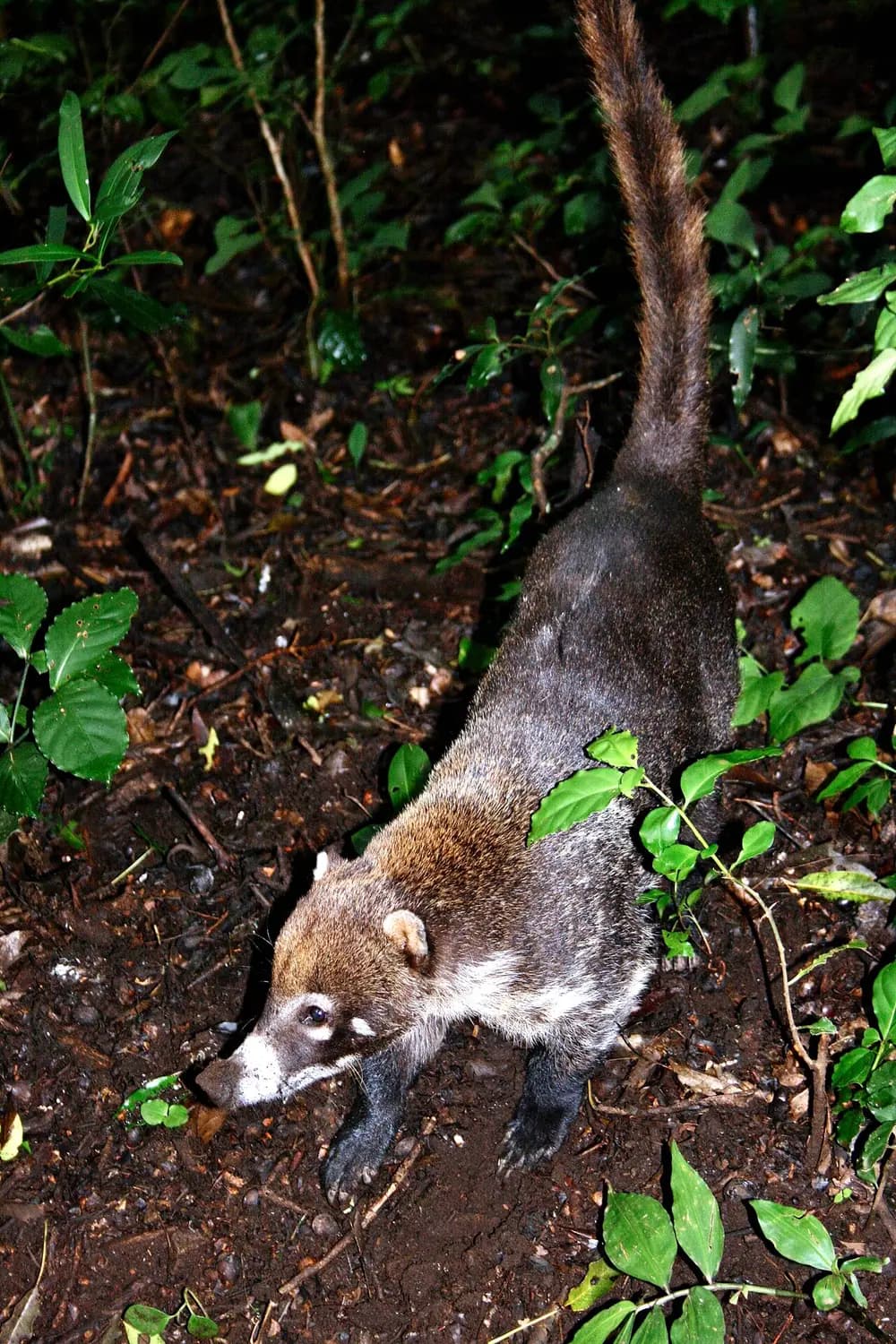
A coati is about the size of a large house cat. It stands roughly 30 cm (12 in) at the shoulder, and males can grow almost twice as large as females, with long, sharp canine teeth. The coat ranges from light brown or rusty to nearly black above, with paler underparts. White marks circle the eyes and edge the ears and snout.
Snout, tail and feet
The snout is the coati's signature. It is long, slightly upturned and so flexible it can swivel up to 60° in any direction, which earned the animal the nickname "hog-nosed raccoon." Coatis use it to push objects, probe under logs and sniff out buried prey.
The long tail is ringed, with rings that range from sharply defined to very faint and, as in raccoons, run all the way around it. It is not prehensile, but it helps with balance, and coatis often carry it straight up, which helps a troop keep together in tall vegetation. Like bears and raccoons, coatis walk on the soles of their feet, and their claws do not retract. They can rotate their ankles beyond 180°, which lets them climb down trees headfirst.
Behavior and diet
Diet
Omnivore; fruit, invertebrates, lizards, rodents, eggs and carrion
Unlike their nocturnal raccoon cousins, coatis are mostly diurnal, spending the day foraging and the night asleep in crude nests high in the trees. Females and young males up to two years old travel in loose, noisy bands, usually of 4 to 25 animals. Adult males are pushed out by the females and live alone, rejoining a band only in the breeding season.
Coatis talk constantly. Chirps signal anything from contentment during grooming to irritation; snorts while digging, with the tail held up, stake a claim to food. A coati hides its nose between its front paws to show submission, while a lowered head and bared teeth mean a challenge.
When threatened, coatis can be fierce. Strong jaws, sharp canines, quick claws and a tough hide make them hard for dogs or jaguars to hold. They are good climbers and swimmers, and when disturbed in a tree they usually descend and escape on the ground.
What coatis eat
Coatis are omnivores. Most of their food is fruit and invertebrates dug from the leaf litter, from beetle larvae and termites to scorpions, centipedes and tarantulas. They also take lizards, rodents, small birds, eggs, including crocodile eggs, and carrion. The keen nose and clawed front feet work together, hog-style, to unearth prey. Near villages they sometimes raid crops, garbage and poultry.
Family life
The breeding season is timed to the rains and the peak of fruit. A single adult male is accepted into a band to mate. Pregnant females then leave the group, build a nest in a tree or rocky niche and give birth after about 11 weeks to three to seven kits. Young South American coatis open their eyes at about 10 days, can climb at about 26 days and rejoin the band with their mother at five to six weeks. Females mature at two years and males at about three.
Range and habitat
Habitat
Forests of many kinds, from dry scrub to rainforest and cloud forest, from sea level to about 3,000 m (9,800 ft)
Coatis cover a huge range, from southern Arizona, New Mexico and Texas through Mexico and Central America to Uruguay and northern Argentina. The white-nosed coati holds the northern part of that range, while the South American coati lives from Colombia and Venezuela south to Uruguay and northern Argentina. A small breeding group of about 10 coatis is thought to have formed in Cumbria, in the United Kingdom.
They live in a wide range of habitats: hot, dry country, humid Amazon rainforest, cloud forest, riverside gallery forest, dry scrub, grassland and cold Andean slopes. South American coatis are found up to about 2,500 m (8,200 ft). Where people have cleared land, they often favor secondary forest and forest edges. Predators include jaguars, mountain lions, ocelots, jaguarundis, boas, large birds of prey, foxes and dogs.
Coati vs raccoon
Coatis are often described as long-nosed raccoons, and the two really are close: both belong to the family Procyonidae, along with the ringtail and kinkajou.
| Feature | Coati | Raccoon |
|---|---|---|
| Family | Procyonidae | Procyonidae |
| Active | Mostly by day | Mostly at night |
| Tail rings | Go all the way around the tail | Go all the way around the tail |
| Climbing | Can rotate ankles past 180° to descend headfirst | Shares the ankle-rotating ability |
Read more about the raccoon.
Conservation status
The South American coati and the white-nosed coati are both listed as Least Concern on the IUCN Red List, in assessments published in 2016. The South American coati is not classed as threatened, though it is listed on CITES Appendix III by Uruguay.
That does not mean coatis are trouble-free. Across Central and South America they are threatened by habitat destruction and unregulated hunting, and forest clearing for mining, roads, petroleum and timber reduces their habitat. A shortage of sound population studies means problems facing coati populations could be underestimated.
Where to see coati in the U.S.
15 zoos across 11 states
Find the closest one
Rank the 9 zoos holding coati by how far they are from you. Your location is used in your browser to sort this list and is never sent to us.
6 more zoos hold coati but have no coordinates on file yet, so they aren't ranked here. They're in the full list below.
California· 3
Florida· 2
Georgia· 1
Illinois· 1
Kentucky· 1
Michigan· 1
Mississippi· 1
Missouri· 1
North Carolina· 1
North Dakota· 1
Pennsylvania· 2
AZAThe Association of Zoos and Aquariums. Accredited members have passed an independent inspection of animal care and welfare, safety, conservation and education, repeated every five years. Many smaller facilities never apply, so “not accredited” isn't a verdict on its own. What accreditation means · How we check this
Built from each zoo's own published animal list.
Coati: common questions
What is a coati related to?
The raccoon. Coatis are members of the raccoon family, Procyonidae, and their closest relatives are the olingos.
Are coatis dangerous?
They can be. When provoked or defending themselves, coatis fight hard with strong jaws, sharp canine teeth and fast-scratching claws.
How big do coatis get?
About the size of a large house cat: 33–69 cm (13–27 in) in head and body with a tail about as long, roughly 30 cm (12 in) tall at the shoulder and 2–8 kg (4.4–17.6 lb).
What do coatis eat?
Fruit and invertebrates make up most of the diet, along with lizards, rodents, small birds, eggs and carrion.
Do coatis live in the United States?
Yes. The white-nosed coati reaches southern Arizona, New Mexico and Texas.
How long do coatis live?
Up to about 7 years in the wild. In captivity the average is about 14 years, and some reach their late teens.
Can you keep a coati as a pet?
Some people do, but coatis are wild animals that can be difficult to control or train and behave very differently from dogs. They need a large outdoor enclosure and vaccinations similar to dogs and cats.