- Where to see one
- 8 U.S. zoos in our directory hold white-nosed coati, confirmed against each zoo's own animal list.
- Native range
- Southeastern Arizona and New Mexico through Mexico and Central America to northwestern Colombia
- Size
- About 110 cm (3.6 ft) from nose to tail tip, about half of it tail; usually 4–6 kg (8.8–13.2 lb)
- Lifespan
- Up to about 7 years in the wild; about 14 years on average in captivity
- Group name
- Band (females and young)
- Gestation
- About 77 days (10 to 11 weeks)
Conservation status
Least Concernassessed 2016
IUCN Red List category LC — step 1 of 7.
The white-nosed coati, also called the coatimundi, is a member of the raccoon family that weighs about 4 to 6 kg and measures roughly 110 cm from nose to tail, about half of it tail. It ranges from Arizona and New Mexico through Mexico and Central America to northwestern Colombia, living in tropical and subtropical forests from sea level to 3,000 m. Unlike many relatives it is diurnal. It forages mostly on the ground for small vertebrates, fruits, carrion, insects, snakes and eggs, and climbs trees easily, using its tail for balance. Females live in groups called bands.
About the white-nosed coati
The white-nosed coati, also called the coatimundi, is a long-snouted member of the raccoon family, Procyonidae. It lives in forests from southeastern Arizona and New Mexico through Mexico and Central America to northwestern Colombia. Active by day, it roams the forest floor in bands, sniffing out insects and fruit with its flexible nose.
Its scientific name is Nasua narica. It is one of the coatis, a group that also includes the South American coati, and it is a cousin of the raccoon and the kinkajou. Across its range it goes by many local Spanish names, including pizote, tejón, gato solo and antoon. Coatis from Cozumel Island off Mexico were once treated as a separate species, but most recent authorities consider them a smaller subspecies of the white-nosed coati.
A typical adult weighs 4–6 kg (8.8–13.2 lb), though small females can be as light as 3.1 kg (6.8 lb) and large males as heavy as 9 kg (20 lb). From nose to tail tip it measures about 110 cm (3.6 ft), and roughly half of that is tail.
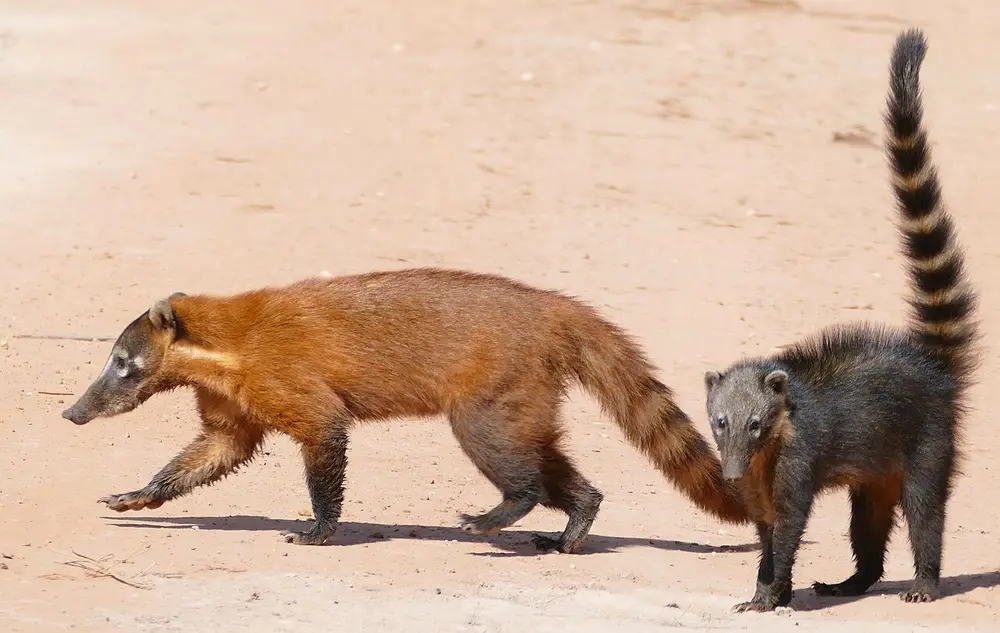
The coat is grayish brown, with silvery grizzling along the sides of the arms. The name comes from the face: a white band crosses the muzzle near the end of the long, pointed nose, which has a flexible tip. White spots sit above and below each eye and on each cheek, and there are touches of white on the throat and belly. The tapering tail is very long, ringed in black and held upright while the animal walks. Coatis walk flat on their soles, with shorter front legs than hind legs. The feet are black with bare soles, and the front feet carry curved claws. According to Animal Diversity Web, coat color and muzzle markings are the only physical traits that separate it from the South American (ring-tailed) coati and the mountain coati.
Behavior and diet
Diet
Omnivore; mainly insects and other invertebrates, plus fruit, small vertebrates, eggs and carrion
Unlike many of their relatives, such as raccoons and kinkajous, coatis are diurnal and do most of their foraging by day, although adult males are sometimes active at night. Days are spent mostly on the ground, and nights are spent up in the treetops, out of reach of most predators. They climb easily and use the tail for balance.
Social life splits along sex lines. Adult males live alone outside the mating season. They mark ranges by spraying urine or dragging their bellies to spread scent from anal glands, their ranges do not overlap, and males fight when they meet. Females live in bands of 4 to 20 animals along with their young, including males up to two years old. Band members are not necessarily related, but once bonds form they are loyal to one another, and females groom and nurse each other's young. A band's home range is about 1 km (0.6 mi) across and overlaps at the edges with neighboring bands, which tend not to fight because new bands usually form when an old one splits.
The white-nosed coati is an omnivore that eats mostly insects and other small invertebrates. It forages with its muzzle low to the ground, sniffing out beetles, spiders, scorpions, ants, termites, grubs, centipedes and even land crabs, and it may travel up to 2,000 m (1.2 mi) in a day looking for food. Fruit is eaten when plentiful, along with eggs, carrion, snakes and small vertebrates such as mice, lizards and frogs, which it pins down with its paws and kills with a bite to the head.
Coatis can also act as pollinators. In a study in Costa Rica, white-nosed coatis pushed their noses into balsa tree flowers to drink the nectar without damaging the blooms, then carried pollen on their faces through the forest. The balsa provides water and food when other resources are scarce, and the coatis help the tree spread.
In February or March, the dominant male in a band's area is allowed to join the group, first by grooming and acting submissively. He mates with the females in the trees and is soon driven away, since adult males are known to kill young. Pregnancy lasts about 77 days. Three to four weeks before giving birth, a female leaves the band to build a nest, most often in a palm tree, and has a litter of two to seven young, each weighing just 100–180 g (3.5–6.3 oz). The young open their eyes at 11 days, are weaned at four months and rejoin the band with their mother at about five months. They reach adult size at 15 months. Females mature at about two years and males at about three.
Range and habitat
Habitat
Tropical and subtropical dry and moist forests, from sea level to 3,000 m (9,800 ft)
The native range runs from Arizona and New Mexico in the north, including the area around Flagstaff, Arizona, through Mexico and Central America into far northwestern Colombia near the Panama border. Animal Diversity Web extends it to western Colombia and Ecuador. Within that range, white-nosed coatis use wooded areas in tropical and subtropical dry forest and moist forest, from sea level up to 3,000 m (9,800 ft). They adapt to many settings, from tropical lowlands to dry, high-altitude forests.
There are rare records in Texas going back to 1877, with sightings scattered across several counties and the Big Bend area. The species has also been introduced to southern Florida. A museum specimen labeled as an escaped captive dates to 1928, sightings have increased since the 1970s, and there is probable evidence of breeding, suggesting the population is well established there.
Conservation status
The IUCN lists the white-nosed coati as Least Concern, based on a 2016 assessment, and NatureServe ranks it G5, globally secure. Locally the picture differs: the coati is listed as endangered in the state of New Mexico.
The species was very plentiful in the 1950s, then suffered major declines in the early 1960s for unknown reasons. Numbers have since recovered, and the recovery has come with a northward spread of the range. Recorded threats include legal hunting by people, since coatis are hunted for meat, and natural predators such as wild cats, boas and large birds of prey. Honduras has listed its population in Appendix III of CITES, which places controls on international trade.
Where to see white-nosed coati in the U.S.
8 zoos across 7 states
Find the closest one
Rank the 7 zoos holding white-nosed coati by how far they are from you. Your location is used in your browser to sort this list and is never sent to us.
1 more zoo holds white-nosed coati but has no coordinates on file yet, so it isn't ranked here. It's in the full list below.
Arizona· 2
District of Columbia· 1
Florida· 1
Kansas· 1
Louisiana· 1
New Jersey· 1
New Mexico· 1
AZAThe Association of Zoos and Aquariums. Accredited members have passed an independent inspection of animal care and welfare, safety, conservation and education, repeated every five years. Many smaller facilities never apply, so “not accredited” isn't a verdict on its own. What accreditation means · How we check this
Built from each zoo's own published animal list.
White-nosed Coati: common questions
Is a coatimundi the same as a white-nosed coati?
Yes. Coatimundi is another common name for the white-nosed coati, Nasua narica.
How big do white-nosed coatis get?
About 110 cm (3.6 ft) from nose to tail tip, half of that tail. Most weigh 4–6 kg (8.8–13.2 lb), with large males up to 9 kg (20 lb).
What do white-nosed coatis eat?
Mostly insects and other invertebrates such as beetles, spiders, scorpions and grubs. They also eat fruit, eggs, carrion and small animals like lizards, frogs and mice.
Are white-nosed coatis related to raccoons?
Yes. They belong to the raccoon family, Procyonidae, along with raccoons and kinkajous.
Do white-nosed coatis live in the United States?
Yes. Their native range reaches into southeastern Arizona and New Mexico, there are rare records in Texas, and an introduced population lives in southern Florida.
How long do white-nosed coatis live?
Up to about seven years in the wild. In captivity they average about 14 years, and some live into their late teens.
Are coatis active during the day?
Yes. Coatis are mainly diurnal, foraging on the ground by day and sleeping in trees at night.
Can you keep a coati as a pet?
Some people do. Animal Diversity Web notes that coatis may be kept as pets, and they are also hunted for their meat.