- Where to see one
- 11 U.S. zoos in our directory hold black-footed ferret, confirmed against each zoo's own animal list.
- Native range
- Central North America, historically from southern Alberta and Saskatchewan south to Texas, New Mexico, and Arizona
- Size
- Males 500 to 533 millimeters (19.7 to 21.0 in) in body length; weight 650 to 1,400 grams (1.43 to 3.09 lb)
About the black-footed ferret
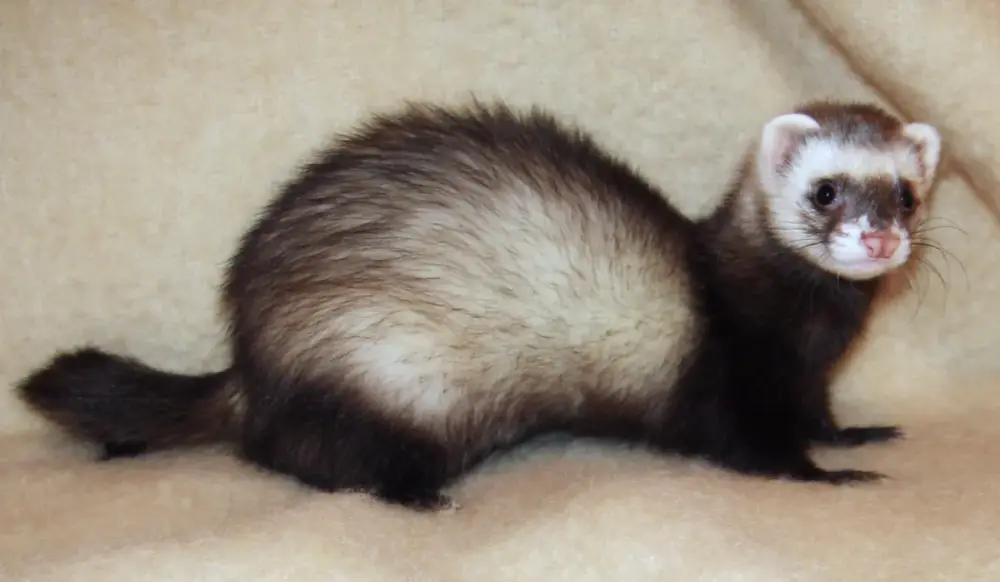
The black-footed ferret, also known as the American polecat or prairie dog hunter, is a mustelid native to central North America, roughly the size of a mink and closely resembling both the European polecat and the Asian steppe polecat. It has a long, slender body with black markings across its paws, ears, parts of its face, and its tail, set against a base coat that is pale yellowish or buffy. A broad band of sooty black crosses the face and includes the eyes, while the sides of the head and the ears stay dirty-white by contrast. A patch of dark umber-brown midway between the front and back legs fades into the lighter fur around it.
Males measure 500 to 533 millimeters (19.7 to 21.0 in) in body length, with a tail adding another 114 to 127 millimeters (4.5 to 5.0 in) — about 22% to 25% of body length. Females run about 10% smaller than males. Adults weigh between 650 and 1,400 grams (1.43 and 3.09 lb). Ferrets bred in captivity for reintroduction programs started out smaller than their wild counterparts but quickly reached historical body sizes once released into the wild.
Genetically, the black-footed ferret's closest relative is the Asian steppe polecat, and the two were once considered a single species. Fossil evidence places the species in the Great Basin and the Rockies by around 750,000 years ago, with the oldest known fossil, from Cathedral Cave in White Pine County, Nevada, dated to 750,000 to 950,000 years old.
Behavior and diet
Diet
Up to 90% prairie dogs, plus small rodents and rabbits
The black-footed ferret is solitary except when breeding or raising young, and it is primarily nocturnal, hunting sleeping prairie dogs inside their own burrows. It is most active above ground from dusk to midnight and again from around 4 a.m. into mid-morning, with the greatest amount of aboveground activity occurring in late summer and early autumn, when juveniles become independent. In winter, it may stay inactive inside a burrow for up to six days at a stretch.
Up to 90% of its diet is prairie dogs, with the remaining 10% made up of small rodents and rabbits. Because it relies so heavily on one prey type, its diet shifts with which prairie dog species is locally available: in areas with white-tailed prairie dogs, which hibernate for about four months, ferrets turn to voles and mice during that hibernation window, while in South Dakota, where black-tailed prairie dogs don't hibernate, the ferret's diet stays fairly constant year-round. In one South Dakota study, black-tailed prairie dog remains showed up in 91% of 82 ferret scats examined, with mouse remains in 26%. Near Meeteetse, Wyoming, 87% of the diet was made up of white-tailed prairie dogs, with deer mice, voles, cottontails, and jackrabbits filling out the rest. A single female raising a litter has been estimated to need somewhere between 412 and 1,421 prairie dogs a year, depending on which species is available, requiring dedicated habitat of 91 to 877 acres per female.
Home ranges differ sharply by sex: females occupy smaller territories, with one tracked female using 39.5 acres (16 ha), while a male whose range overlapped hers used 337.5 acres (137 ha) over the same period. Nightly movement has been measured at an average of 0.87 miles (1.40 km) across 170 tracked individuals, and ferrets may travel up to 11 miles (18 km) in search of prey, moving between prairie dog colonies that far apart.
Mating occurs in February and March. Rather than the more aggressive courtship seen in the European polecat, a male sniffs a female's genital region and waits several hours before mounting her, and copulation itself — with the male gripping the female's nape — lasts 1.5 to 3.0 hours. Gestation runs 42 to 45 days, and litters range from one to five kits, born in prairie dog burrows during May and June. Kits are altricial at birth and depend fully on their mother; they first emerge above ground at about six weeks old, in July, and are moved into individual burrows around their mother's own. Independence comes from late August into October, and sexual maturity follows at one year of age. Juveniles disperse from their natal area a few months after birth, typically traveling 1 to 4 miles (1.6 to 6.4 km), though some young females move less than 0.2 miles (0.32 km) and stay near where they were born.
Range and habitat
Habitat
Shortgrass and mixed-grass prairie, desert grassland, and sagebrush steppe, wherever prairie dog colonies are found
The black-footed ferret's historical range tracked the range of prairie dogs closely, running from southern Alberta and Saskatchewan south through Texas, New Mexico, and Arizona. The species was declared extinct in 1979, only for a small wild population to be discovered in 1981 near Meeteetse, Wyoming — as of 2007 the only known wild population occupied about 6,000 acres (2,400 ha) there. Since 1990, reintroductions have established or attempted populations at sites including Shirley Basin, Wyoming; UL Bend National Wildlife Refuge and the Fort Belknap Indian Reservation in Montana; Conata Basin/Badlands, Buffalo Gap National Grassland, Wind Cave National Park, and the Cheyenne River Sioux Reservation in South Dakota; Aubrey Valley, Arizona; the Rocky Mountain Arsenal National Wildlife Refuge and Wolf Creek in Colorado; Coyote Basin, straddling Colorado and Utah; northern Chihuahua, Mexico; and Grasslands National Park in Canada.
Habitat types historically used include shortgrass prairie, mixed-grass prairie, desert grassland, shrub steppe, sagebrush steppe, mountain grassland, and semi-arid grassland. The species relies heavily on prairie dog burrows, which it uses for raising young, avoiding predators, and staying insulated from temperature extremes; colonies with the highest density of burrows offer the most cover.
Conservation status
The black-footed ferret is classified as Endangered (EN). Its history over the past century has been especially dramatic: the species declined through the 20th century as prairie dog populations shrank and sylvatic plague spread, was declared extinct in 1979, and was then rediscovered as a small residual wild population near Meeteetse, Wyoming, in 1981. A captive-breeding program run by the U.S. Fish and Wildlife Service used that population to reintroduce ferrets into eight western U.S. states, Canada, and Mexico between 1991 and 2009. As of 2015, more than 200 mature individuals were living in the wild across 18 populations, including four considered self-sustaining, in South Dakota, Arizona, and Wyoming.
Its IUCN status has shifted more than once: first listed as endangered in 1982, it was reclassified as extinct in the wild in 1996 before being moved back to endangered in 2008. In February 2021, conservationists announced the first successful clone of a black-footed ferret, a female named Elizabeth Ann.
Where to see black-footed ferret in the U.S.
11 zoos across 9 states
Find the closest one
Rank the 11 zoos holding black-footed ferret by how far they are from you. Your location is used in your browser to sort this list and is never sent to us.
Arizona· 1
Colorado· 1
District of Columbia· 1
Kansas· 2
Kentucky· 1
North Dakota· 1
Pennsylvania· 2
Texas· 1
Wisconsin· 1
AZAThe Association of Zoos and Aquariums. Accredited members have passed an independent inspection of animal care and welfare, safety, conservation and education, repeated every five years. Many smaller facilities never apply, so “not accredited” isn't a verdict on its own. What accreditation means · How we check this
Built from each zoo's own published animal list.
Black-footed Ferret: common questions
Is the black-footed ferret endangered?
Yes. It's classified as Endangered, after a history that included being declared extinct in 1979 and briefly reclassified as extinct in the wild in 1996.
How big does a black-footed ferret get?
Males measure 500 to 533 millimeters (19.7 to 21.0 in) in body length, with females about 10% smaller, and adults weigh 650 to 1,400 grams (1.43 to 3.09 lb).
What does a black-footed ferret eat?
Up to 90% prairie dogs, with the remainder made up of small rodents and rabbits.
Where do black-footed ferrets live in the wild?
In prairie habitat across central North America, historically from southern Alberta and Saskatchewan south to Texas, New Mexico, and Arizona, always tied to prairie dog colonies.
Which U.S. zoos have black-footed ferrets?
Five zoos in our directory list them, including the Cheyenne Mountain Zoo, the Roosevelt Park Zoo, and the Abilene Zoological Gardens.