- Where to see one
- 15 U.S. zoos in our directory hold domestic ferret, confirmed against each zoo's own animal list.
- Native range
- Domesticated form of the European polecat; no wild native range
- Size
- About 50 cm (20 in) long, including a 13 cm (5.1 in) tail; 0.7–2.0 kg (1.5–4.4 lb)
- Lifespan
- 7 to 10 years
Conservation status
Not Evaluated
This species has not been assessed for the IUCN Red List, so it sits outside the threat scale entirely.
Not Evaluated (NE); domestic animals are not assessed on the IUCN Red List
About the domestic ferret
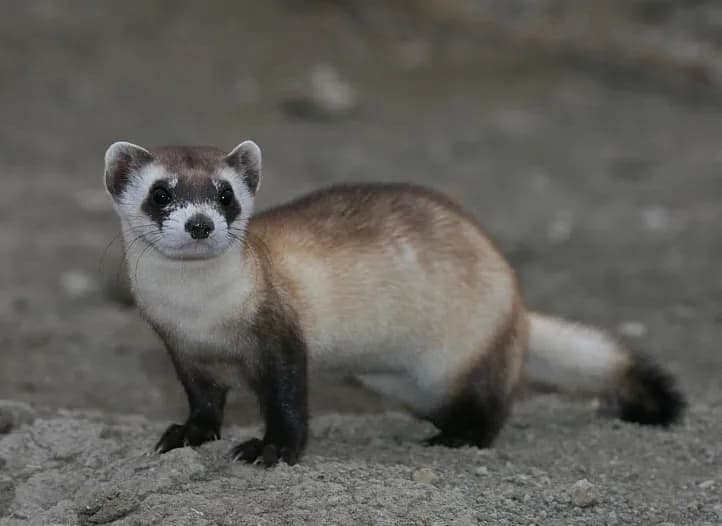
The domestic ferret is a small, domesticated mustelid, most likely descended from the wild European polecat. The two can still interbreed and produce hybrid offspring, which is one of the strongest pieces of evidence for that ancestry. Like other mustelids, the ferret has a long, slender body. Including the tail, an adult measures around 50 cm (20 in), with the tail itself accounting for about 13 cm (5.1 in) of that length. Ferrets weigh between 0.7 and 2.0 kg (1.5 and 4.4 lb), and the species is sexually dimorphic, with males noticeably larger than females. Coat color varies widely and can be black, brown, white, or a mixture of those shades.
The name "ferret" traces back to the Late Latin furittus, meaning "little thief," a nod to the animal's habit of stashing away small objects. English versions of the word appeared by the 14th century, settling into the modern spelling by the 16th. Ferrets also carry a whole vocabulary of their own: a male is a hob, a female a jill, a spayed female a sprite, a neutered male a gib, and a vasectomized male a hoblet. Ferrets under a year old are kits, and a group of them is called a "business."
The domestic ferret is frequently confused with the black-footed ferret (Mustela nigripes), a separate species native to North America. Genetic analysis of mitochondrial DNA suggests the domestic ferret was bred from the European polecat roughly 2,500 years ago, likely from a North African lineage, though claims that ancient Egyptians were the first to keep them are considered unlikely since no mummified ferret remains or hieroglyphs of the animal have turned up. The American Society of Mammalogists treats the domestic ferret, Mustela furo, as a distinct species from its wild ancestor.
Behavior and diet
Diet
Obligate carnivore
Ferrets are crepuscular, meaning they are most active around dawn and dusk, and they spend an outsized 14 to 18 hours of the day asleep. A caged ferret needs to be let out daily, with at least an hour to explore and play. Unlike the largely solitary wild polecat, most domestic ferrets are comfortable living in social groups. They are territorial animals that like to burrow and prefer sleeping somewhere enclosed.
Ferrets have scent glands near the anus and use the secretions for marking; they can identify individuals, and even sex, from these scent traces, and they also use urine marking for mating and recognition. When startled, a ferret may release this scent as a defense, though the smell is far milder and fades faster than a skunk's, and most pet ferrets sold in the U.S. have had the glands removed. A joyful, excited ferret performs the "weasel war dance," a burst of sideways hops and leaps often paired with a soft clucking sound called "dooking." A scared ferret hisses, and an upset one squeaks softly.
Ferrets are obligate carnivores. In the wild, their polecat ancestors ate whole small prey — meat, organs, bones, skin, feathers, and fur — and domestic ferrets keep the same short digestive tract and fast metabolism, so they need to eat often. They lack a cecum and cannot meaningfully digest plant matter, which is why high-meat prepared foods, rather than fruit or vegetables once wrongly recommended by breeders, are considered appropriate. Ferrets imprint on their food at around six months old, which can make it hard to introduce new foods later in life. Reproductively, the average gestation period is 42 days, and females can have two or three litters a year, each with three to seven kits. Kits are weaned at three to six weeks, become independent at three months, and reach sexual maturity around six months.
Range and habitat
Habitat
Kept as a companion and working animal; ancestral polecat is a burrowing hunter
The domestic ferret has no wild native range of its own; it exists as a bred form of the European polecat, which is native to Europe. Feral colonies of ferrets, and of ferret–polecat hybrids, have established themselves where there is little competition from similarly sized predators, notably in Scotland's Shetland Islands and in remote parts of New Zealand. New Zealand's feral population has been claimed to be the largest of its kind in the world, the legacy of a 19th-century campaign: farmers pushed for ferrets to be brought in starting in 1877 to control rabbits, which had themselves been introduced by people, and thousands were released through the 1880s. On the voyage over, some of those ferrets interbred with European polecats, producing hybrids well suited to surviving outdoors, and once rabbit numbers fell, the ferrets and their relatives turned to New Zealand's native birds, which had evolved with no mammalian predators to guard against.
In the United States, ferrets arrived in the 17th century and were used for generations to guard grain stores from rodents, a role they held into the start of World War II. Today, in the U.S., the domestic ferret's "habitat" is almost entirely domestic: homes, and the diretory's zoos, rather than any wild landscape.
Conservation status
Domestic animals are not assessed on the IUCN Red List, so the domestic ferret has no Red List category. It is a long-domesticated form of the European polecat rather than a wild species with a tracked population, and it should not be confused with the black-footed ferret, a separate, wild North American species.
Ferrets have proven useful beyond the household: they have served as research animals in neuroscience and in infectious-disease studies, especially around influenza. In North America the domestic ferret has become an increasingly common household pet, with more than five million kept in the United States.
Rules on ownership vary widely by place. Ferrets are illegal to keep in California and in Hawaii, where officials cite the risk of rabies, and Puerto Rico has a similar restriction; New York City has also renewed a local ban. Some states, including Rhode Island, require a permit, while Illinois and Georgia require one only to breed ferrets rather than simply to own one. Most of the state-level bans that once existed in the U.S. were lifted in the 1980s and 1990s as ferrets grew more popular as pets.
Where to see domestic ferret in the U.S.
15 zoos across 11 states
Find the closest one
Rank the 14 zoos holding domestic ferret by how far they are from you. Your location is used in your browser to sort this list and is never sent to us.
1 more zoo holds domestic ferret but has no coordinates on file yet, so it isn't ranked here. It's in the full list below.
California· 2
Colorado· 1
Idaho· 1
Kansas· 2
Kentucky· 1
Louisiana· 1
Mississippi· 1
New York· 1
Pennsylvania· 1
South Dakota· 1
Wisconsin· 3
AZAThe Association of Zoos and Aquariums. Accredited members have passed an independent inspection of animal care and welfare, safety, conservation and education, repeated every five years. Many smaller facilities never apply, so “not accredited” isn't a verdict on its own. What accreditation means · How we check this
Built from each zoo's own published animal list.
Domestic Ferret: common questions
Is the domestic ferret endangered?
No. The domestic ferret is a long-domesticated animal rather than a wild species, and domestic animals are not assessed on the IUCN Red List.
How big does a domestic ferret get?
About 50 cm (20 in) long including the tail, and 0.7 to 2.0 kg (1.5 to 4.4 lb) in weight, with males noticeably larger than females.
What does a domestic ferret eat?
It's an obligate carnivore. Its wild ancestor ate whole small prey, and domestic ferrets are typically fed high-meat prepared foods because they cannot digest plant matter.
How long do domestic ferrets live?
Around 7 to 10 years.
Where do domestic ferrets live in the wild?
They have no wild native range of their own; they're a domesticated form of the European polecat. Feral colonies exist in places like the Shetland Islands and New Zealand.
Which U.S. zoos have domestic ferrets?
Five U.S. zoos list them, including CuriOdyssey in California, Cheyenne Mountain Zoo in Colorado, and the Baton Rouge Zoo in Louisiana.