White-spotted Bamboo Shark
Chiloscyllium plagiosum
Also known as Whitespotted Bamboo Shark
- Where to see one
- 6 U.S. zoos in our directory hold white-spotted bamboo shark, confirmed against each zoo's own animal list.
- Native range
- Indo-Pacific coasts from Japan to India; common around Indonesia
- Size
- Up to 93 cm (37 in) long
- Reproduction
- Lays eggs about 13 cm (5 in) long that hatch in 14–15 weeks
- Activity
- Mostly nocturnal
Conservation status
Near Threatenedassessed 2021
IUCN Red List category NT — step 2 of 7.
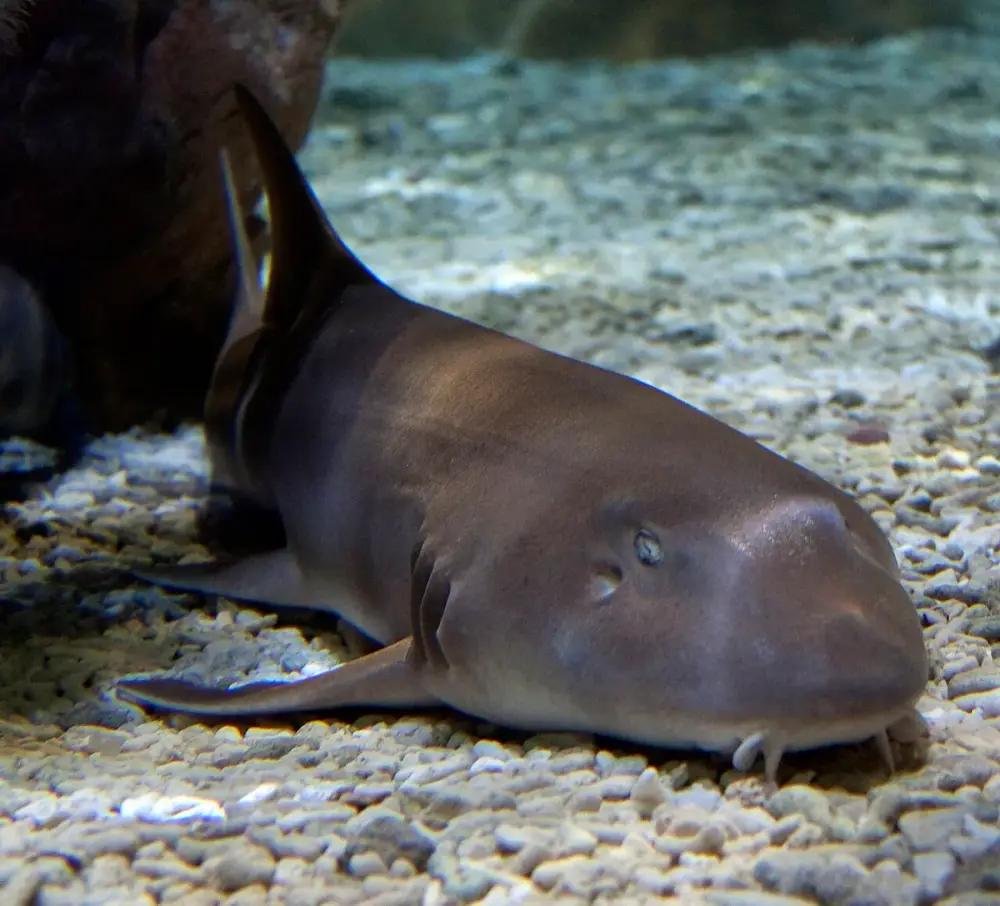
The whitespotted bamboo shark is a small, mostly nocturnal carpet shark that grows up to 93 centimetres long and is harmless to humans. It lives on coral reefs of the Pacific Ocean, is common in the coastal waters of Indonesia, and its range extends from Japan to India. It rests on the bottom, propped up on its bent pectoral fins, and feeds at night on small fish and invertebrates, using electroreceptors along its snout to locate prey buried in sand and mud. Its teeth can grasp soft prey, and for hard prey they pivot backwards to form a continuous plate that crushes crabs. It lays eggs.
About the white-spotted bamboo shark
The white-spotted bamboo shark is a small, harmless carpet shark of Indo-Pacific coral reefs, found from Japan to India and especially common around Indonesia. It belongs to the longtail carpet shark family, Hemiscylliidae, and grows to about 93 cm (37 in). Dark bands and light spots on a pale body make it easy to identify.
Its scientific name is Chiloscyllium plagiosum. It is a close relative of the brownbanded bamboo shark, Chiloscyllium punctatum, which is often called simply the bamboo shark. The two are separate species in the same genus.
Like its relatives in the family, the white-spotted bamboo shark has an elongated, cylindrical body, short barbels near the mouth, large spiracles, and a tail longer than the rest of the body. The rear edges of its dorsal fins are convex, curving outward, which is one way to tell it from the brownbanded bamboo shark, whose dorsal fin edge curves inward.
The color pattern is the real giveaway. The body is white, crossed with dark bands and dotted with purple and pink spots. This pattern is unique within the family, which makes the species simple to identify.
The teeth are small and not strongly differentiated. Each has a central cusp and weak root lobes, with 26 to 35 teeth in the upper jaw and 21 to 32 in the lower. They can grasp soft prey, and when the shark bites something hard, the teeth pivot backward so their flat front surfaces form a continuous crushing plate. That is how a small shark manages to crack crabs.
Members of the genus Chiloscyllium share a fairly long snout with the nostrils set just below the tip, eyes that are barely raised, and a mouth closer to the eyes than to the snout tip. Their pectoral and pelvic fins are thin rather than heavily muscled, and none has the black hood or large black side spot seen on their cousins, the epaulette sharks.
Behavior and diet
Diet
Small fish and invertebrates, including crabs
The white-spotted bamboo shark is a mostly nocturnal hunter. It feeds at night on small fish and invertebrates. Like most sharks, it carries electroreceptors called ampullae of Lorenzini along its snout, which let it detect prey buried in sand and mud. Because it hunts on the sea floor rather than in open water, like the spadenose shark does, it makes efficient use of food sources that settle to the bottom. Juveniles need more carbon in their diet than adults, especially during wet seasons.
At rest, bamboo sharks typically sit on the bottom with the head and front of the body propped up on bent pectoral fins. The family as a whole is sluggish, feeding on bottom-dwelling invertebrates and smaller fish. Bamboo sharks also make noise: popping and sucking sounds while feeding, jaw clicks when handled as a stress signal, and hissing made by forcing water out of the gills.
The species lays eggs. The egg cases are about 13 cm (5 in) long and hatch after 14 or 15 weeks, releasing pups about 15 cm (6 in) long.
Its reproduction has made headlines. In July 2002, a captive female white-spotted bamboo shark that had been kept away from males for six years laid eggs that hatched three young. Three explanations were considered most likely: that the female had both male and female reproductive organs, that she had stored sperm for years, or that her eggs developed without fertilization, a process called parthenogenesis. None has been confirmed. It appears to be the first reported case of parthenogenesis in this species.
Albinism is extremely rare in sharks, but an estimated 1 in 10,000 white-spotted bamboo sharks is born albino, and albino individuals have hatched in captivity.
Range and habitat
Habitat
Coral reefs, where it lives and hunts near the sea floor
White-spotted bamboo sharks live on coral reefs of the Pacific Ocean, with a range reaching west to India. They are common in coastal waters of Indonesia and the surrounding seas, and the full range extends from Japan to India. Specimens have been collected around Ternate and Halmahera islands in Indonesia.
The family as a whole lives in shallow waters of the tropical Indo-Pacific, typically in tide pools, coral beds and around boulders. That liking for confined spaces is one reason members of the family adapt well to home aquariums.
White-spotted bamboo shark vs brownbanded bamboo shark
Both species go by "bamboo shark," but they are different animals with different patterns, fins and ranges.
| Feature | White-spotted bamboo shark | Brownbanded bamboo shark |
|---|---|---|
| Scientific name | Chiloscyllium plagiosum | Chiloscyllium punctatum |
| Adult pattern | Dark bands with many light spots | Plain; only juveniles are banded |
| Rear edge of dorsal fins | Convex | Concave |
| Maximum length | 93 cm (37 in) | 1.04 m (41 in) |
| Range | Japan to India | Japan to northern Australia |
| IUCN status | Near Threatened (2021) | Near Threatened (2024) |
Conservation status
The white-spotted bamboo shark is listed as Near Threatened on the IUCN Red List (2021). The species is used for human consumption in Madagascar and Taiwan. It is also one of the more common sharks kept in home aquariums.
It feeds and breeds readily in captivity, and several species in its family have been bred successfully in human care. Its small size and bottom-dwelling habits suit aquarium life.
Where to see white-spotted bamboo shark in the U.S.
6 zoos across 5 states
Find the closest one
Rank the 6 zoos holding white-spotted bamboo shark by how far they are from you. Your location is used in your browser to sort this list and is never sent to us.
AZAThe Association of Zoos and Aquariums. Accredited members have passed an independent inspection of animal care and welfare, safety, conservation and education, repeated every five years. Many smaller facilities never apply, so “not accredited” isn't a verdict on its own. What accreditation means · How we check this
Built from each zoo's own published animal list.
White-spotted Bamboo Shark: common questions
Are white-spotted bamboo sharks dangerous?
No. The species is small, mostly nocturnal and harmless to humans.
How big do white-spotted bamboo sharks get?
Up to 93 cm (37 in) long, with adults approaching about 1 m (3.3 ft).
What do white-spotted bamboo sharks eat?
Small fish and invertebrates, including crabs, which they crush with pivoting teeth. In aquariums they eat squid, shrimp, clams, scallops and fish.
Where do white-spotted bamboo sharks live?
On Indo-Pacific coral reefs from Japan to India, and especially commonly around Indonesia.
Can you keep a white-spotted bamboo shark as a pet?
Some aquarists do, but adults need a tank of at least 180 gallons (680 L), and preferably more. Longtail carpet sharks dig, so caves and decor must be stable; collapsing structures have caused fatal injuries.
Are there albino white-spotted bamboo sharks?
Yes. Albinism is very rare in sharks, but an estimated 1 in 10,000 white-spotted bamboo sharks is born albino, and albino young have hatched in captivity.
Do white-spotted bamboo sharks swim much?
Not much. They spend a lot of time resting on the bottom, propped up on their pectoral fins, and hunt along the sea floor at night.
What is the difference between a white-spotted and a brownbanded bamboo shark?
Adult white-spotted bamboo sharks keep dark bands and light spots, while adult brownbanded bamboo sharks are plain. The white-spotted's dorsal fins also have convex rear edges.