- Where to see one
- 8 U.S. zoos in our directory hold redhead, confirmed against each zoo's own animal list.
- Native range
- North America, breeding from Alaska and Canada to the northern U.S. and wintering south to Mexico and the Caribbean
- Size
- 40–56 cm (16–22 in) long, wingspan 74–84 cm (29–33 in), average weight about 1–1.1 kg (2.3–2.4 lb)
- Lifespan
- Oldest known wild bird lived 22 years 7 months after banding
- Incubation
- 24–28 days
- Population
- Over 1.4 million in North America
Conservation status
Least Concernassessed 2021
IUCN Red List category LC — step 1 of 7.
The redhead is a medium-sized North American diving duck. During the breeding season the male has a copper-colored head and neck, a black breast, a gray back and a pale blue bill with a black tip, while the female has a yellow to brown head. Like other pochards, it has legs set far back on the body, which makes walking on land difficult. It breeds from northern Canada to the Dakotas, preferring semipermanent wetlands with dense emergent vegetation, and winters in the southern United States, Mexico, Guatemala, Cuba and the Bahamas. It eats mostly animal matter such as snails and insect larvae in breeding season, then mainly plants after migrating south.
About the redhead
The redhead is a medium-sized North American diving duck. Breeding males have a copper-red head, black breast, grey body and pale blue bill. It belongs to the pochards, genus Aythya; its closest relatives are the Eurasian common pochard and the canvasback. Redheads breed on prairie wetlands of Canada and the northern U.S.
Its scientific name, Aythya americana, combines a Greek word for an unidentified seabird with the Latin for "of America." It is 40 to 56 cm (16 to 22 in) long, with a wingspan of 74 to 84 cm (29 to 33 in). Males average about 1,080 g (38 oz) and females about 1,030 g (36 oz).
As a pochard, the redhead is built for feeding underwater. Its legs sit far back on the body, which makes walking on land awkward. Its feet have larger webbing than a dabbling duck's, the bill is broad, and the hind toe has a lobe of skin. Unlike many ducks, pochards have no shiny metallic patch, or speculum, on the wing.
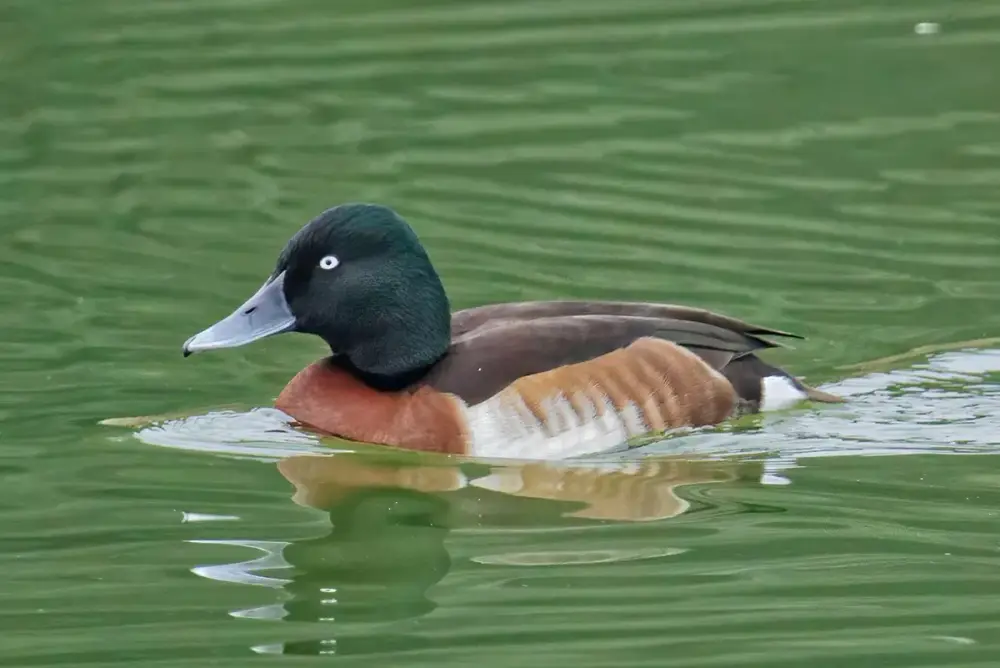
The breeding male has a copper head and neck, a black breast, grey back and sides, a white belly and a black rump and tail. His eyes are yellow, and his pale blue bill ends in a black tip, with a thin white ring between the two. Outside the breeding season the copper fades to brown.
The female is much plainer and keeps the same look all year. Her head and neck are yellowish to brown, her body grey-brown, her belly whitish, and her eyes brown. Her bill is slate with a dark tip separated by a pale blue ring.
Behavior and diet
Diet
Pondweeds, wild celery, shoal grass and other water plants, plus snails, mollusks and insect larvae
Redheads are excellent divers. Their diet changes with the seasons. During the breeding season they eat as much animal food as they can find, including snails, mollusks and insect larvae; before laying, females raise their animal intake to about 77% of the diet for protein. After migrating south they switch mostly to plants: pondweeds, wild rice, wild celery, wigeon grass, bulrushes, muskgrass and shoal grass. They dive to the bottom for plants and mollusks and dabble in shallow marshes for insects.
Pairs form each winter, in December or January, after a long courtship. Unpaired birds travel north in "courting parties" of up to 25. The male kinks his neck and throws back his head while calling, then stretches his neck out fully and gives a cat-like "wheee-oww," sometimes adding a soft cough. An interested female answers with a soft "errrr" while lifting her chin and moving her head from side to side, and the male swims ahead and turns the back of his head toward her. Pairs last for one year. Males desert the females once incubation begins.
Nests are built from bulrush, cattails and sedges in emergent vegetation over or near water, deeply hollowed and lined with down. Incubation lasts 24 to 28 days, and broods number five to seven young. The mother leaves her ducklings at about eight weeks, two to four weeks before they can fly.
The redhead's most unusual habit is brood parasitism. Many females, especially young ones, lay eggs in other ducks' nests, including those of canvasbacks, ring-necked ducks and scaups. Some lay a few eggs elsewhere and raise the rest; others lay all their eggs in a host's nest. This parasitism lowers the hatching success of the hosts, especially canvasbacks, and helps explain hybrids between redheads and several other diving ducks.
Outside the breeding season redheads gather in flocks of 5 to 15, and hundreds or even thousands at favored wintering sites. They fly fast in V-formations, with rapid wingbeats.
Range and habitat
Habitat
Prairie potholes, marshes and shallow lakes; coastal bays and estuaries in winter
Redheads breed across a wide band of North America. Many breed in the Prairie Pothole region of the northern Great Plains. Favored areas include interior British Columbia, Alberta, Saskatchewan, Manitoba and the Dakotas, with smaller groups in Ontario, Quebec and central Alaska. Ideal breeding sites are small, semi-permanent wetlands in open country, with water at least 71 cm (28 in) deep for diving and dense emergent plants for cover.
In fall they migrate south. Most winter along the Gulf of Mexico, off Louisiana, Florida and Mexico, and others winter from California to the Atlantic coast and south to Guatemala, Cuba and the Bahamas. In winter they move to large, sheltered coastal waters, as well as reservoirs, lakes, river deltas, marshes, estuaries and bays. Spring migration begins in late January and February, with the northernmost birds on the move by late April.
Redhead vs canvasback
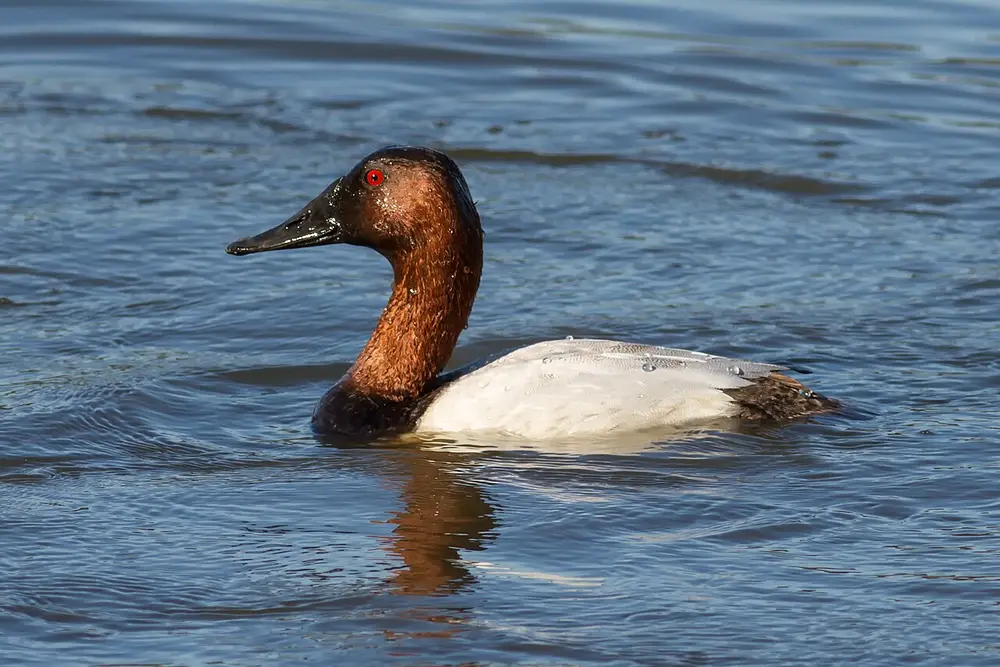
The redhead's lookalike is its close relative the canvasback. Both males have a rusty head, black breast and pale body, but the details differ. The Eurasian common pochard looks even more similar but rarely shares a range with the redhead.
| Feature | Redhead | Canvasback |
|---|---|---|
| Head shape | Rounded | Less rounded |
| Bill | Shorter, pale blue with black tip | Longer |
| Male eye color | Yellow | Red |
| Nesting | Often lays eggs in other ducks' nests | A frequent host of redhead eggs |
Conservation status
The redhead is listed as Least Concern on the IUCN Red List, assessed by BirdLife International in 2021. Its North American population has grown over recent decades to well over 1.4 million birds, above the North American Waterfowl Management Plan goal of 760,000. Redheads make up about 2% of North America's ducks but only 1% of harvested ducks. Restrictive hunting bag limits, and the species' use of permanent and semi-permanent wetlands that hold up during droughts, may help keep the population stable.
Redheads are more likely to die from disease or indirect human effects than from predators. Duck virus enteritis and avian botulism kill some birds. Because they feed on the bottom, redheads are also very susceptible to lead poisoning from swallowing spent shotgun pellets. Mink are the main predator of adults, alongside river otters, red-tailed hawks, great horned owls and eagles. Northern pike and snapping turtles eat ducklings, and skunks, raccoons, crows and magpies take eggs. Wetland conservation is the focus of future management.
Where to see redhead in the U.S.
8 zoos across 8 states
Find the closest one
Rank the 7 zoos holding redhead by how far they are from you. Your location is used in your browser to sort this list and is never sent to us.
1 more zoo holds redhead but has no coordinates on file yet, so it isn't ranked here. It's in the full list below.
Connecticut· 1
District of Columbia· 1
Florida· 1
Illinois· 1
Louisiana· 1
Massachusetts· 1
Oregon· 1
Wisconsin· 1
AZAThe Association of Zoos and Aquariums. Accredited members have passed an independent inspection of animal care and welfare, safety, conservation and education, repeated every five years. Many smaller facilities never apply, so “not accredited” isn't a verdict on its own. What accreditation means · How we check this
Built from each zoo's own published animal list.
Redhead: common questions
Why is it called a redhead?
Because the breeding male has a copper-red head and neck. Females are plain brown and don't share the color.
Is a redhead a diving duck?
Yes. It is a pochard, a diving duck with legs set far back, broad webbed feet and a broad bill for feeding underwater, unlike "puddle" or dabbling ducks such as the mallard.
What do redhead ducks eat?
Mostly water plants such as pondweeds, wild celery, shoal grass and muskgrass in winter. In the breeding season they eat more snails, mollusks and insect larvae.
How big is a redhead duck?
About 40–56 cm (16–22 in) long with a wingspan of 74–84 cm (29–33 in). Adults average roughly 1–1.1 kg (2.3–2.4 lb).
Where do redheads live?
They breed on prairie wetlands of Canada, the northern U.S. and Alaska, and most winter along the Gulf of Mexico, with others from California to the Atlantic coast and into Mexico and the Caribbean.
How long do redhead ducks live?
The oldest known wild redhead lived 22 years and 7 months after it was banded.
Do redheads lay eggs in other ducks' nests?
Yes. Many females, especially young ones, lay some or all of their eggs in the nests of other ducks such as canvasbacks and scaups, leaving the host to incubate them.