- Where to see one
- 10 U.S. zoos in our directory hold pig, confirmed against each zoo's own animal list.
- Origin
- Domesticated from wild boar in the Near East and, separately, in China during the Neolithic
- Size
- Adults usually 140–300 kg (310–660 lb); the Göttingen minipig is about 26 kg (57 lb)
- Lifespan
- Maximum of about 27 years
- Gestation
- About 112–120 days
- Teeth
- 44 in adults
Conservation status
Not Evaluated
This species has not been assessed for the IUCN Red List, so it sits outside the threat scale entirely.
Not Evaluated (NE) as a domestic animal; its wild ancestor, the wild boar, is Least Concern
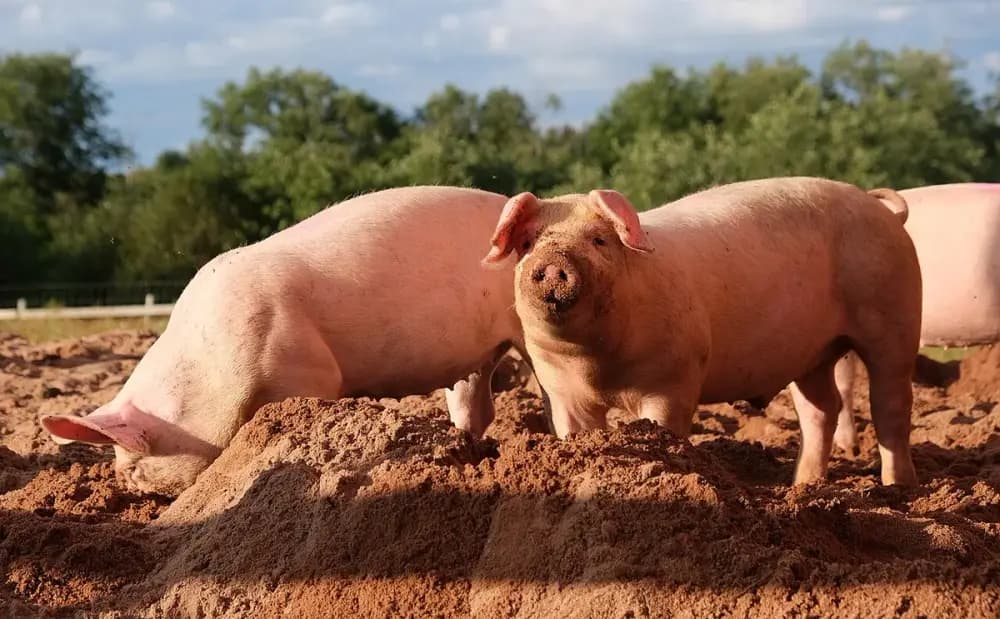
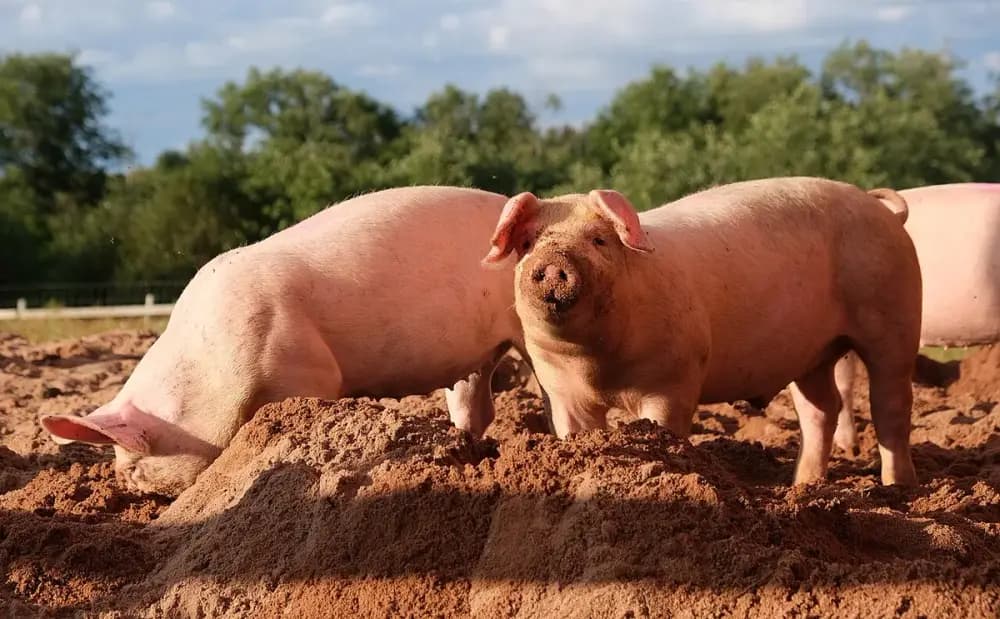
The pig, also called swine or hog, is an omnivorous, domesticated, even-toed, hoofed mammal, regarded by some authorities as a subspecies of the wild boar. Pigs were domesticated independently twice during the Neolithic, in the Near East and in China. They have a large head with a long snout strengthened by a prenasal bone and a disc of cartilage, used to dig for food. Adults generally weigh 140 to 300 kg. Pigs eat leaves, stems, roots, fruits and flowers, and where they roam freely they walk roughly 4 km a day. They seek out other pigs but do not naturally form large herds, living in groups of about 8 to 10 adult sows with young and some single males.
About the pig
The pig, also called swine or hog, is a domesticated, hoofed, even-toed mammal raised mainly for meat. It descends from the wild boar of Eurasia and North Africa and is often classed as a subspecies of it. With about a billion alive, it is one of the most numerous large mammals on the planet.
The formal name Sus scrofa domesticus follows from treating the pig as a subspecies of the wild boar, Sus scrofa. In 1777 Johann Christian Polycarp Erxleben named it a species of its own, Sus domesticus, and the American Society of Mammalogists follows that view.
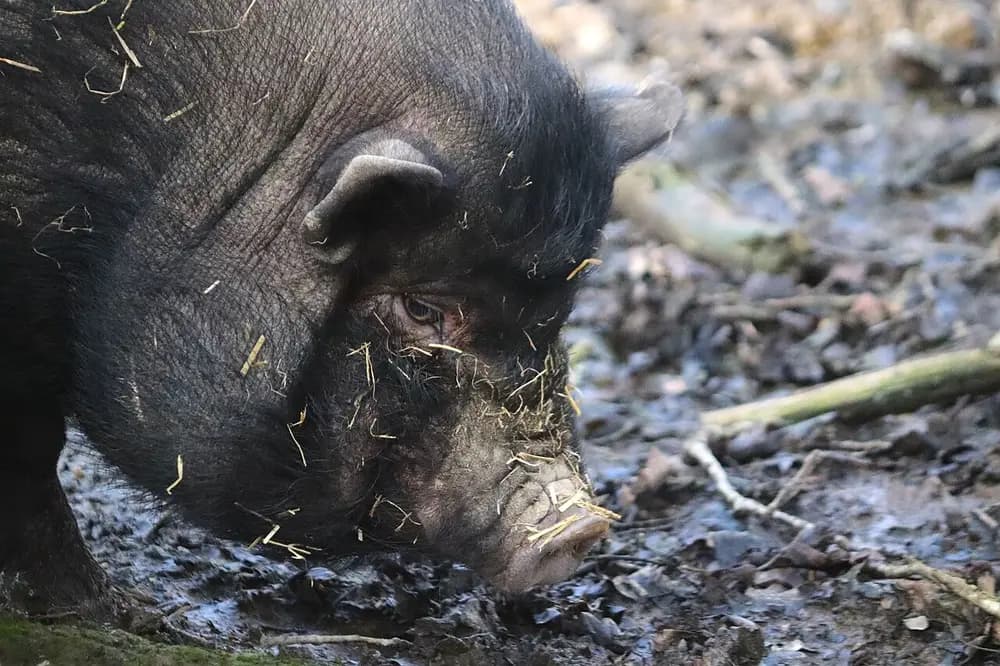
A pig has a large head and a long snout, strengthened by a special prenasal bone and tipped with a disk of cartilage. The snout is both a digging tool and a sensitive sense organ. In males, the canine teeth can grow into tusks that keep growing and are sharpened by grinding against each other. Each foot has four hoofed toes, with the two central ones bearing most of the weight.
Most pigs have sparse, bristly hair, though a few breeds, such as the Mangalitsa, have woolly coats. Adults usually weigh 140–300 kg (310–660 lb). Farmers have created around 600 breeds, mostly in Europe and Asia, that differ in color, shape and size, from the tiny Göttingen minipig to heavy commercial breeds.
Behavior and diet
Diet
Omnivorous; mainly leaves, stems, roots, fruits and flowers
Pigs are omnivores, though they mainly eat leaves, stems, roots, fruits and flowers. They root with their snouts to dig food from the ground, a behavior that starts when newborn piglets nudge for milk. Given the chance, pigs feed for many hours and then sleep for many hours. Free-roaming pigs walk about 4 km (2.5 mi) a day within a home range of around 1 hectare (2.5 acres).
Pigs have few working sweat glands and cannot cool off well by panting, so they keep cool by wallowing. They start coating themselves in mud from head to tail once the air reaches about 17–21 °C (63–70 °F). Mud may also act as sunscreen and keep parasites off. Most bristled pigs shed much of their coarse coat once a year in spring or early summer.
Pigs are social. They seek out other pigs and often huddle together, living in groups of about 8–10 adult sows with young animals and some single males, but they do not naturally form big herds. Pigs kept in crowded, barren conditions may bite each other's tails, and toys and other enrichment can reduce the problem.
They are clever animals, roughly on par with dogs. Pigs recognize one another as individuals, play, have good long-term memory and respond to the emotions of other pigs. In experiments they have solved mazes, worked with a simple symbol language, recognized themselves in a mirror and used a joystick with their snouts to pick targets on a screen.
Smell is a pig's strongest sense. Pigs have 1,113 genes for smell receptors, slightly more than dogs, and trained pigs are used in Europe to find truffles underground. They identify each other by scent rather than sight. Their eyes give panoramic vision of about 310°, and they probably see at least some color.
Sows reach maturity at 3–12 months, and pregnancy lasts about 112–120 days. Shortly before giving birth, a sow leaves the group, roots out a hollow and builds a nest mound of twigs and leaves, sometimes topping it with branches up to 2 m (6.5 ft) long. Unlike most hoofed mammals, she gives birth lying down. Sows typically have 12–14 teats, and piglets, born with sharp teeth, fight for the front ones, which give the most milk, then keep the same teat.
Range and habitat
Habitat
Farms worldwide; feral populations in many regions
Pigs were domesticated from wild boar in the Near East, around the Tigris Basin, and separately in China starting some 8,000 years ago. Pigs were on Cyprus more than 11,400 years ago, which suggests domestication on the nearby mainland by then. Domestic pigs reached Europe at least 8,500 years ago and interbred so heavily with European wild boar that their genomes kept less than 5% Near Eastern ancestry.
Austronesian seafarers carried pigs, along with chickens and dogs, across Island Southeast Asia and Oceania about 4,000 years ago. Spanish explorers including de Soto brought pigs to southeastern North America, and escaped animals went feral.
Today around 1.5 billion pigs are raised each year. China is the largest pork producer, followed by the European Union and the United States. In industrialized countries most pigs are raised in large intensive farms, while many farmers in Africa use low-input, free-range systems.
Feral pigs now live in many parts of the world. In the southeastern United States they have spread north into the Midwest, where many states run removal programs. Feral hybrids of wild boar and domestic pigs damage crops, spread diseases such as foot-and-mouth disease, and eat wildlife including young seabirds and tortoises.
Pig vs wild boar
The domestic pig and the wild boar are close enough that many scientists treat them as one species, and the two still interbreed. Domestic pigs remain far heavier on average than European wild boar.
| Feature | Domestic pig | Wild boar |
|---|---|---|
| Scientific name | Sus scrofa domesticus or Sus domesticus | Sus scrofa |
| Weight | Usually 140–300 kg (310–660 lb) | Males in most of Europe average 75–100 kg (165–220 lb) |
| Coat | Usually sparse bristles; some woolly breeds | Long, coarse bristles over a short downy underfur in winter |
| Range | Farms worldwide | Eurasia and North Africa; introduced to the Americas and Oceania |
| IUCN status | Not evaluated (domestic) | Least Concern |
Conservation status
The domestic pig is a farm animal and is not assessed on the IUCN Red List. Its wild ancestor, the wild boar, is listed as Least Concern in a 2019 assessment, thanks to its wide range, large numbers and adaptability.
Some breeds are in trouble, though. According to The Livestock Conservancy, as of 2016 three pig breeds were critically rare, with fewer than 2,000 animals worldwide: the Choctaw hog, the Mulefoot and the Ossabaw Island hog.
Pigs face many diseases and parasites, including roundworms, African swine fever and parvovirus. Their lungs are small for their body size, making them more prone than other farm animals to fatal bronchitis and pneumonia. Heat stress is a growing problem on farms, and intensive farming has raised animal welfare concerns.
Where to see pig in the U.S.
10 zoos across 6 states
Find the closest one
Rank the 7 zoos holding pig by how far they are from you. Your location is used in your browser to sort this list and is never sent to us.
3 more zoos hold pig but have no coordinates on file yet, so they aren't ranked here. They're in the full list below.
California· 1
Florida· 3
Illinois· 2
Minnesota· 1
Virginia· 2
Wisconsin· 1
AZAThe Association of Zoos and Aquariums. Accredited members have passed an independent inspection of animal care and welfare, safety, conservation and education, repeated every five years. Many smaller facilities never apply, so “not accredited” isn't a verdict on its own. What accreditation means · How we check this
Built from each zoo's own published animal list.
Pig: common questions
Are pigs smart?
Yes. Pigs are roughly as intelligent as dogs. They can solve mazes, learn simple symbols, recognize themselves in a mirror and remember things for a long time.
How big do pigs get?
Most adult pigs weigh 140–300 kg (310–660 lb), though some breeds are larger. The Göttingen minipig, the smallest known breed, weighs about 26 kg (57 lb).
How long do pigs live?
Pigs have a maximum lifespan of about 27 years.
What do pigs eat?
Pigs are omnivores. They mainly eat leaves, stems, roots, fruits and flowers, and root in the ground for food.
Why do pigs roll in mud?
To cool off. Pigs have few working sweat glands, so they wallow in mud or water, which may also protect them from sunburn and parasites.
Is a pig the same as a wild boar?
Not quite. The domestic pig descends from the wild boar and is often classed as a subspecies of it, but some scientists treat it as a separate species.
Can you keep a pig as a pet?
Some people do, but pigs have not been bred as companions for long. They can be independent and assertive, and pigs that are not spayed or neutered may become aggressive and develop serious health problems.