Guinea Hog
Sus scrofa domesticus
Also known as American Guinea Hog, American Guinea Hog Threatened
- Where to see one
- 12 U.S. zoos in our directory hold guinea hog, confirmed against each zoo's own animal list.
- Native range
- Southeastern United States
- Size
- 38–51 cm (15–20 in) tall; body weight about 70–135 kg (154–298 lb)
Conservation status
Not Evaluated
This species has not been assessed for the IUCN Red List, so it sits outside the threat scale entirely.
Not Evaluated (NE) by the IUCN as a domestic breed; an endangered breed, estimated at no more than 400 head as of 2009
About the Guinea Hog
The Guinea Hog is a small, black domestic pig breed that originated in the southeastern United States. It has gone by several older names, including Acorn Eater, Guinea Forest Hog, Pineywoods Guinea, and Yard Pig, before being officially renamed the American Guinea Hog in 2006. Its exact origin is unknown, though a link to the Essex pig of eastern England has been suggested. It is a distinct breed from an older, larger red pig once also called the Guinea Hog or Red Guinea, which was raised in the northeastern United States and disappeared by the late 19th century, apparently merging into the population that would later form the modern Duroc breed.
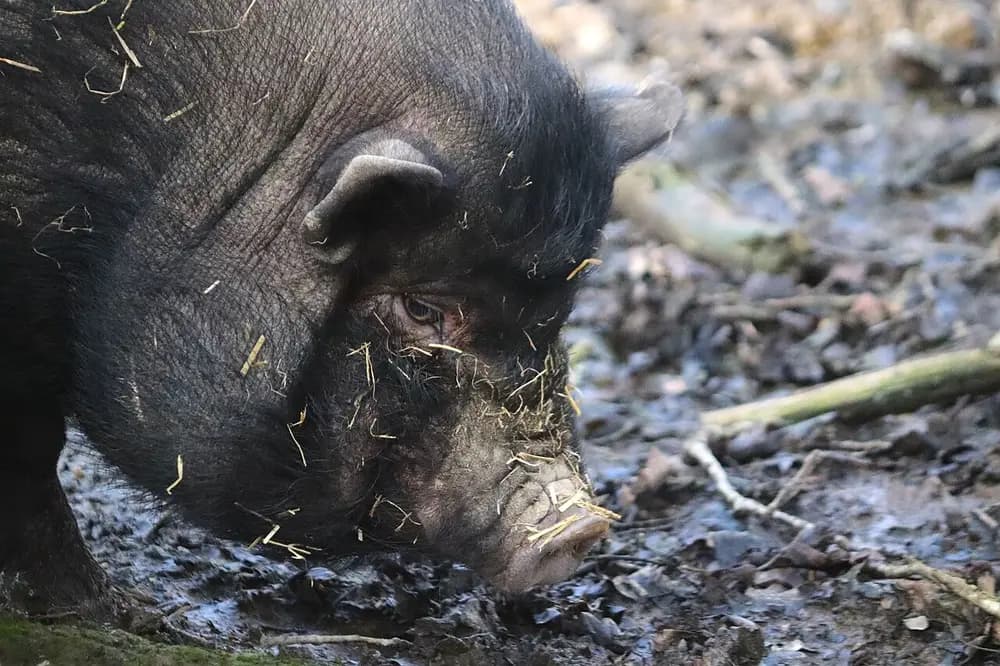
The breed has a sturdy body, a curly tail, and upright ears, and its coat is usually black, sometimes with white markings on the snout tip and lower legs. Red and blue coloring have also been documented historically and still occasionally appear, though blue coloring can also result from vitiligo. There are two recognized sub-types within the breed, one small-boned and one large-boned with longer legs, and the length of the snout and overall bone structure can vary considerably between individual animals.
This traditional rural breed was first documented in 1811 and was raised widely across the rural Southeast, well suited to small farms, through the first half of the 20th century. Numbers then fell sharply in the second half of the century. A breed association, the Guinea Hog Association, formed in 1991 and became the American Guinea Hog Association in 2005. The breed is included in the Ark of Taste, a project of the international Slow Food Foundation that catalogs foods and breeds at risk of disappearing.
Behavior and diet
The breed has an unusual place in research history: feral Guinea Hogs from Alabama were brought to the Hormel Institute at the University of Minnesota in St. Paul starting in 1949, where they were used alongside feral pigs from other regions in developing the now-extinct Minnesota Miniature, also known as the Hormel breed of miniature pig.
Range and habitat
Habitat
Domestic — kept on smallholdings and family farms
The Guinea Hog is native to the southeastern United States, where it has been raised since at least the early 19th century on smallholdings and family farms suited to extensive, low-input management. It is not connected to a similarly named African suid, Potamochoerus porcus, that was reported present in Brazil in the 17th century, nor to the unrelated Red Guinea pig breed once found in the northeastern United States.
Conservation status
As a domestic pig breed, the Guinea Hog is Not Evaluated (NE) on the IUCN Red List, which assesses wild species rather than livestock breeds. As a breed, though, it is rare and is described as endangered.
Its numbers fell sharply during the second half of the 20th century, and by 2009 the entire breed was estimated at no more than 400 animals. Breeders formed the Guinea Hog Association in 1991, which became the American Guinea Hog Association in 2005, and the breed is included in the Slow Food Foundation's Ark of Taste.
Where to see guinea hog in the U.S.
12 zoos across 10 states
Find the closest one
Rank the 12 zoos holding guinea hog by how far they are from you. Your location is used in your browser to sort this list and is never sent to us.
California· 1
Colorado· 1
Connecticut· 1
Illinois· 1
Kansas· 1
Massachusetts· 3
Oklahoma· 1
Tennessee· 1
Virginia· 1
Wisconsin· 1
AZAThe Association of Zoos and Aquariums. Accredited members have passed an independent inspection of animal care and welfare, safety, conservation and education, repeated every five years. Many smaller facilities never apply, so “not accredited” isn't a verdict on its own. What accreditation means · How we check this
Built from each zoo's own published animal list.
Guinea Hog: common questions
Is the Guinea Hog endangered?
As a breed, yes. It is described as an endangered breed, with no more than about 400 animals estimated in 2009. Domestic breeds are not assessed on the IUCN Red List.
How big does a Guinea Hog get?
Adults stand about 15 to 20 inches tall and weigh roughly 154 to 298 pounds.
Where does the Guinea Hog come from?
It originated in the southeastern United States, first documented in 1811, and was officially named the American Guinea Hog in 2006.
What color is a Guinea Hog?
Most are black, sometimes with white markings on the snout tip and lower legs, though red and blue coloring have also been recorded historically.
Which U.S. zoos have Guinea Hogs?
Six U.S. zoos list them, including Connecticut's Beardsley Zoo and Zoo Knoxville in Tennessee.