- Where to see one
- 9 U.S. zoos in our directory hold masked lapwing, confirmed against each zoo's own animal list.
- Native range
- Northern and eastern Australia, New Guinea, and New Zealand
- Size
- 30–37 cm (12–15 in) long, with a wingspan of 75–85 cm (30–33 in); weighs 191–412 g (6.7–14.5 oz) depending on subspecies
- Lifespan
- About 16 years
About the masked lapwing
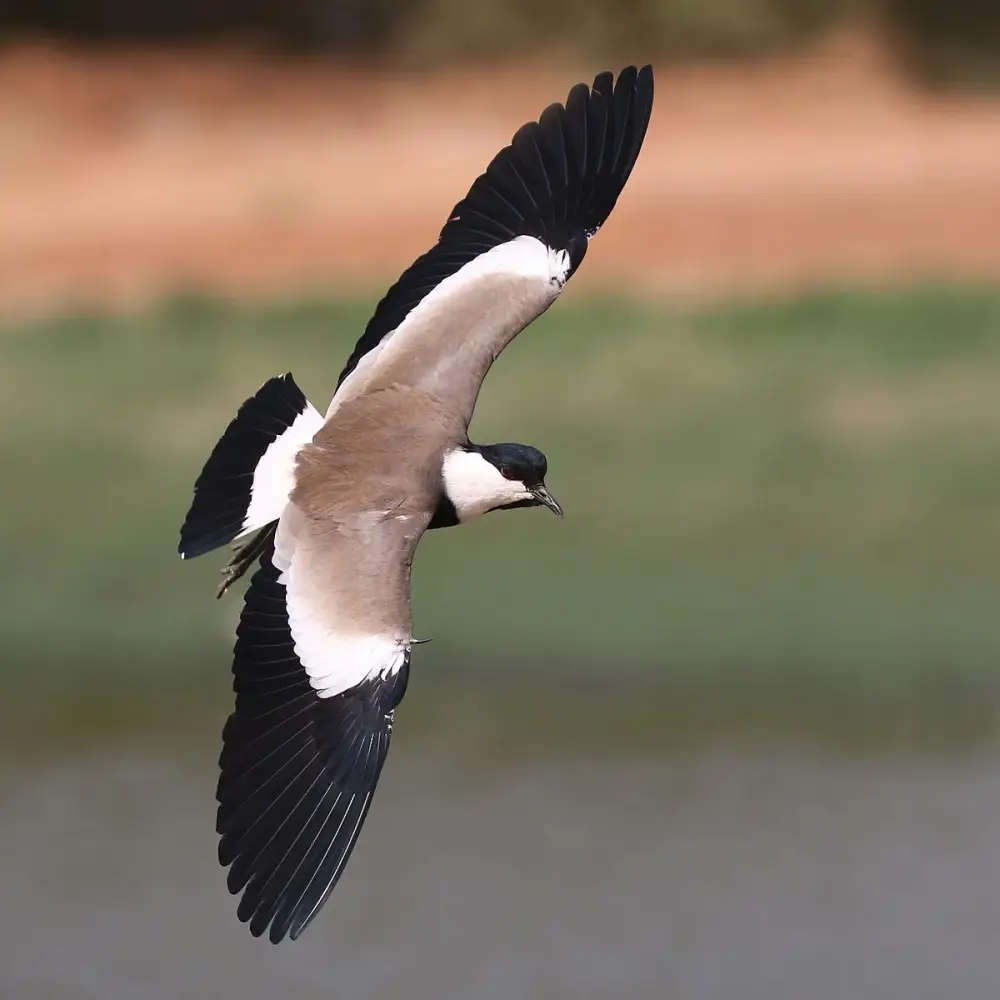
The masked lapwing is a large, common, and conspicuous bird native to Australia — especially its northern and eastern regions — as well as New Guinea and New Zealand. Despite also being known as the masked plover, or often simply called "plover" or "spur-winged plover" within its range, it belongs to its own subfamily, Vanellinae, distinct from the true plovers of subfamily Charadriinae. It is the largest member of the plover family, Charadriidae, measuring 30 to 37 cm (12 to 15 in) in length with a wingspan of 75 to 85 cm (30 to 33 in), and every masked lapwing carries a conspicuous yellow spur on the carpal joint — essentially the wrist — of each wing.
Two subspecies are recognized, and they look distinctly different from one another. The nominate subspecies, Vanellus miles miles, found along coastal New Guinea, the Aru Islands, and northern Australia, has an all-white neck and large yellow facial wattles, with males showing a more pronounced dark mask and bigger wattles than females. The southern subspecies, V. m. novaehollandiae, found across southern and eastern Australia and in New Zealand, has a black stripe down the neck and smaller wattles; it is often called the spur-winged plover locally, though that name refers to an unrelated bird in the Northern Hemisphere. The nominate subspecies weighs 191 to 300 g (6.7 to 10.6 oz), while the larger southern subspecies weighs 296 to 412 g (10.4 to 14.5 oz). Some authorities treat the southern form as a full species in its own right, the black-shouldered lapwing, even though the two subspecies interbreed where their ranges meet in northern Queensland and the Lake Eyre basin.
The masked lapwing was first described in 1781 by the French naturalist Buffon, though it was Dutch naturalist Pieter Boddaert who assigned it a scientific name — Tringa miles — in 1783, based on Buffon's account. The species has since been reclassified into the genus Vanellus, Latin for "lapwing," while its species name, miles, is Latin for "soldier."
Behavior and diet
Diet
Insects and worms, found by foraging on the ground
Masked lapwings spend much of their time on the ground, searching for worms and insects, and the birds are almost constantly alert — even while resting, the species is described as never sleeping properly. They produce a wide range of calls audible at any hour, including distinct warning calls, defensive calls, courtship calls, and calls directed at their young.
The species is shy and largely harmless outside the breeding season, but it is famous for the opposite behavior once nesting begins. Masked lapwings will build a nest on almost any open ground — suburban parks, school ovals, supermarket parking lots, and even flat rooftops — and defend it aggressively. A nesting pair calls loudly, spreads its wings, and swoops fast and low at intruders, striking with its feet and the yellow spur on its wing if necessary. This defensiveness has caused real problems at airports, where lapwings' reluctance to abandon a nesting site, even for approaching aircraft, has led to several bird strikes. Despite a persistent myth that the wing spur delivers venom, it does not — the misconception likely grew out of fear of the bird's territorial swooping. Attacks are most vicious against other birds, such as ravens, and against cats and dogs; strikes on humans are rarer since people tend to notice and react to the warning displays.
Breeding usually begins after the winter solstice on June 21, though it can start earlier. Chicks reach full growth after four to five months and often remain with their parents for one to two years, forming family groups of three to five birds that stay together through the summer. Some lapwings living in busy residential suburbs never successfully breed at all, disturbed too often by pets, foot traffic, and cars. The species' lifespan is approximately 16 years.
Range and habitat
Habitat
Wetland edges, open moist ground, beaches, and coastlines
Masked lapwings are most commonly found around the edges of wetlands and in other moist, open environments, though they are adaptable enough to turn up in surprisingly arid country as well as on beaches and coastlines. The southern subspecies, V. m. novaehollandiae, spread on its own to Southland, New Zealand, in the 1930s and has since expanded across the whole country, where it is now recognized as a self-introduced native species known locally as the spur-winged plover.
Conservation status
The masked lapwing is classified as Least Concern, reflecting its status as a common and widespread species across its Australian, New Guinean, and New Zealand range. No specific threats or conservation programs are described for the species here, consistent with its stable, unthreatened status.
Where to see masked lapwing in the U.S.
9 zoos across 7 states
Find the closest one
Rank the 8 zoos holding masked lapwing by how far they are from you. Your location is used in your browser to sort this list and is never sent to us.
1 more zoo holds masked lapwing but has no coordinates on file yet, so it isn't ranked here. It's in the full list below.
California· 2
Connecticut· 1
Florida· 2
Illinois· 1
Kansas· 1
Maryland· 1
Ohio· 1
AZAThe Association of Zoos and Aquariums. Accredited members have passed an independent inspection of animal care and welfare, safety, conservation and education, repeated every five years. Many smaller facilities never apply, so “not accredited” isn't a verdict on its own. What accreditation means · How we check this
Built from each zoo's own published animal list.
Masked Lapwing: common questions
Is the masked lapwing endangered?
No. It is classified as Least Concern, reflecting a common and widespread population.
How big does a masked lapwing get?
It measures 30 to 37 cm (12 to 15 in) long with a wingspan of 75 to 85 cm (30 to 33 in), and weighs between 191 and 412 g (6.7 to 14.5 oz) depending on subspecies.
What does a masked lapwing eat?
Mainly insects and worms, which it finds by foraging on the ground.
How long do masked lapwings live?
About 16 years.
Where do masked lapwings live in the wild?
Across northern and eastern Australia, New Guinea, and New Zealand, favoring wetland edges and other open, moist ground, though it also adapts to arid areas and coastlines.
Which U.S. zoos have masked lapwings?
Six zoos in our directory list the masked lapwing, including the Los Angeles Zoo, Brevard Zoo, and the Cincinnati Zoo and Botanical Garden.