- Where to see one
- 11 U.S. zoos in our directory hold spur-winged lapwing, confirmed against each zoo's own animal list.
- Native range
- Eastern Mediterranean, sub-Saharan west Africa, and Arabia
- Size
- Not stated here
- Lifespan
- Not stated here
About the spur-winged lapwing
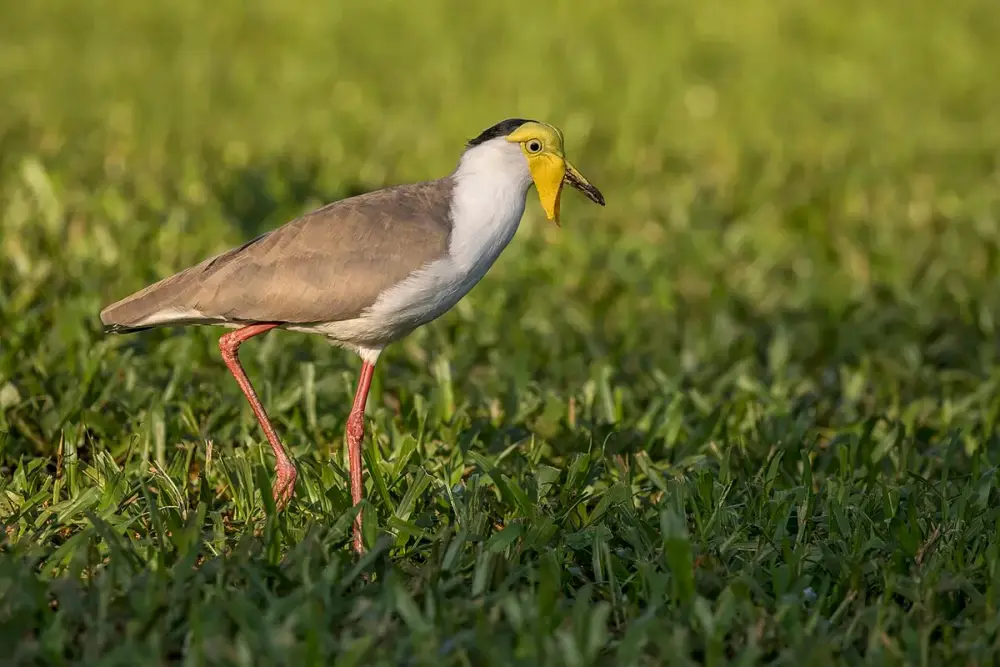
The spur-winged lapwing, also called the spur-winged plover, is a member of the plover family Charadriidae — a group of largish wading birds. It was formally described in 1758 by Carl Linnaeus, who originally placed it with the true plovers in the genus Charadrius, basing his account on an earlier description by the naturalist Fredrik Hasselquist and naming Egypt as the type locality. The species was later moved into the genus Vanellus, which now holds 23 lapwing species; the spur-winged lapwing itself is monotypic, meaning no subspecies are recognized.
It's a medium-large wader with a black crown, chest, foreneck stripe, and tail, set against a white face, neck, and belly. The wings and back are light brown, and the bill and legs are black. Its common name comes from a small claw, or spur, hidden in each wing — a feature it will put to use when defending its nest. The bird also has a loud, distinctive call often rendered as "did-he-do-it."
Behavior and diet
Diet
Insects and other invertebrates
The spur-winged lapwing feeds on insects and other invertebrates, which it picks directly off the ground, typically in and around marshes and other freshwater wetland habitat. It nests on a simple ground scrape, laying four blotchy yellowish eggs. When animals, or rarely people, come too close to its exposed young, the lapwing will sometimes attack using the wing-spurs that give it its name.
The species has also picked up an odd bit of cultural history. Some naturalists identified it as the "trochilus" bird described by the Greek historian Herodotus as involved in what would now be called a cleaning symbiosis with the Nile crocodile. There's no reliable evidence that this or any other bird actually does this, though field observations do confirm that spur-winged lapwings are the birds most often seen feeding around basking crocodiles, which tolerate their presence.
Range and habitat
Habitat
Marshes and similar freshwater wetlands
The spur-winged lapwing breeds around the eastern Mediterranean and across a wide band running from sub-Saharan west Africa to Arabia. Populations in Greece and Turkey migrate, while the rest of the species' range is held by resident, non-migratory birds. It is declining in its northern range but remains abundant through much of tropical Africa, where it can be found at nearly any wetland. In eastern and southern Africa its range has actually expanded in recent decades — it was first recorded in Zambia in 1999 and has continued spreading south and west since.
Conservation status
The spur-winged lapwing is listed as Least Concern. It is one of the species covered by the Agreement on the Conservation of African-Eurasian Migratory Waterbirds. Within that broad picture of stability, there's a split: the bird is declining at the northern edge of its range while remaining abundant, and even expanding into new territory, through tropical Africa.
Where to see spur-winged lapwing in the U.S.
11 zoos across 9 states
Find the closest one
Rank the 10 zoos holding spur-winged lapwing by how far they are from you. Your location is used in your browser to sort this list and is never sent to us.
1 more zoo holds spur-winged lapwing but has no coordinates on file yet, so it isn't ranked here. It's in the full list below.
California· 2
Connecticut· 1
Florida· 1
Idaho· 2
Maryland· 1
Michigan· 1
Missouri· 1
Oklahoma· 1
Oregon· 1
AZAThe Association of Zoos and Aquariums. Accredited members have passed an independent inspection of animal care and welfare, safety, conservation and education, repeated every five years. Many smaller facilities never apply, so “not accredited” isn't a verdict on its own. What accreditation means · How we check this
Built from each zoo's own published animal list.
Spur-winged Lapwing: common questions
Is the spur-winged lapwing endangered?
No. It's listed as Least Concern, and while it's declining at the northern edge of its range, it remains abundant across tropical Africa and is even expanding into new areas.
What does a spur-winged lapwing eat?
Insects and other invertebrates, which it picks off the ground, usually near marshes and other wetlands.
Where do spur-winged lapwings live in the wild?
Around the eastern Mediterranean and across a band from sub-Saharan west Africa to Arabia, with the range recently expanding into southern Africa.
Why is it called the spur-winged lapwing?
For a small claw, or spur, hidden in each wing, which the bird can use to defend its nest and chicks.
Which U.S. zoos have spur-winged lapwings?
Six zoos in our directory currently list one, including the Los Angeles Zoo, the Saint Louis Zoo, and the Oregon Zoo.