- Where to see one
- 11 U.S. zoos in our directory hold golden-breasted starling, confirmed against each zoo's own animal list.
- Native range
- Northeastern Africa — Somalia, Ethiopia, Kenya, and northern Tanzania
- Size
- About 35 cm (14 in) in body length
About the golden-breasted starling
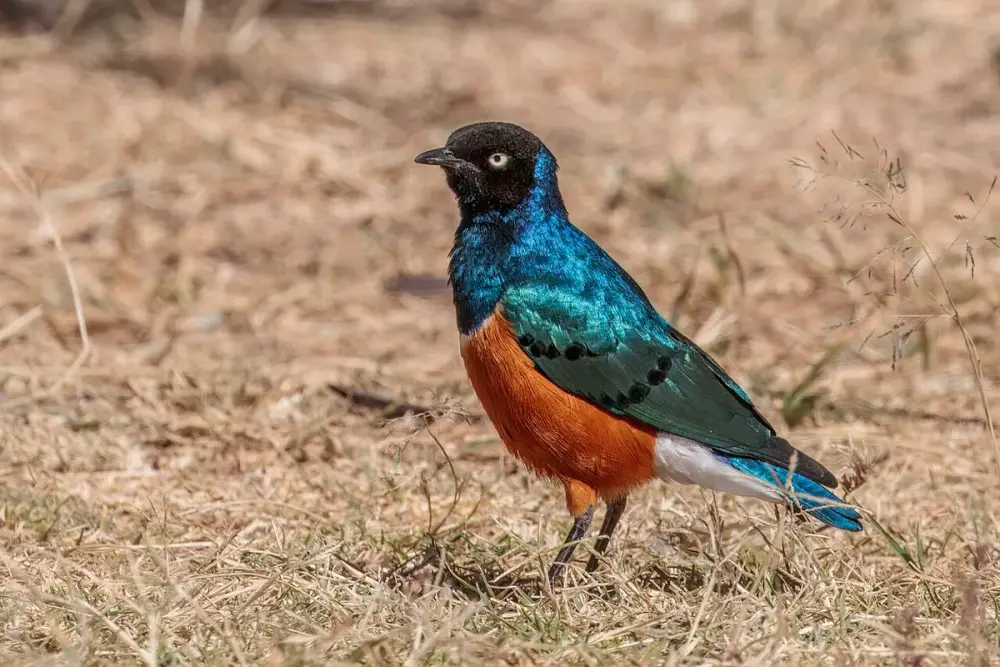
The golden-breasted starling, also known as the royal starling, is a medium-sized passerine bird in the starling family. It reaches a body length of about 35 cm (14 in) and is one of the more strikingly colored members of a family already known for iridescent plumage. Adults have a metallic green head and upper back, a bright golden-yellow breast and belly, a dark bill and legs, a white iris, and metallic violet-blue coloring across the wings, back, neck, and long tail feathers. Males and females look alike, while young birds are duller than adults. Two subspecies are recognized, Lamprotornis regius regius and Lamprotornis regius magnificus.
The species is native to a broad swath of northeastern Africa, ranging through Somalia, Ethiopia, Kenya, and northern Tanzania. Within that range it favors open, dry country: grassland and savannah, thickets of acacia, dry-thorn forest, and shrubland rather than dense or wet forest. Its wide distribution across this region has kept the population trend stable, and the golden-breasted starling is evaluated as being of Least Concern on the IUCN Red List of Threatened Species.
Behavior and diet
Diet
Mainly insects and termites, with occasional snails, spiders, crustaceans, and small vertebrates
Golden-breasted starlings are social birds, typically living in groups of three to twelve individuals. They are monogamous breeders, and entire family groups cooperate in raising young, sharing the work of gathering both food and nesting materials. Adults have been recorded from January to June and from August to November, with numbers peaking in January. The birds molt once a year, after the breeding season ends.
Nesting takes place in tree holes, most often ones that woodpeckers have already excavated and abandoned, with the nest itself built from leaves, roots, and other plant material. The female usually lays between three and five pale green eggs marked with red speckles. Unlike many of the more brilliantly colored starlings, which lean heavily on fruit, the golden-breasted starling's diet consists mainly of insects and termites: adults catch insects in flight and dig into termite mounds to find prey. Snails, spiders, crustaceans, and small vertebrates such as lizards round out the diet on occasion.
Range and habitat
Habitat
Grassland, savannah, acacia thickets, dry-thorn forest, and shrubland
The golden-breasted starling has a very large range across northeastern Africa, spanning Somalia, Ethiopia, Kenya, and northern Tanzania. Throughout this range it occupies dry, open habitats rather than forest interiors — grassland and savannah, acacia thickets, dry-thorn forest, and shrubland. No major range contraction or expansion is described for the species; it remains widespread across its historical habitat.
Conservation status
The golden-breasted starling is classified as Least Concern (LC) by the IUCN Red List of Threatened Species. Its population trend is described as stable across a range that remains large and largely intact. No specific threats or protection programs are named for the species beyond its current, stable standing in the wild.
Where to see golden-breasted starling in the U.S.
11 zoos across 10 states
Find the closest one
Rank the 11 zoos holding golden-breasted starling by how far they are from you. Your location is used in your browser to sort this list and is never sent to us.
Florida· 1
Illinois· 1
Kansas· 1
Kentucky· 1
Massachusetts· 2
Missouri· 1
New York· 1
Ohio· 1
Oklahoma· 1
Oregon· 1
AZAThe Association of Zoos and Aquariums. Accredited members have passed an independent inspection of animal care and welfare, safety, conservation and education, repeated every five years. Many smaller facilities never apply, so “not accredited” isn't a verdict on its own. What accreditation means · How we check this
Built from each zoo's own published animal list.
Golden-breasted Starling: common questions
Is the golden-breasted starling endangered?
No. It is classified as Least Concern, and its population trend is described as stable.
How big does a golden-breasted starling get?
It reaches a body length of about 35 cm (14 in).
What does a golden-breasted starling eat?
Mainly insects and termites, caught in flight or dug from termite mounds, with occasional snails, spiders, crustaceans, and small lizards.
Where do golden-breasted starlings live in the wild?
They are native to northeastern Africa, including Somalia, Ethiopia, Kenya, and northern Tanzania, where they favor grassland, savannah, acacia thickets, and dry-thorn forest.
Which U.S. zoos have golden-breasted starlings?
Our directory lists 8 zoos with golden-breasted starlings, including the Lincoln Park Zoo in Chicago, the Saint Louis Zoo, and the Oregon Zoo.