- Where to see one
- 27 U.S. zoos in our directory hold dromedary camel, confirmed against each zoo's own animal list.
- Native range
- Historically the Arabian Peninsula and Sahara; no longer occurs in the wild
- Size
- Males 1.8–2.4 m (5.9–7.9 ft) at the shoulder and 400–690 kg (880–1,520 lb); females 1.7–1.9 m (5.6–6.2 ft) and 300–540 kg (660–1,190 lb)
Conservation status
Not Evaluated
This species has not been assessed for the IUCN Red List, so it sits outside the threat scale entirely.
Not Evaluated (NE); domestic animals are not assessed on the IUCN Red List
About the dromedary camel
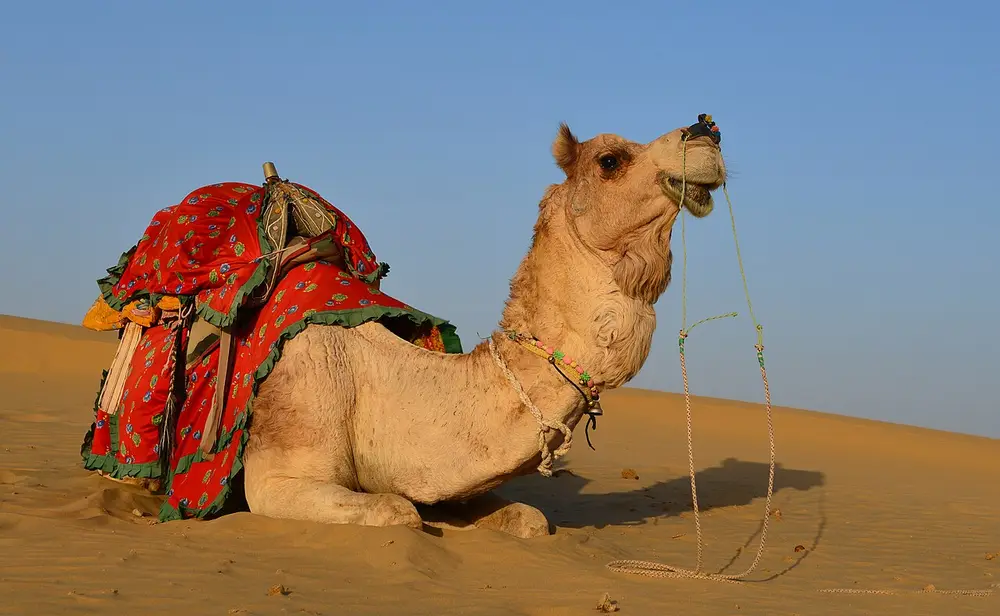
The dromedary, also called the Arabian camel or one-humped camel, is the tallest of the three living camel species. Adult males stand 1.8 to 2.4 m (5.9 to 7.9 ft) at the shoulder and typically weigh between 400 and 690 kg (880 and 1,520 lb); females are somewhat smaller, standing 1.7 to 1.9 m (5.6 to 6.2 ft) and weighing 300 to 540 kg (660 to 1,190 lb). Its most recognizable features are a long, curved neck, a narrow chest, a single hump made of fat bound together by fibrous tissue and standing at least 20 cm (7.9 in) tall, and long hair concentrated on the throat, shoulders, and hump. The coat is generally some shade of brown, though it can range from black to nearly white, and piebald individuals have been reported in Sudan.
The dromedary shares its genus, Camelus, with the two-humped Bactrian camel and the wild Bactrian camel, and it belongs to the family Camelidae. It was given its current scientific name, Camelus dromedarius, by Carl Linnaeus in 1758. The dromedary and Bactrian camel can and do interbreed to produce fertile hybrids, which tend to be larger and stronger than either parent, though hybrids from other crosses are often bad-tempered or undersized. Genetically, the two species show about 10.3 percent divergence in one commonly studied gene.
Distinctive anatomical details include thick, double-layered eyelashes and bushy eyebrows, sharp vision, and a keen sense of smell. Males have a soft palate nearly 18 cm (7.1 in) long that inflates into a pink sac used to attract females during the mating season, and is often mistaken by onlookers for the animal's tongue. The dromedary has long, powerful legs ending in two-toed, flat, leathery-padded feet, and — like a giraffe — it moves both legs on one side of its body together when it walks. Compared with the Bactrian camel, the dromedary has a lighter build, longer limbs, and shorter hair.
The dromedary has 74 diploid chromosomes, the same count found across camelids, and its karyotype closely resembles that of the Bactrian camel. Fossil evidence traces the camel lineage back to Protylopus, the oldest and smallest known camel, which lived in North America during the upper Eocene. Camels later migrated across the Bering Strait and spread through Asia, eastern Europe, and Africa; by the Pleistocene, ancestors of the modern dromedary were established in the Middle East and northern Africa. The dromedary itself likely evolved in the hot, arid regions of western Asia from the Bactrian camel, though the older theory that a two-humped fetal stage supported this idea has since been shown to be false.
Behavior and diet
Diet
Foliage and desert vegetation
Dromedaries feed on foliage and desert vegetation, a diet paired with a suite of adaptations for extreme water scarcity: the animal can tolerate losing more than 30 percent of its total water content, an extraordinary margin compared with most mammals. Its blood cells are oval rather than round — the only mammal known to have this trait — which helps blood keep flowing even during severe dehydration, and a dehydrated camel also lowers its breathing rate to conserve moisture. The kidneys can produce urine with a high chloride concentration, another way the body limits water loss.
Dromedaries are mainly active during daylight hours and live in herds of around 20 animals, led by a dominant male. Mating happens annually and peaks during the rainy season; after a lengthy gestation of about 15 months, females give birth to a single calf. The species has not existed in the wild for nearly 2,000 years — every dromedary alive today is a domesticated or feral descendant of animals that were probably first tamed on the Arabian Peninsula around 4,000 years ago. Camels have long supported human communities directly: their meat and milk sustain several North African tribes, and they are widely used for riding and as pack animals.
Range and habitat
Habitat
Semiarid to arid desert regions
Wild dromedaries inhabited arid regions, including the Sahara, but the species has not occurred naturally in the wild for close to two millennia. Today, domesticated dromedaries are kept across the semiarid to arid regions of the Old World, primarily in Africa, on the Arabian Peninsula, and in the Thar Desert spanning Pakistan and India. A feral population also lives in Australia. The dromedary was likely first domesticated on the Arabian Peninsula roughly 4,000 years ago, and a jawbone dated to around 8,200 BC found on Saudi Arabia's Red Sea coast points to ancestors of the modern dromedary occupying the Middle East and northern Africa well before that.
Conservation status
Domestic animals are not assessed on the IUCN Red List, so the dromedary has no Red List category. The species no longer exists in the wild, so its population is entirely bound up with human management as a domesticated or feral animal.
The main concerns for the dromedary are health ones. It has been identified as a likely host of Middle East respiratory syndrome coronavirus (MERS-CoV), with high antibody prevalence found in Saudi Arabian herds. The species is generally hardier than other livestock such as goats and cattle, though it remains susceptible to trypanosomiasis, a usually fatal parasite-borne disease, and to brucellosis, which appears more often in dense populations than in free-ranging nomadic herds.
Other documented ailments include sarcoptic mange, caused by Sarcoptes mites (a 2000 study in Jordan found 83 percent of the camels examined tested positive), along with internal parasites such as the trematode Fasciola gigantica, tapeworms, and roundworms. Nervous individuals may vomit when handled roughly, which does not necessarily signal illness, and rutting males can experience nausea as part of the breeding season. Camels also carry natural antibodies against rinderpest and ovine rinderpest viruses, evidence of long-standing exposure to those pathogens.
Where to see dromedary camel in the U.S.
27 zoos across 14 states
Find the closest one
Rank the 16 zoos holding dromedary camel by how far they are from you. Your location is used in your browser to sort this list and is never sent to us.
11 more zoos hold dromedary camel but have no coordinates on file yet, so they aren't ranked here. They're in the full list below.
Alabama· 1
California· 2
Delaware· 1
Florida· 4
Illinois· 2
Kansas· 2
Kentucky· 2
Maryland· 1
Michigan· 3
Nebraska· 1
New York· 2
Ohio· 1
Tennessee· 1
Texas· 4
AZAThe Association of Zoos and Aquariums. Accredited members have passed an independent inspection of animal care and welfare, safety, conservation and education, repeated every five years. Many smaller facilities never apply, so “not accredited” isn't a verdict on its own. What accreditation means · How we check this
Built from each zoo's own published animal list.
Dromedary Camel: common questions
Is the dromedary camel endangered?
No. The dromedary no longer exists in the wild and is managed entirely as a domesticated or feral species, and domestic animals are not assessed on the IUCN Red List.
How big does a dromedary camel get?
Males stand 1.8 to 2.4 m (5.9 to 7.9 ft) at the shoulder and weigh 400 to 690 kg (880 to 1,520 lb); females are somewhat smaller.
What does a dromedary camel eat?
Foliage and desert vegetation, supported by adaptations that let it tolerate losing more than 30 percent of its body water.
Where do dromedary camels live?
Domesticated herds are kept across semiarid and arid regions of Africa, the Arabian Peninsula, and the Thar Desert of Pakistan and India, with a feral population in Australia.
Which U.S. zoos have dromedary camels?
Five U.S. zoos list them, including the Alabama Gulf Coast Zoo, Oakland Zoo in California, and Brevard Zoo in Florida.