- Where to see one
- 16 U.S. zoos in our directory hold camel, confirmed against each zoo's own animal list.
- Native range
- Domesticated across North Africa, the Horn of Africa, the Middle East and Central and South Asia; feral in Australia
- Size
- Dromedary 1.85 m (6 ft 1 in) at the shoulder; dromedaries weigh 300–600 kg (660–1,320 lb), Bactrians 300–1,000 kg (660–2,200 lb)
- Lifespan
- About 40–50 years
- Top speed
- Up to 65 km/h (40 mph) in short bursts
- Gestation
- About 15 months (370–440 days) in dromedaries
Conservation status
Not Evaluated
This species has not been assessed for the IUCN Red List, so it sits outside the threat scale entirely.
Not Evaluated (NE) for the two domestic species; the wild Bactrian camel is Endangered
Camels are even-toed ungulates of the genus Camelus, marked by fatty humps on the back. Three species survive: the one-humped dromedary, which makes up 94% of the world's camels, and the two-humped Bactrian, with the wild Bactrian a separate species. Long domesticated, camels supply milk, meat and fiber and serve as working animals in desert country. Their mouths have a thick leathery lining for chewing thorny plants, and long eyelashes and closable nostrils guard against sand. The humps hold fat as a calorie reserve, not water. A dromedary can drink as seldom as once every 10 days in great heat and can lose up to 30% of its body mass to dehydration.
About the camel
A camel is a large, long-legged hoofed mammal in the genus Camelus, known for the fatty humps on its back. Three species survive: the one-humped dromedary, the two-humped Bactrian camel and the wild Bactrian camel. Most camels are domestic livestock in the deserts of Africa and Asia, and they belong to the same family, Camelidae, as llamas and alpacas.
The one-humped dromedary makes up about 94% of the world's camels, and the two-humped Bactrian camel about 6%. The wild Bactrian camel is a separate species, not the ancestor of the domestic Bactrian. In a looser sense, "camel" sometimes covers the whole family Camelidae, including the South American llama, alpaca, guanaco and vicuña.
A full-grown dromedary stands about 1.85 m (6 ft 1 in) at the shoulder and 2.15 m (7 ft 1 in) at the hump, and Bactrians can be about 30 cm (1 ft) taller. The dromedary has a long, curved neck, a deep, narrow chest and a single hump of fat bound by fibrous tissue. The hump shrinks and can lean to one side when the animal is starving. Coat color is usually caramel or sandy brown but runs from almost black to nearly white.
The head and feet are built for sand and heat. Long eyelashes, hairy ears and nostrils that can close keep out blowing sand, and a clear third eyelid can wipe grit from the eye. Thick, leathery lips and mouth linings let camels chew thorny plants, and wide, padded feet keep them from sinking into sand. Dromedaries also have a thick pad on the chest that lifts the body off hot ground when they lie down.
Behavior and diet
Diet
Thorny plants, dry grasses, saltbush and other desert vegetation
The hump does not hold water. It is a store of fat that can be burned for energy when food is short. Water is carried in the bloodstream instead, and a thirsty camel can drink as much as 140 L (30 imperial gallons) at once. A dromedary can drink 100 L (26 US gal) in just 10 minutes, an amount that would kill most mammals.
Camels can go a long time without drinking. A dromedary can drink as rarely as once every 10 days even in very hot conditions and survive losing up to 30% of its body mass to dehydration. Most mammals suffer heart failure at about 12–14% dehydration. Oval red blood cells, unlike the round cells of other mammals, keep blood flowing when a camel is dehydrated and resist bursting when it drinks heavily.
Body temperature is allowed to drift from about 34 °C (93 °F) at dawn to 40 °C (104 °F) by sunset, which saves water that would otherwise go to sweating. Camels rarely sweat, even at 49 °C (120 °F). Their kidneys and intestines reclaim so much water that urine comes out as a thick syrup and dung is dry enough to burn without drying.
Camels are herbivores. Dromedaries eat mainly thorny plants, dry grasses and saltbush but will eat almost anything that grows in the desert, browsing as high as 3.5 m (11.5 ft). They spread out while feeding and take only a few leaves from each plant. They need six to eight times as much salt as other animals, so about a third of their food must be salt-tolerant plants. Camels have a three-chambered stomach and chew cud, though they are not true ruminants.
Dromedaries usually live in groups of 2 to 20, built around one male with several females and their young. Apart from rutting males, they show little aggression, and they tend to travel in single file. During the rut, a male dromedary pushes a pink, inflatable sac called a dulla out of the side of his mouth to show dominance. Camelids are the only hoofed mammals that mate sitting down. A single calf is born after about 15 months and can move freely by the end of its first day.
Range and habitat
Habitat
Deserts and dry grassland with a long dry season
There were about 14 million camels alive in 2010. Domestic dromedaries live mainly in the Horn of Africa, the Sahel, the Maghreb, the Middle East and South Asia, and the Horn of Africa holds the largest concentration of camels in the world. Dromedaries prefer deserts with a long dry season and a short rainy one and do poorly in cold, humid climates.
Bactrian camels, about 1.4 million in 2010 and mostly domesticated, are the two-humped camels of Central Asia. The only truly wild camels left are wild Bactrian camels in the Gobi and Taklamakan deserts of China and Mongolia. Feral camel populations exist in Australia, India and Kazakhstan. More than one million feral dromedaries roam Australia, descended from transport animals brought in during the 19th and early 20th centuries.
Camels have deep roots in North America. Their earliest known ancestor, Protylopus, lived there 40–50 million years ago and was about the size of a rabbit. The ancestor of modern camels crossed the Bering land bridge into Asia between 7.5 and 6.5 million years ago, and the last native North American camel died out at the end of the Pleistocene.
Dromedary vs Bactrian camel
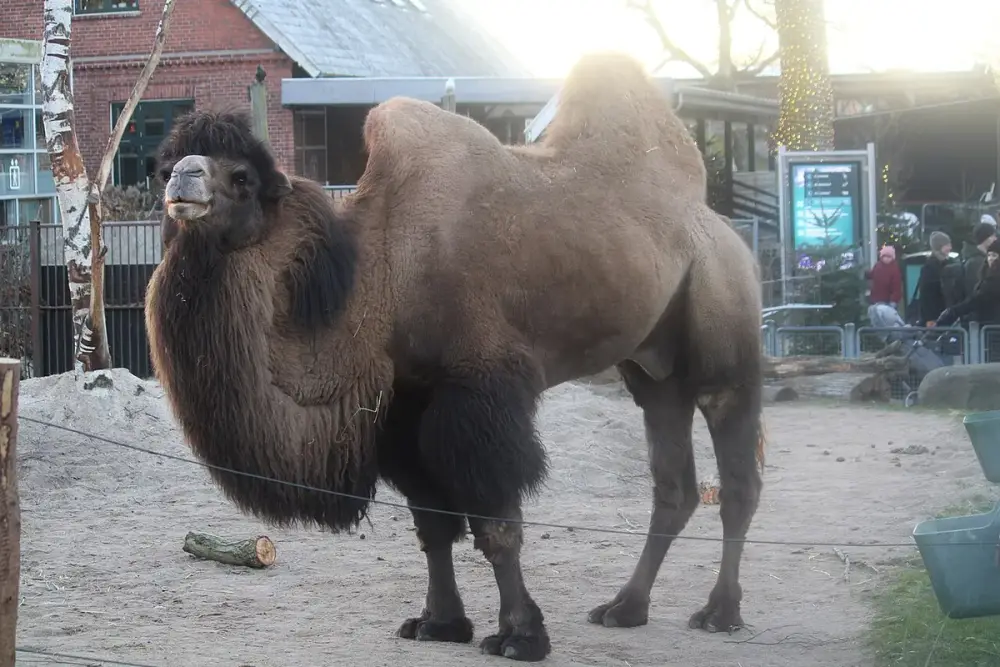
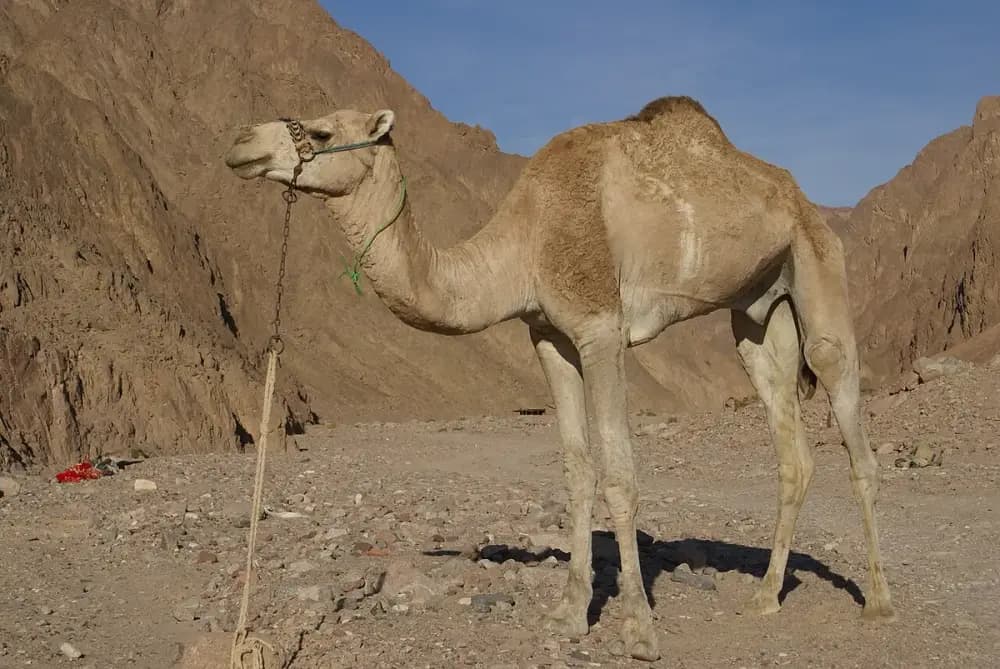
The two domestic camels are easiest to tell apart by their humps. The dromedary has one and the Bactrian has two. They are separate species that split about 1 million years ago, though they can interbreed, and the hybrid has one hump with a dip in it.
| Feature | Dromedary | Bactrian camel |
|---|---|---|
| Scientific name | Camelus dromedarius | Camelus bactrianus |
| Humps | One | Two |
| Weight | 300–600 kg (660–1,320 lb) | 300–1,000 kg (660–2,200 lb) |
| Height | About 1.85 m (6 ft 1 in) at the shoulder | Up to about 30 cm (1 ft) taller |
| Share of world camels | About 94% | About 6% |
| Main region | North and East Africa, Middle East, South Asia | Central Asia |
Conservation status
The dromedary and the domestic Bactrian camel are domestic animals, so they are not assessed on the IUCN Red List and have no special conservation status. Their numbers run into the millions, and in Australia more than 100,000 feral camels have been culled, partly because they use scarce resources that sheep farmers need.
The wild Bactrian camel is a different story. It is rated Endangered on the IUCN Red List in a 2025 assessment, with around 1,000 animals left and a continuing decline. It survives only in the Gobi and Taklamakan deserts of China and Mongolia.
Where to see camel in the U.S.
16 zoos across 12 states
Find the closest one
Rank the 9 zoos holding camel by how far they are from you. Your location is used in your browser to sort this list and is never sent to us.
7 more zoos hold camel but have no coordinates on file yet, so they aren't ranked here. They're in the full list below.
Arizona· 1
California· 2
Florida· 1
Kansas· 1
Maine· 1
Massachusetts· 2
North Carolina· 3
Oklahoma· 1
Tennessee· 1
Texas· 1
West Virginia· 1
Wisconsin· 1
AZAThe Association of Zoos and Aquariums. Accredited members have passed an independent inspection of animal care and welfare, safety, conservation and education, repeated every five years. Many smaller facilities never apply, so “not accredited” isn't a verdict on its own. What accreditation means · How we check this
Built from each zoo's own published animal list.
Camel: common questions
Do camels store water in their humps?
No. The humps are stores of fat that can be used for energy. A camel keeps the water it drinks in its bloodstream.
How long can a camel go without water?
A dromedary can go as long as 10 days between drinks even in very hot weather, and it can survive losing up to 30% of its body mass to dehydration.
How big do camels get?
A dromedary stands about 1.85 m (6 ft 1 in) at the shoulder and weighs 300–600 kg (660–1,320 lb). Bactrian camels can be a foot taller and weigh up to 1,000 kg (2,200 lb).
How long do camels live?
About 40 to 50 years.
How fast can a camel run?
Up to 65 km/h (40 mph) in short bursts, and about 40 km/h (25 mph) over longer stretches.
What do camels eat?
Desert plants. Dromedaries eat mostly thorny plants, dry grasses and saltbush and need a lot of salty plants in their diet.
Are camels endangered?
Domestic camels are not; they number in the millions. The wild Bactrian camel is Endangered, with around 1,000 left in China and Mongolia.
What is the difference between one-hump and two-hump camels?
One-humped camels are dromedaries and two-humped camels are Bactrians. They are separate species, and dromedaries make up about 94% of all camels.