- Where to see one
- 7 U.S. zoos in our directory hold cane toad, confirmed against each zoo's own animal list.
- Native range
- South Texas through Central America to the central Amazon and southeastern Peru
- Introduced range
- Australia, Florida, Hawaii, the Philippines, New Guinea, Fiji and most Caribbean islands
- Size
- Usually 10–15 cm (4–6 in) long, maximum about 24 cm (9.4 in); average weight about 106 g (3.7 oz)
- Lifespan
- 10–15 years in the wild; one captive toad reportedly lived 35 years
- Eggs
- 8,000–25,000 per clutch, laid in jelly strings up to 20 m (66 ft) long
Conservation status
Least Concernassessed 2009
IUCN Red List category LC — step 1 of 7.
The cane toad is a large, terrestrial true toad native to South America and mainland Central America, and the largest species in the toad family Bufonidae. It has dry, warty skin, ridges above the eyes and a large parotoid gland behind each eye. Adults average 10 to 15 cm long. Opportunistic feeding is unusual among amphibians: it eats both living and dead matter. Females lay thousands of eggs in a single clump. Its skin is toxic and can kill many animals, and the tadpoles are highly toxic if eaten. It was introduced to islands in the Pacific and Caribbean, and to northern Australia, to control agricultural pests.
About the cane toad
The cane toad is a large, warty, poisonous true toad native to South Texas, Central America and South America. Also called the giant toad or marine toad, it is considered the largest member of the true toad family, Bufonidae. Released worldwide to control sugarcane pests, it is now an invasive species in Australia, Florida and many Pacific islands.
Its scientific name is Rhinella marina; many herpetologists long knew it as Bufo marinus. The name "marine toad" comes from an 18th-century naturalist's mistaken belief that it lived both on land and in the sea. It does not live in the sea, though its tadpoles can tolerate some salt. Since 2016, the populations of Mesoamerica and northwestern South America are sometimes treated as a separate species, Rhinella horribilis.
Adults typically measure 10 to 15 cm (4 to 6 in) long, and the largest on record had a snout-to-vent length of 24 cm (9.4 in). Females are longer than males. Toads tend to grow larger where their populations are thinner.
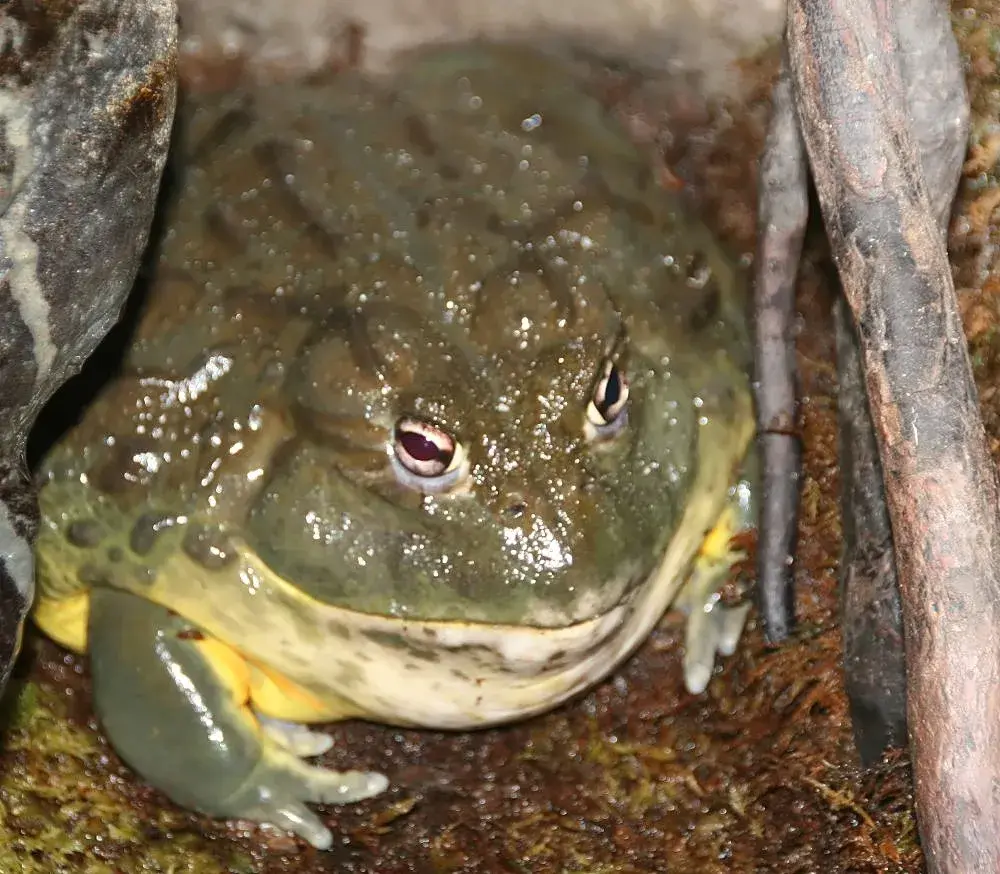
The skin is dry and covered with warts. Color varies from grey, yellowish or red-brown to olive-brown, and the cream belly may be blotched with black or brown. Bony ridges run above the eyes and down the snout. Behind each eye sits a large parotoid gland, a swollen poison gland that can stretch halfway down the back. The pupils are horizontal, the irises gold, and the toes are webbed only at the base.
Young toads look different. Juveniles have smooth, dark skin and lack the big parotoid glands, so they are usually less poisonous. Tadpoles are small, uniformly black, 10 to 25 mm (0.4 to 1 in) long, and gather in schools near the bottom.
Behavior and diet
Diet
Insects and other invertebrates, small mammals, reptiles, frogs, birds, plants, pet food and garbage
Cane toads are nocturnal and solitary, moving in short, fast hops. In cold or dry seasons they stay inactive in shallow burrows under cover. They are also tough: some can survive losing more than half their body water, and some populations can adjust their tolerance to cold within hours. These traits help explain how they have spread outside the tropics.
They find prey mainly by sight, but also by smell. Their diet is unusually broad for a frog or toad, taking both living and dead food. Prey includes ants, beetles, earwigs, dragonflies, grasshoppers, true bugs, crustaceans and snails, along with small rodents, reptiles, other amphibians, birds and even bats. They also eat plants, dog and cat food, feces and household garbage.
Their main defense is poison. When threatened, glands in the skin, especially the parotoid glands, release a milky white fluid called bufotoxin, which is largely made of substances that act on the heart. A cane toad can also inflate its lungs and lift its body to look bigger. Its usual response to attack is to sit still and let the toxin work.
In the tropics, cane toads breed nearly year-round; in subtropical areas, only in warm, wet periods. Males gather in still or slow water and call for mates. A female lays 8,000 to 25,000 eggs at once, in jelly strings up to 20 m (66 ft) long. Eggs usually hatch within 48 hours, and tadpoles take 12 to 60 days, typically about four weeks, to become toadlets of 10 to 11 mm (0.4 in).
Eggs and tadpoles are toxic, but young toadlets lose that protection before their parotoid glands develop. Only about 0.5% of cane toads reach adulthood. In Australia, tadpoles have evolved to be far more cannibalistic: 30 times more likely to show interest in eating their siblings and 2.6 times more likely to actually do so.
Range and habitat
Habitat
Open grassland and woodland; gardens, ditches and other human-modified areas
The native range runs from the Rio Grande Valley in South Texas south through Central America to the central Amazon and southeastern Peru, plus islands near Venezuela such as Trinidad and Tobago. It covers both tropical and semi-arid country. The toads prefer open grassland and woodland and show a "distinct preference" for land altered by people, such as gardens and drainage ditches. Dense foliage tends to limit their spread.
Introduced toads live at much higher densities. In South America, one count found about 20 adults per 100 m (110 yd) of shoreline, just 1 to 2% of the density recorded in Australia.
Starting before the 1840s, people released cane toads to control crop pests. A 1920 release in Puerto Rico was credited with wiping out sugarcane white grubs, though record rainfall may have helped. That reputation led to releases across the Pacific in the 1930s, including Hawaii in 1932 and Australia in 1935. In Australia, 102 toads brought from Hawaii became a population that spread from Queensland into the Northern Territory and New South Wales, and in 2010 one turned up as far west as Broome, Western Australia.
The toads largely failed at their job. The cane beetles they were meant to eat live at the tops of sugarcane, and cane toads are poor climbers. In Florida, failed early releases were followed by an accidental escape at Miami International Airport in 1957 and releases by animal dealers in 1963 and 1964. Toads now range from the Keys to north of Tampa, and the state wildlife agency recommends residents kill them.
Cane toad vs southern toad
In the southeastern United States, the cane toad can be mistaken for native toads, especially the southern toad (Anaxyrus terrestris).
| Feature | Cane toad | Southern toad |
|---|---|---|
| Status in Florida | Introduced, invasive | Native |
| Parotoid glands | Very large, reaching halfway down the back | Two bulbs in front of the parotoid glands |
Conservation status
The cane toad is listed as Least Concern on the IUCN Red List, in a 2009 assessment. Outside its native range, the species is a serious problem. In Australia, populations of native predators that try to eat the toads have declined, including several monitor lizards, two venomous snakes and the freshwater crocodile. The toad has been linked to declines of northern quolls in Kakadu National Park, including local extinction.
The toxin is dangerous to pets. Dogs are especially prone to poisoning from licking or biting toads; drooling, very red gums, head-shaking, loss of coordination or convulsions call for immediate veterinary care. Human deaths have been recorded from eating cane toads.
Some predators cope. In its native range, caimans, cat-eyed snakes, eels and bullet ants eat cane toads, and opossums of the genus Didelphis likely can eat them safely. In Australia, water rats learned within two years to flip toads over and eat only the non-toxic organs, and crows, kites, kookaburras and tawny frogmouths also take them. Researchers have even used toad-meat baits laced with a nausea-causing chemical to teach native animals to avoid them.
Where to see cane toad in the U.S.
7 zoos across 7 states
Find the closest one
Rank the 6 zoos holding cane toad by how far they are from you. Your location is used in your browser to sort this list and is never sent to us.
1 more zoo holds cane toad but has no coordinates on file yet, so it isn't ranked here. It's in the full list below.
Colorado· 1
Indiana· 1
Kansas· 1
Louisiana· 1
Massachusetts· 1
Montana· 1
New York· 1
AZAThe Association of Zoos and Aquariums. Accredited members have passed an independent inspection of animal care and welfare, safety, conservation and education, repeated every five years. Many smaller facilities never apply, so “not accredited” isn't a verdict on its own. What accreditation means · How we check this
Built from each zoo's own published animal list.
Cane Toad: common questions
Are cane toads poisonous?
Yes. Their skin and the large parotoid glands behind the eyes release bufotoxin, which can kill many animals, including dogs, and human deaths have been recorded from eating them. Eggs and tadpoles are toxic too.
Can cane toads kill dogs?
Yes. Dogs are especially at risk from licking or biting toads, and a poisoned pet that drools heavily, has very red gums or convulses needs a vet immediately.
How big do cane toads get?
Usually 10–15 cm (4–6 in) long, with a record of 24 cm (9.4 in). They average about 106 g (3.7 oz).
What do cane toads eat?
Almost anything they can swallow: insects, snails, small mammals, reptiles, frogs, birds and bats, plus plants, pet food and garbage.
Where are cane toads native?
From South Texas through Central America to the Amazon and Peru. They were introduced to Florida, Hawaii, Australia and many islands to fight crop pests.
How long do cane toads live?
About 10–15 years in the wild. They can live considerably longer in captivity, with one reportedly reaching 35 years.
Why are cane toads a problem in Australia?
They were released in 1935 to eat cane beetles, failed to control them, and spread widely. Native predators that eat the poisonous toads die, and several species have declined.