- Where to see one
- 7 U.S. zoos in our directory hold wild turkey, confirmed against each zoo's own animal list.
- Native range
- Much of the United States, southern Canada and Mexico; introduced in the western U.S., Hawaii and New Zealand
- Size
- Males 100–125 cm (39–49 in) long and 5–11 kg (11–24 lb); females 76–95 cm (30–37 in) and 2.5–5.4 kg (5.5–11.9 lb)
- Wingspan
- 1.25–1.44 m (4 ft 1 in–4 ft 9 in)
- Lifespan
- Average life expectancy 1.3–1.6 years in the wild; the oldest known lived at least 13 years
- Names
- Males are toms or gobblers, females are hens, young males are jakes, and chicks are poults
Conservation status
Least Concernassessed 2018
IUCN Red List category LC — step 1 of 7.
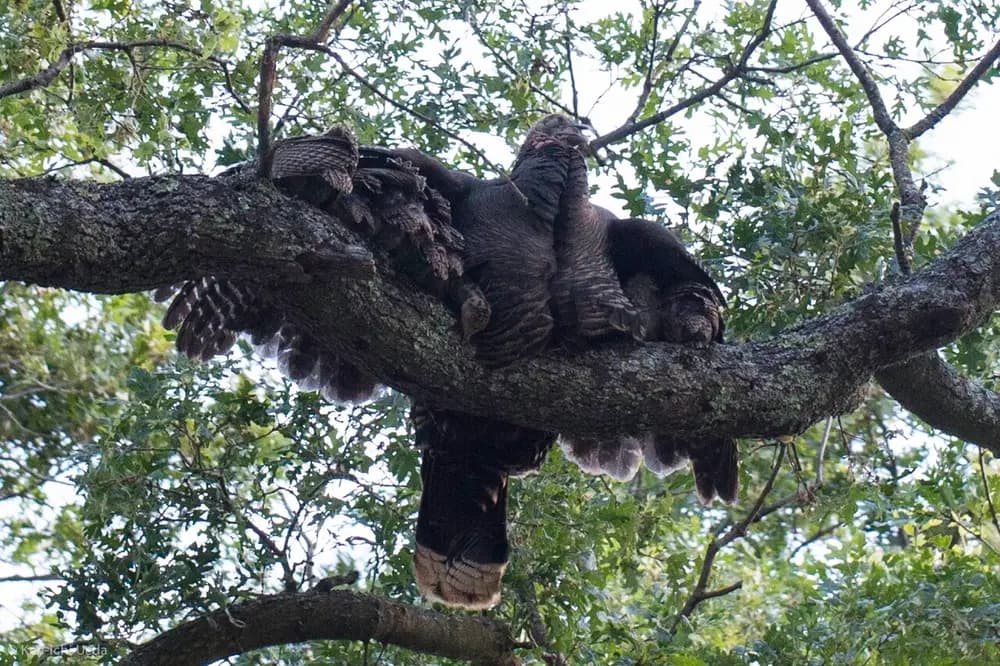
The wild turkey is an upland game bird native to North America and the heaviest member of the order Galliformes. It is the ancestor of the domestic turkey. Wild turkeys prefer hardwood and mixed conifer-hardwood forests with scattered openings such as pastures, fields and seasonal marshes. They are omnivorous, foraging on the ground or climbing shrubs and small trees for acorns, nuts, seeds, berries, buds, leaves and insects. Males are much larger and more iridescent than the duller brown and gray hens. Their eyesight is very good by day but poor at night, so at twilight most roost well off the ground in trees.
About the wild turkey
The wild turkey is a large, ground-dwelling game bird native to North America and the wild ancestor of the domestic turkey. It is one of two living turkey species, alongside the ocellated turkey, and the heaviest member of the order Galliformes. It lives in forests and woodland edges across the United States, southern Canada and Mexico.
Its scientific name is Meleagris gallopavo. Carl Linnaeus described it in 1758, with Mexico as the type locality. The genus name comes from the Ancient Greek word for guineafowl, and gallopavo combines the Latin for "fowl" and "peacock." Six subspecies are recognized. The farmyard bird, the domestic turkey, comes from one of them, the south Mexican wild turkey, which native peoples domesticated in Mexico or Mesoamerica. Unlike that farm descendant, the wild bird is an agile, fast flier.
Wild turkeys are big birds with strong differences between the sexes. An adult male usually weighs 5–11 kg (11–24 lb) and measures 100–125 cm (39–49 in) long, while females weigh 2.5–5.4 kg (5.5–11.9 lb) and measure 76–95 cm (30–37 in). In two large studies, males averaged 7.6 kg (17 lb) and females 4.26 kg (9.4 lb). The record male, according to the National Wild Turkey Federation, weighed 17.06 kg (37.6 lb). Given those weights, the wild turkey is among the heaviest flying birds in the world. The wings are fairly short, as is typical of its order, but the wingspan still reaches 1.25–1.44 m (4 ft 1 in–4 ft 9 in).
Males are the showier sex. A mature tom has a bare, reddish head, red wattles hanging from the throat and neck, and fleshy bumps called caruncles on the head. A flap of skin over the bill, the snood, swells when he is excited, and the head and neck can shift among red, white and blue with his mood. His feathers shine with red, purple, green, copper, bronze and gold, and he has a dark, fan-shaped tail and a spur on the back of each lower leg for sparring with rivals. Most males also grow a "beard," a tuft of coarse, hair-like feathers from the middle of the breast that keeps growing throughout life. Hens are smaller and duller, in browns and greys, and about 10% of them have a beard too. A turkey has roughly 5,000 to 6,000 feathers.
Behavior and diet
Diet
Omnivore; acorns and other nuts, seeds, berries, leaves, roots, insects and small reptiles
Despite their weight, wild turkeys fly well. Flights are usually short and close to the ground, a quarter mile (400 m) at most, yet the birds have been recorded at 88.5 km/h (55 mph). They are also swift runners, and when a predator approaches they usually run rather than fly. Their daytime eyesight is excellent, but they see poorly at night, so at dusk they fly up to roost high in trees.
Wild turkeys are omnivores that feed on the ground or climb into shrubs and small trees. Favorite foods are acorns and other nuts, including hazel, chestnut, hickory and pinyon pine, along with seeds, berries, buds, leaves, fern fronds, roots, grasses and insects. They occasionally catch salamanders, lizards and small snakes. They often forage in cow pastures and harvested fields and sometimes visit backyard feeders. Most feeding happens in the early morning and late afternoon. Turkeys sometimes forage with deer and squirrels, each animal helping the others watch for predators.
Turkeys have a large vocabulary: gobbles, yelps, purrs, clucks, cutts, cackles and the "putt" alarm, among others. In early spring, males gobble to announce themselves to hens and rivals, and a gobble can be heard up to a mile away. A chest air sac lets males produce a low-pitched drumming, much like a prairie chicken's booming, and a sharp "spit" when air is forced out of it.
Males are polygamous and mate with as many hens as they can. They court by strutting, puffing out their feathers, fanning their tails and dragging their wings, starting in March and April while flocks are still together on wintering grounds. Males often court in pairs, and the pair are usually close relatives. In one study, a dominant male courting with a partner fathered six more eggs on average than a male courting alone, which may help the subordinate brother pass on shared genes.
After mating, the hen scrapes a shallow nest in the dirt under woody cover and lays 10–14 eggs, usually one a day. Incubation lasts at least 28 days. The chicks, called poults, can leave the nest within 12–24 hours of hatching. Ground nesting makes turkeys vulnerable, and poult deaths are highest in the first two weeks. If surprised with no time to flee, poults dive under the hen's wings while she sits tight.
Predators are many. Ravens, crows, raccoons, opossums, skunks, foxes and snakes take eggs and poults, while hawks, great horned owls and bald eagles hunt young birds. Coyotes, wolves, bobcats, cougars, lynx and golden eagles can kill adults, and alligators take turkeys near water in the Southeast. Humans are now the leading predator of adult turkeys. Cornered turkeys fight back by kicking with their spurs, biting and ramming.
Range and habitat
Habitat
Hardwood and mixed forest with openings such as fields, pastures and marshes
Wild turkeys prefer hardwood and mixed conifer-hardwood forest broken up by openings such as pastures, fields, orchards and seasonal marshes. Open, mature forest with a mix of tree species suits them best, and they adapt to almost any dense native plant community as long as cover and clearings are both available. They do not migrate. In snowy regions they shelter in conifers during blizzards.
The six subspecies differ in color, habitat and range:
- Eastern wild turkey (M. g. silvestris): the eastern half of the U.S. from Maine to northern Florida and west to Minnesota and Missouri, plus southeastern Canada; about 5.1–5.3 million birds and the most hunted subspecies.
- Osceola or Florida wild turkey (M. g. osceola): the Florida peninsula; about 80,000–100,000 birds, the smallest subspecies at 7–8 kg (16–18 lb).
- Rio Grande wild turkey (M. g. intermedia): Texas and the southern Great Plains, introduced to California, Hawaii and elsewhere; about 1 million birds.
- Merriam's wild turkey (M. g. merriami): the Rocky Mountains and high mesas of the Southwest, in ponderosa pine country.
- Gould's wild turkey (M. g. mexicana): northwestern Mexico and the southern edges of Arizona and New Mexico; the largest subspecies.
- South Mexican wild turkey (M. g. gallopavo): Mexico; the only subspecies not found in the United States or Canada, the ancestor of the domestic turkey, and thought to be critically endangered as of 2010.
Conservation status
The wild turkey is listed as Least Concern on the IUCN Red List, based on a 2018 BirdLife International assessment. That status reflects a dramatic comeback.
Overhunting and habitat loss nearly wiped the species out. By the late 1930s, game managers estimated only about 30,000 wild turkeys remained in the United States. By the 1940s the bird was almost gone from Canada, and it had disappeared entirely from 18 U.S. states, including New York and Vermont, which lost their turkeys in the 1850s.
Early reintroduction attempts with hand-reared birds failed because the birds could not survive in the wild. What worked was "trap and transfer": wildlife managers protected the surviving wild flocks, netted surplus birds and moved them to empty habitat, then repeated the cycle. The U.S. population reached an estimated 1.3 million by 1973, and the total is now put at about 7 million. Since the 1980s, transfers have also brought turkeys back to several Canadian provinces, where they have thrived even far north of their expected range. Hunting is now legal in 49 states. The south Mexican subspecies remains the exception, and Gould's wild turkey is heavily protected because of its threatened status.
Where to see wild turkey in the U.S.
7 zoos across 7 states
Find the closest one
Rank the 7 zoos holding wild turkey by how far they are from you. Your location is used in your browser to sort this list and is never sent to us.
Arizona· 1
Colorado· 1
Florida· 1
Kansas· 1
Louisiana· 1
New Mexico· 1
Rhode Island· 1
AZAThe Association of Zoos and Aquariums. Accredited members have passed an independent inspection of animal care and welfare, safety, conservation and education, repeated every five years. Many smaller facilities never apply, so “not accredited” isn't a verdict on its own. What accreditation means · How we check this
Built from each zoo's own published animal list.
Wild Turkey: common questions
Can wild turkeys fly?
Yes. Wild turkeys are fast, agile fliers, recorded at 88.5 km/h (55 mph), though most flights are short and low. They roost in trees at night.
How big do wild turkeys get?
Males usually weigh 5–11 kg (11–24 lb) and measure up to 125 cm (49 in) long. Hens are much smaller, at 2.5–5.4 kg (5.5–11.9 lb).
What do wild turkeys eat?
Mostly acorns, nuts, seeds, berries, leaves and roots, plus insects and the occasional salamander, lizard or small snake.
How long do wild turkeys live?
Average life expectancy in the wild is only about 1.3–1.6 years, but the oldest known wild turkey lived at least 13 years.
Are wild turkeys dangerous?
Usually not. They may act aggressively if startled, cornered, harassed or approached too closely, and males sometimes attack their own reflection in cars or windows.
Is the domestic turkey the same species as the wild turkey?
Yes. The [domestic turkey](/animals/turkey/) descends from the south Mexican subspecies of the wild turkey and is the same species, Meleagris gallopavo.
Did Benjamin Franklin want the turkey as the national bird?
No. He praised the turkey over the bald eagle in a 1784 private letter to his daughter, but he never publicly proposed it as a national symbol, and the story is considered a myth.