- Where to see one
- 11 U.S. zoos in our directory hold turkey, confirmed against each zoo's own animal list.
- Native range
- North America, from southern Canada through the United States to Mexico
- Size
- Males 100–125 cm (39–49 in) long and 5–11 kg (11–24 lb); females 76–95 cm (30–37 in) and 2.5–5.4 kg (5.5–11.9 lb); wingspan 1.25–1.44 m (4 ft 1 in to 4 ft 9 in)
- Lifespan
- Wild birds average 1.3–1.6 years; the oldest known wild turkey lived at least 13 years
- Clutch
- 10–14 eggs, incubated at least 28 days
- Names
- Male is a tom or gobbler, young male a jake, female a hen, chick a poult
Conservation status
Least Concernassessed 2018
IUCN Red List category LC — step 1 of 7.
The wild turkey is an upland game bird native to North America and the heaviest member of the order Galliformes. It is the ancestor of the domestic turkey, which was derived from a southern Mexican subspecies. Adult males weigh 5 to 11 kg and females 2.5 to 5.4 kg. Wild turkeys prefer hardwood and mixed conifer-hardwood forests with scattered openings. They are omnivorous, foraging on the ground for acorns, nuts, seeds, berries and insects. They are agile, fast fliers but usually fly close to the ground for no more than 400 m, and because their night vision is poor they roost in trees. In early spring males gobble, a call that carries up to a mile, and strut for females.
About the turkey
The wild turkey (Meleagris gallopavo) is a large upland game bird native to North America, one of two living turkey species and the heaviest member of the order Galliformes. It is the ancestor of the domestic turkey, which came from a southern Mexican subspecies, and it lives in forests and woodland edges across the United States.
The domestic turkey kept on farms is the same species. People in Mesoamerica domesticated the south Mexican wild turkey at least 2,000 years ago; the Spanish carried the bird to Europe in the 16th century, and English colonists brought domestic turkeys back across the Atlantic, arriving at Jamestown in 1608. The genus name Meleagris is Ancient Greek for guineafowl, and gallopavo is late Latin combining "fowl" and "peacock."
Wild turkeys are big birds. An adult male normally weighs 5–11 kg (11–24 lb) and measures 100–125 cm (39–49 in) long; hens are much smaller at 2.5–5.4 kg (5.5–11.9 lb) and 76–95 cm (30–37 in). Two large studies found averages of 7.6 kg (17 lb) for males and 4.26 kg (9.4 lb) for females. The record wild tom weighed 17.06 kg (37.6 lb). Among North American birds, only the trumpeter swan has a higher maximum average weight.
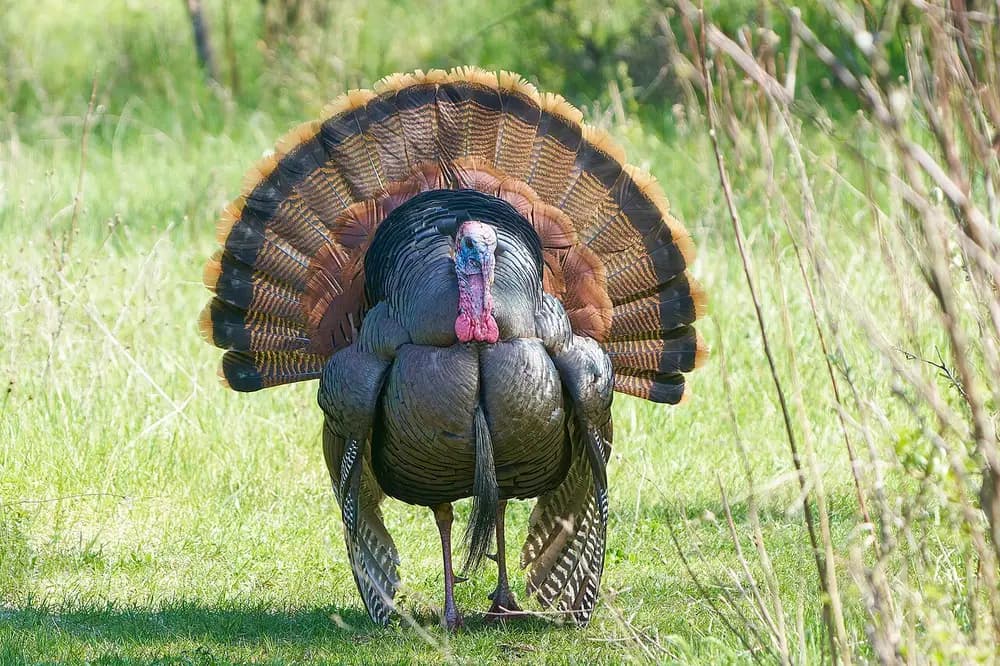
The body feathers are mostly blackish to gray-brown with a coppery sheen; a male's plumage flashes red, purple, green, copper, bronze and gold. A turkey carries about 5,000 to 6,000 feathers. Mature males have a large, bare, reddish head with red wattles on the throat and neck, fleshy bumps called caruncles, and a flap over the bill called a snood that swells when the bird is excited. Males also grow a "beard," a tuft of coarse, hair-like filaments from the breast that lengthens throughout life, and about 10% of hens have one too. Each leg of a male carries a spur used in fights with other males. Hens are duller brown and gray.
Behavior and diet
Diet
Omnivore; acorns, nuts, seeds, berries, buds, leaves, roots, grasses and insects, with occasional salamanders, lizards and small snakes
Turkeys are omnivores that forage on the ground or climb into shrubs and small trees. They favor acorns, nuts and other hard mast from oak, hazel, chestnut, hickory and pinyon pine, plus seeds, berries, buds, leaves, fern fronds, roots, grasses and insects. They occasionally take salamanders, lizards and small snakes. Wild turkeys also feed in cow pastures, scavenge harvested croplands for spilled grain and sometimes visit backyard bird feeders. Early morning and late afternoon are the main feeding times.
Despite their weight, wild turkeys are agile, fast fliers, unlike most of their domestic cousins. They usually fly low and for no more than about 400 m (a quarter mile). Their daytime eyesight is very good, but their night vision is poor, so at twilight they fly up to roost high in trees. Wild turkeys do not migrate, and in snowy regions they ride out blizzards in conifer trees.
They are talkative birds with a long list of calls: yelps, clucks, purrs, cutts, a "kee kee run," a fly-down cackle and an alarm "putt." The famous gobble, given mostly by males in early spring, can be heard up to a mile (1.6 km) away. Males also make a low drumming sound with an air sac in the chest and a sharp "spit."
In courtship, males strut: they puff out their feathers, fan their tails and drag their wings while the bare skin of the head turns red, white and blue, going solid white at peak excitement. Males are polygamous. Closely related males sometimes court as a pair, and the dominant male of a pair fathers more eggs than a male courting alone, which may help pass on the genes the two share.
The hen nests in a shallow dirt scrape hidden in woody vegetation and lays 10–14 eggs, usually one a day. Incubation lasts at least 28 days. The poults are precocial and leave the nest within about 12 to 24 hours. Because they nest on the ground, turkeys lose many eggs and young to predators, including raccoons, opossums, skunks, foxes, snakes, crows and hawks. Adults are hunted by coyotes, bobcats, cougars, gray wolves, golden eagles and, in the Southeast, American alligators. Today humans are the leading predator of adult turkeys.
Range and habitat
Habitat
Hardwood and mixed forests with openings such as fields, pastures, orchards and marshes
Wild turkeys prefer hardwood and mixed conifer-hardwood forests broken up by pastures, fields, orchards and seasonal marshes, and they can use almost any dense native plant community with enough cover and openings. In the Northeast they are most common in oak-hickory forest. In the Southeast they use river bottoms and cypress and tupelo swamps, and in California they favor open oak woodland and oak savanna, where acorns are a staple.
Six subspecies are recognized. The eastern wild turkey covers the eastern half of the United States, numbering 5.1 to 5.3 million birds. The Osceola turkey lives in peninsular Florida; the Rio Grande turkey ranges through the southern plains; Merriam's turkey lives in the Rocky Mountains and nearby prairies; Gould's turkey, the largest subspecies, lives mainly in northwestern Mexico; and the south Mexican wild turkey, ancestor of the domestic bird, is the only subspecies not found in the United States or Canada.
Turkeys have also been introduced outside their native range, including to western states, Hawaii and New Zealand, and small populations live in the Czech Republic and Germany.
Wild turkey vs domestic turkey
Wild and domestic turkeys are the same species, but centuries of breeding have produced very different birds.
| Feature | Wild turkey | Domestic turkey |
|---|---|---|
| Origin | Native wild bird of North America | Bred from the south Mexican wild turkey at least 2,000 years ago |
| Plumage | Dark, iridescent bronze, copper and green | Mostly bred white; bronze, black, red and slate breeds also exist |
| Weight | Mature male approximately 10.8 kg (24 lb) | Commercial toms can exceed 20 kg (44 lb) by 18–20 weeks; maximum 39 kg (86 lb) |
| Flight | Agile, fast flier | Semi-flightless; the largest birds cannot fly at all |
| Breeding | Natural mating | Broad Breasted Whites are too large to mate naturally and are bred by artificial insemination |
Conservation status
The wild turkey is listed as Least Concern on the IUCN Red List, but it came close to disappearing from much of its range. Overhunting, market hunting and habitat loss drove numbers down until game managers estimated only about 30,000 wild turkeys were left in the United States by the late 1930s. The species was nearly wiped out in Canada and became extinct in 18 U.S. states.
Early efforts to release hand-reared birds failed because the birds couldn't survive in the wild. Wildlife officials switched to trapping surplus wild birds with projectile nets and moving them into empty habitat, then repeating the cycle. That "trap and transfer" reintroduction worked. The U.S. population reached an estimated 1.3 million by 1973, and current estimates put the total wild turkey population at about 7 million. Since the 1980s, transfers have also restored wild turkeys to several Canadian provinces, where they have spread farther north than expected.
Where to see turkey in the U.S.
11 zoos across 9 states
Find the closest one
Rank the 7 zoos holding turkey by how far they are from you. Your location is used in your browser to sort this list and is never sent to us.
4 more zoos hold turkey but have no coordinates on file yet, so they aren't ranked here. They're in the full list below.
Alaska· 1
Colorado· 1
Delaware· 1
District of Columbia· 1
Florida· 1
Illinois· 3
Michigan· 1
North Carolina· 1
South Carolina· 1
AZAThe Association of Zoos and Aquariums. Accredited members have passed an independent inspection of animal care and welfare, safety, conservation and education, repeated every five years. Many smaller facilities never apply, so “not accredited” isn't a verdict on its own. What accreditation means · How we check this
Built from each zoo's own published animal list.
Turkey: common questions
Can wild turkeys fly?
Yes. Wild turkeys are agile, fast fliers over short distances, usually no more than about 400 m (a quarter mile), and they fly up into trees to roost at night.
How big do turkeys get?
Wild males usually weigh 5–11 kg (11–24 lb) and hens 2.5–5.4 kg (5.5–11.9 lb). Domestic commercial toms can exceed 20 kg (44 lb).
What do wild turkeys eat?
Acorns, nuts, seeds, berries, buds, leaves, roots, grasses and insects, plus the occasional salamander, lizard or small snake.
How long do wild turkeys live?
The average wild turkey lives only about 1.3 to 1.6 years, but the oldest known wild bird lived at least 13 years.
Are wild turkeys dangerous?
Not usually. They can turn aggressive if startled, cornered or approached too closely, kicking with their spurs, biting and ramming, so it's best to give them space.
Is a domestic turkey the same species as a wild turkey?
Yes. Domestic turkeys belong to the same species, Meleagris gallopavo, and descend from the south Mexican wild turkey.
Did Benjamin Franklin want the turkey as the national bird?
No. The idea comes from a private 1784 letter to his daughter praising the turkey, but Franklin never publicly proposed it as a national symbol; the story is considered a myth.