- Where to see one
- 10 U.S. zoos in our directory hold violet turaco, confirmed against each zoo's own animal list.
- Native range
- West Africa, from Senegal to Nigeria, with isolated populations in Chad and the Central African Republic
- Size
- About 48 cm (19 in) long including the tail, with a 4 cm (1.6 in) bill, a 21 cm (8.3 in) wing length, and a weight of roughly 360 g (13 oz)
Conservation status
Near Threatenedassessed 2025
IUCN Red List category NT — step 2 of 7.
Near Threatened (NT), assessed in 2025
About the violet turaco
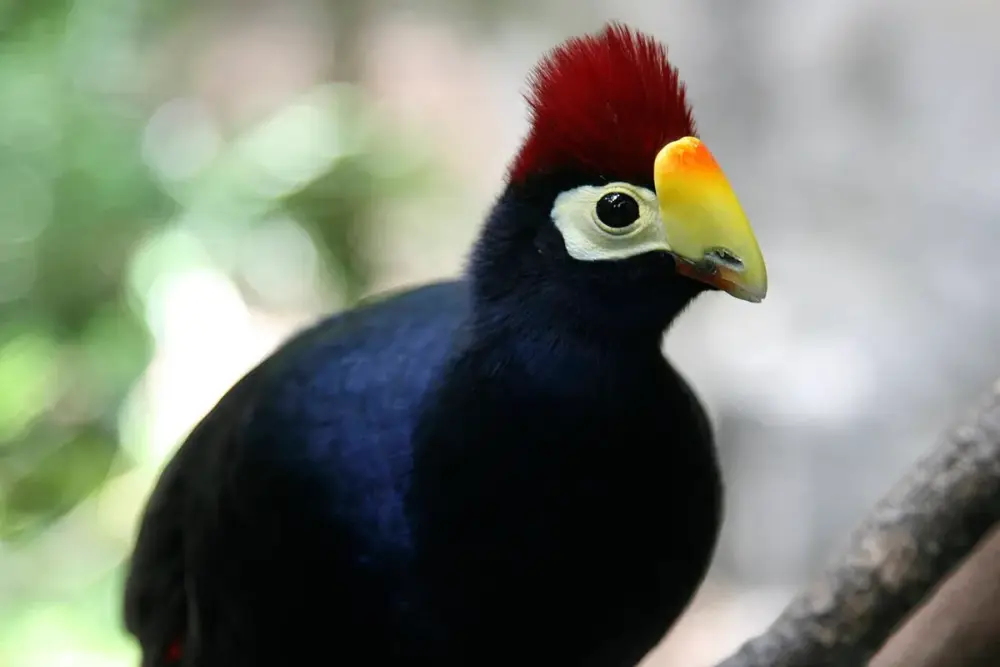
The violet turaco, also called the violaceous plantain eater, is a large member of the turaco group, a family of African birds. It is an unmistakable bird up close, but shy and often hard to spot once it settles into a treetop. Its plumage is a glossy violet over most of the body, set off by a yellow forehead, a chestnut crown, and white ear coverts. The bill is thick and bright red. In flight, the crimson primary flight feathers flash against the violet body, a splash of color typical of turacos as a group.
The bird runs about 48 cm (19 in) long from bill to tail tip, with the bill itself measuring around 4 cm (1.6 in) and the wing spanning 21 cm (8.3 in). A violet turaco weighs roughly 360 g (13 oz), putting it solidly in the "large turaco" category rather than among the smaller species in the family.
In the wild, the violet turaco is resident across West Africa, with a large range stretching from Senegal through Nigeria and isolated pockets in Chad and the Central African Republic. It favors tropical savannas, wetlands, woodlands, and forests, moving through the tree canopy rather than open ground.
Behavior and diet
Diet
Fruit (especially figs), leaves, buds, flowers, insects, snails, and slugs
Violet turacos are social birds that travel in flocks of roughly ten to twelve individuals. They are not strong fliers; instead, they get around mostly by hopping along branches, and when startled they can move quickly through the trees rather than take flight. Their call, a loud "cooroo-cooroo," carries through the canopy and is often the first sign of a flock nearby.
Fruit makes up most of the diet, with figs a particular favorite, rounded out with leaves, buds, flowers, insects, snails, and slugs. This mixed menu of plant and animal matter lets the birds forage across a range of wooded and wetland habitats.
Breeding timing varies across the range: it begins around April in Senegal and Gambia, but runs from June through October in Nigeria. The female lays two eggs in a flimsy platform nest built in a tree, and both parents share incubation and chick-rearing duties. Cooperative breeding, where birds beyond the pair help raise young, has been observed in captive violet turacos.
Range and habitat
Habitat
Tropical savannas, wetlands, woodlands, and forests
The violet turaco's native range covers a wide swath of West Africa, running from Senegal in the west to Nigeria in the east, with additional isolated populations in Chad and the Central African Republic. Across that range it occupies a mix of habitat types: tropical savanna, wetland edges, woodland, and forest, all of which offer the fruiting trees and dense canopy cover the species relies on.
Conservation status
The violet turaco is listed as Near Threatened on the IUCN Red List, in a 2025 assessment by BirdLife International. The species remains locally common across much of its range, but it is vulnerable to trapping for the pet trade, which affects populations in Guinea, Sierra Leone, Liberia, and Ghana in particular.
Where to see violet turaco in the U.S.
10 zoos across 7 states
Find the closest one
Rank the 10 zoos holding violet turaco by how far they are from you. Your location is used in your browser to sort this list and is never sent to us.
California· 1
Florida· 2
Georgia· 1
Illinois· 1
Kansas· 1
Massachusetts· 2
New York· 2
AZAThe Association of Zoos and Aquariums. Accredited members have passed an independent inspection of animal care and welfare, safety, conservation and education, repeated every five years. Many smaller facilities never apply, so “not accredited” isn't a verdict on its own. What accreditation means · How we check this
Built from each zoo's own published animal list.
Violet Turaco: common questions
Is the violet turaco endangered?
Not endangered, but it is listed as Near Threatened on the IUCN Red List (2025). It remains locally common through much of its West African range, while trapping for the pet trade is a pressure in several countries.
How big does a violet turaco get?
About 48 cm (19 in) long including the tail, with a wing length of 21 cm (8.3 in) and a weight around 360 g (13 oz).
What does a violet turaco eat?
Mostly fruit, especially figs, along with leaves, buds, flowers, insects, snails, and slugs.
Where do violet turacos live in the wild?
Across West Africa, from Senegal through Nigeria, with isolated populations in Chad and the Central African Republic, in savanna, wetland, woodland, and forest habitat.
Which U.S. zoos have violet turacos?
Five U.S. zoos list them, including Lincoln Park Zoo in Illinois, Franklin Park Zoo in Massachusetts, and the Central Florida Zoo and Botanical Gardens.