- Where to see one
- 10 U.S. zoos in our directory hold ross's turaco, confirmed against each zoo's own animal list.
- Native range
- Angola, Botswana, Burundi, Cameroon, Central African Republic, Democratic Republic of the Congo, Gabon, Kenya, Rwanda, South Sudan, Tanzania, Uganda, Zambia
- Size
- 15 to 18 inches long, just under one pound
- Lifespan
- 8 to 20 years (sources vary)
About the Ross's turaco
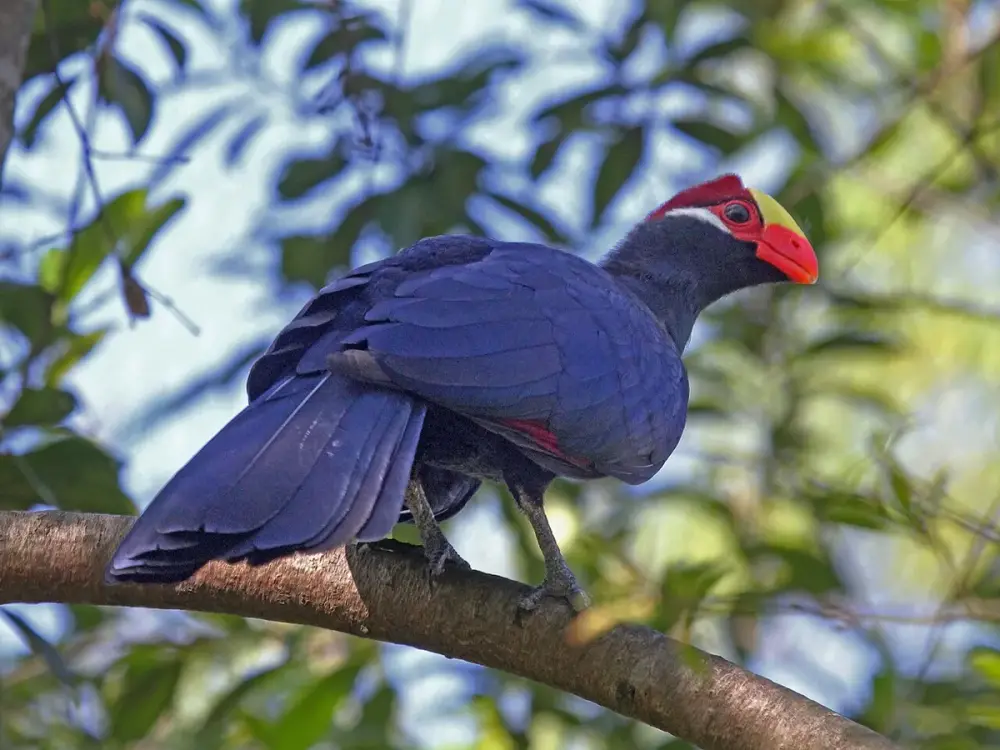
The Ross's turaco, also called Lady Ross's turaco, is a deep bluish-purple African bird in the turaco family, Musophagidae. It shows very little difference between males and females: both are the same rich shade of blue with red crowns and red flight feathers. The main way to tell the sexes apart is the bill, which flares into an orange forehead shield in both — females can show a bit more yellow-green in the beak, while males are consistently bright yellow.
Its wings are round and short, built for quick bursts of flight rather than long-distance travel. Its feet have three forward-facing toes plus a fourth, semi-zygodactylous toe, which makes it a nimble canopy dweller. Adults run 15 to 18 inches long and weigh just under a pound, and are described as sturdy birds capable of living anywhere from 8 to 20 years, though lifespan estimates vary by source.
In the wild, Ross's turaco is found across a wide swath of central, eastern, and southern Africa, including Angola, Botswana, Burundi, Cameroon, the Central African Republic, the Democratic Republic of the Congo, Gabon, Kenya, Rwanda, South Sudan, Tanzania, Uganda, and Zambia. It favors woodlands, open forest, and riparian (streamside) habitat, generally avoiding the densest forest interior.
Behavior and diet
Diet
Fruit, flowers, seeds; occasional insects like termites and snails
Ross's turaco is largely frugivorous, eating mostly fruit, flowers, and seeds from both wild and cultivated plants, and it ranks among the more effective seed spreaders in its region. It supplements this plant diet with small insects such as termites and snails, particularly around brooding season. The family name Musophagidae translates to "plantain eater," but that's something of a misnomer — Ross's turaco rarely goes for banana or plantain trees, preferring figs above most other food. Its opportunistic feeding habits also make it unpopular with farmers, since flocks can damage crops and gardens.
Breeding pairs are monogamous and share incubation and feeding duties. A clutch is 2 to 3 eggs, which hatch after roughly 25 days, and chicks then spend another 4 to 7 weeks with their parents in the nest before fledging. Oddly, young turacos become largely independent before they can fly, getting around by climbing through the canopy instead. They reach sexual maturity at about one year and typically stay near their parents in extended family flocks of up to thirty birds, where other flock members often help raise chicks — especially useful when the mother is breeding for the first time. Turacos become more territorial during brooding season, particularly toward predatory or unfamiliar birds.
Range and habitat
Habitat
Woodlands, open forest, and riparian habitats
Ross's turaco ranges across a large portion of sub-Saharan Africa, from West-Central nations like Cameroon and Gabon east to Kenya and Tanzania and south to Zambia, Botswana, and Angola. It sticks to woodlands, open forest, and habitat along rivers and streams, and it tends to avoid heavily forested interior areas. The species is non-migratory: individuals rarely wander far from where they hatched, though they will move to find food when it grows scarce nearby.
Conservation status
Ross's turaco is listed as Least Concern (LC). Its numbers remain strong despite ongoing habitat loss driven by the expansion of agriculture across its range.
Where to see ross's turaco in the U.S.
10 zoos across 10 states
Find the closest one
Rank the 10 zoos holding ross's turaco by how far they are from you. Your location is used in your browser to sort this list and is never sent to us.
Colorado· 1
Illinois· 1
Louisiana· 1
Maine· 1
New York· 1
Ohio· 1
Oklahoma· 1
Rhode Island· 1
South Dakota· 1
Virginia· 1
AZAThe Association of Zoos and Aquariums. Accredited members have passed an independent inspection of animal care and welfare, safety, conservation and education, repeated every five years. Many smaller facilities never apply, so “not accredited” isn't a verdict on its own. What accreditation means · How we check this
Built from each zoo's own published animal list.
Ross's Turaco: common questions
Is the Ross's turaco endangered?
No. It is listed as Least Concern, and its population remains strong despite habitat loss from agricultural expansion.
How big does a Ross's turaco get?
It measures 15 to 18 inches long and weighs just under a pound.
What does a Ross's turaco eat?
Mostly fruit, flowers, and seeds, with figs a particular favorite, plus occasional insects like termites and snails.
How long do Ross's turacos live?
Sources vary, but estimates range from 8 to 20 years.
Where do Ross's turacos live in the wild?
Across a broad band of sub-Saharan Africa, including Angola, Botswana, Cameroon, Kenya, Tanzania, Uganda, and Zambia, in woodlands, open forest, and riparian habitat.
Which U.S. zoos have Ross's turacos?
Five zoos in our directory, including the Cincinnati Zoo and Botanical Garden, the Buffalo Zoo, and the Tulsa Zoo and Living Museum.