- Where to see one
- 15 U.S. zoos in our directory hold golden pheasant, confirmed against each zoo's own animal list.
- Native range
- Mountainous forests of western China; feral populations established in several other countries
- Size
- Males about 100 cm (39 in) long and 500–700 g (1–2 lb); females 60–80 cm (24–31 in) long and around 350 g (1 lb)
About the golden pheasant
The golden pheasant, also known as the Chinese pheasant or rainbow pheasant, is a gamebird in the order Galliformes and the pheasant family, Phasianidae. Its genus name comes from Ancient Greek words meaning "with golden crest," while its species name is Latin for "painted." Carl Linnaeus formally described the bird in 1758, giving China as its original type location; it was later placed, alongside the closely related Lady Amherst's pheasant, in the genus Chrysolophus.
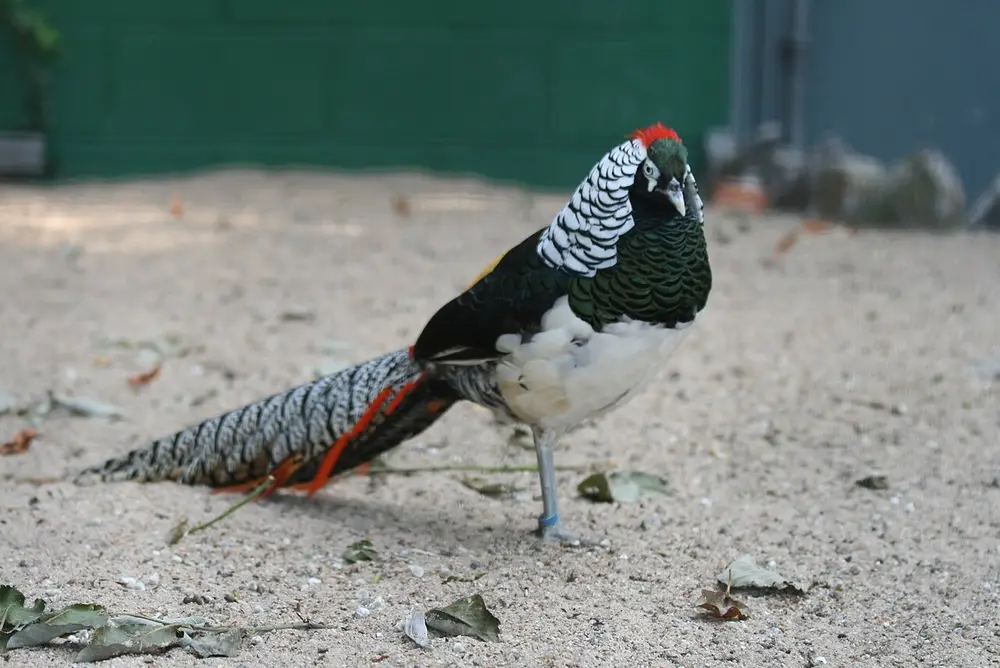
The adult male is the more dramatic of the two sexes, reaching about 100 cm (39 in) in length — two-thirds of which is tail — and weighing around 500 to 700 g (1 to 2 lb). His plumage combines a golden crest and rump with a bright red body, an orange ruff or "cape" that can be spread into an alternating black-and-orange fan covering most of the face, and a bright yellow eye with a pinpoint black pupil. The upper back is green, the rest of the back and rump golden-yellow, the wing tertials blue, and the scapulars dark red; the central tail feathers are black spotted with cinnamon, tipped in cinnamon buff. The female, by contrast, measures only 60 to 80 cm (24 to 31 in) — with a proportionally longer tail making up about half her length — and weighs around 350 g (1 lb). Her plumage is a duller, mottled brown, similar to a female common pheasant but darker and more slender, with a barred buff-and-blackish-brown breast and sides, a plain buff abdomen, and a buff face and throat. Both sexes have yellow legs and bills, and some abnormal females can develop patches of male-type plumage later in life.
Behavior and diet
Diet
Grain, leaves, seeds, berries, and invertebrates
Golden pheasants feed on the ground, taking grain, leaves, and invertebrates, but roost in trees at night. In winter, flocks tend to forage near human settlements at forest edges, feeding mainly on wheat leaves and seeds. Though capable of short, clumsy bursts of flight, they prefer to run and spend most of their time on the ground; this "flapping flight" style is linked to the absence of a deep layer of a particular flight muscle commonly attributed to stabilizing flight in other birds, a trait golden pheasants share with other ground-dwelling birds that rely on running rather than flying to escape predators.
Breeding females lay 8 to 12 eggs at a time, incubating them for around 22 to 23 days. The diet more broadly includes berries, grubs, and seeds along with other vegetation. Males give a distinctive metallic call during the breeding season. In captivity, the species is popular in zoos and aviaries, though captive-bred birds often carry some Lady Amherst's pheasant ancestry through hybridization. Breeders also maintain a number of color mutations beyond the wild type — including dark-throated, yellow, cinnamon, salmon, peach, splash, mahogany, and silver forms — with the original wild coloring referred to as "red-golden" to distinguish it from these variants. Research on captive males has found that the hue, brightness, and chroma of their feathers correlate with the diversity of a key part of their immune system, suggesting plumage quality can signal genetic quality.
Range and habitat
Habitat
Forests in mountainous areas; feral birds forage at forest edges near human settlements
The golden pheasant is native to forested, mountainous areas of western China. Beyond its native range, feral populations have become established in a striking number of other countries, including the United Kingdom, Canada, the United States, Mexico, Colombia, Peru, Bolivia, Chile, Argentina, Uruguay, the Falkland Islands, Germany, Belgium, the Netherlands, France, Ireland, Australia, and New Zealand. In Great Britain, the species was first recorded free-ranging in Norfolk in 1845 and was subsequently released at various sites in England and Scotland; British populations peaked at 1,000 to 2,000 individuals in the 1980s and 1990s before declining due to fewer releases and rising predation by goshawks, with most survivors now concentrated in Norfolk and Suffolk. In Hawaii, golden pheasants introduced to Maui before 1996 have established a reproducing population in the Waikamoi Preserve, with secondary groups later found in the Hanawī Natural Area Reserve and Haleakalā National Park, occupying elevations between about 1,700 and 2,400 m (5,577 to 7,874 ft) on the island's windward slope.
Conservation status
The golden pheasant is classified as Least Concern (LC) on the IUCN Red List. It has a widespread native range in western China, along with numerous self-sustaining feral populations established around the world through releases for hunting estates and aviculture, even as some regional feral populations, such as those in Great Britain, have fluctuated due to predation and changes in release practices.
Where to see golden pheasant in the U.S.
15 zoos across 14 states
Find the closest one
Rank the 12 zoos holding golden pheasant by how far they are from you. Your location is used in your browser to sort this list and is never sent to us.
3 more zoos hold golden pheasant but have no coordinates on file yet, so they aren't ranked here. They're in the full list below.
Alabama· 1
California· 1
Connecticut· 1
Georgia· 1
Illinois· 1
Kansas· 1
Maine· 1
Maryland· 1
Massachusetts· 2
North Carolina· 1
Ohio· 1
Pennsylvania· 1
South Dakota· 1
Tennessee· 1
AZAThe Association of Zoos and Aquariums. Accredited members have passed an independent inspection of animal care and welfare, safety, conservation and education, repeated every five years. Many smaller facilities never apply, so “not accredited” isn't a verdict on its own. What accreditation means · How we check this
Built from each zoo's own published animal list.
Golden Pheasant: common questions
Is the golden pheasant endangered?
No. It is classified as Least Concern, with a large native range in China and numerous established feral populations elsewhere.
How big does a golden pheasant get?
Males reach about 100 cm (39 in) in length, most of it tail, and weigh 500 to 700 g (1 to 2 lb); females are smaller, 60 to 80 cm (24 to 31 in) long and around 350 g (1 lb).
What does a golden pheasant eat?
Grain, leaves, seeds, berries, grubs, and invertebrates, foraged mainly on the ground.
Where do golden pheasants live in the wild?
Natively in mountainous forests of western China, with feral populations also established in the United Kingdom, the United States, and more than a dozen other countries.
Which U.S. zoos have golden pheasants?
Our directory lists 5 zoos with golden pheasants, including the Franklin Park Zoo in Boston, the Stone Zoo, and the Elmwood Park Zoo.