- Where to see one
- 7 U.S. zoos in our directory hold lady amherst's pheasant, confirmed against each zoo's own animal list.
- Other name
- Chinese copper pheasant
- Native range
- Southwestern China and far northern Myanmar
- Size
- Males 100–120 cm (39.5–47 in) long, including a tail of about 80 cm (31 in); females much smaller and plainer
- Closest relative
- Golden pheasant, the only other member of its genus
- Roosting
- In trees at night
Conservation status
Least Concernassessed 2018
IUCN Red List category LC — step 1 of 7.
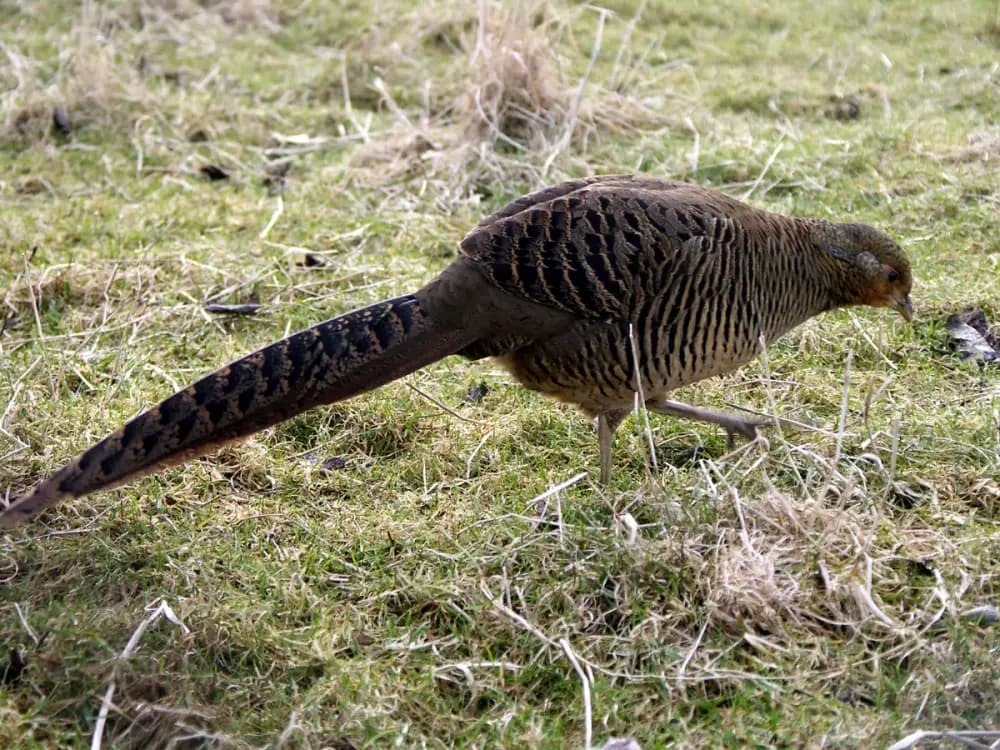
Lady Amherst's pheasant is a long-tailed bird of the pheasant family, native to southwestern China and far northern Myanmar. The male is unmistakable, with a white-and-black cape that can be raised in display, a red crest, a dark green back, a yellow rump and a greyish-white tail barred with black. The female is far duller, mottled brown. Despite the male's colours, the birds are hard to see in the dense, dark forests with thick undergrowth where they live, so little is known of their behaviour. They feed on the ground on grain, leaves and invertebrates, roost in trees at night, and prefer running to flying.
About the Lady Amherst's pheasant
Lady Amherst's pheasant is a long-tailed pheasant native to the forests of southwestern China and far northern Myanmar. It is one of just two species in the ruffed pheasant genus Chrysolophus, alongside its close relative the golden pheasant, and the male stands out with a black-and-white cape, a red crest and an extraordinarily long barred tail.
The male is hard to mistake. He measures 100–120 cm (39.5–47 in), and about 80 cm (31 in) of that is tail. The tail is grayish white with black bars and red streaks near the base. Around the neck sits a nuchal cape of white feathers edged in black, which he can raise and spread when displaying, and a red crest tops the head. The throat is scaled in green, the back is dark green, the wings are blue and brown, the chest and belly are white, and the rump is yellow.
The eye is yellow and surrounded by bare blue-green skin. The bill is horn-colored and the legs are blue-gray. The genus name Chrysolophus comes from Ancient Greek for "with golden crest."
The female looks entirely different. She is much less showy, with dull, mottled brown plumage all over. She resembles a hen common pheasant but with finer barring, and is very similar to a female golden pheasant, though she has a darker head and cleaner underparts. This strong difference between the sexes is typical of pheasants, in which males are usually larger, longer-tailed and far more brightly colored.
The English name and the species name amherstiae both honor Sarah Amherst, Countess Amherst, who sent the first specimen of the bird to London in 1828. Chrysolophus amherstiae is also sometimes called the Chinese copper pheasant.
Behavior and diet
Diet
Grain, leaves and invertebrates, taken on the ground
For all the male's color, these are very hard birds to see in the wild. They live in dense, dark forest with thick undergrowth, and as a result little is known of their behavior in their native range.
What is known is that they feed on the ground, eating grain, leaves and invertebrates, and fly up to roost in trees at night. They can fly but would rather run. When startled, though, a bird can burst upward suddenly and fast, with a distinctive sound from its wings. In the breeding season the male gives a metallic call.
Breeding
Little has been recorded about this species' breeding in the wild, so what follows describes the pheasant family as a whole and its closest relative, not observations of Lady Amherst's pheasant itself. Pheasants breed seasonally, usually in spring or early summer when food is most plentiful. Males are typically polygynous, holding a territory and attracting several females with displays of plumage, calls and wing-flapping, and they will fight over females.
The female builds a ground nest hidden in tall grass, bushes or logs, and incubates the clutch alone; males take no part in nesting or raising chicks. The golden pheasant, the Lady Amherst's closest relative, lays 8 to 12 eggs and incubates them for about 22 to 23 days.
Range and habitat
Habitat
Dense, dark forest with thick undergrowth
Lady Amherst's pheasant is native to southwestern China and the far north of Myanmar, where it lives in dense, dark forest with thick undergrowth. It has also been introduced outside its native range.
A feral population was established in England. Sarah Amherst first released the ornamental bird on her estates near Woburn Abbey, the Duke of Bedford's estate, where the birds were also shot as game. The self-supporting population that followed had its stronghold in west Bedfordshire.
That population is now believed to have been locally extinct since 2015. Several causes worked together. Eurasian goshawks, which had been largely absent from Britain when the pheasants were introduced, preyed on them. Introduced Reeves's muntjac browsed away the woodland understory the pheasants relied on. Hardwood forests were felled and replaced by commercial softwood plantations with little undergrowth, and other woods saw more human recreation. Loss of wildlife corridors cut the remaining groups off from one another. Occasional birds are still seen across the UK, most likely escapes from private collections.
Lady Amherst's pheasant vs golden pheasant
The two Chrysolophus pheasants are close relatives. Where both were introduced in England, they interbred extensively, and most golden pheasants in Britain carry at least some Lady Amherst's ancestry. Captive golden pheasants are often hybrids too. Males are easy to tell apart; hens take more care.
| Feature | Lady Amherst's pheasant | Golden pheasant |
|---|---|---|
| Scientific name | Chrysolophus amherstiae | Chrysolophus pictus |
| Male length | 100–120 cm (39.5–47 in), slightly larger | About 100 cm (39 in) |
| Male crest | Red | Golden |
| Male cape | White edged with black | Orange and black |
| Male body | White chest and belly, dark green back, yellow rump | Bright red body, golden rump |
| Bare skin around eye | Blue-green | Yellow |
| Legs | Blue-gray | Yellow |
| Female | Darker head, cleaner underparts | Breast and sides barred buff and blackish brown |
| Native range | Southwestern China and far northern Myanmar | Mountain forests of western China |
For a full profile of its relative, see the golden pheasant. Other pheasants in the same family include the silver pheasant.
Conservation status
Lady Amherst's pheasant is listed as Least Concern on the IUCN Red List, most recently assessed in 2018.
Outside its native range, the introduced English population declined and is now thought to be locally extinct because of goshawk predation, loss of woodland understory and habitat fragmentation. Hybridization with golden pheasants also blurred the line between the two species in Britain. In its native range, the bird's shy habits and dense forest home mean that much about its life in the wild remains unstudied.
Where to see lady amherst's pheasant in the U.S.
7 zoos across 6 states
Find the closest one
Rank the 5 zoos holding lady amherst's pheasant by how far they are from you. Your location is used in your browser to sort this list and is never sent to us.
2 more zoos hold lady amherst's pheasant but have no coordinates on file yet, so they aren't ranked here. They're in the full list below.
California· 1
Connecticut· 1
North Carolina· 1
Ohio· 2
Pennsylvania· 1
Tennessee· 1
AZAThe Association of Zoos and Aquariums. Accredited members have passed an independent inspection of animal care and welfare, safety, conservation and education, repeated every five years. Many smaller facilities never apply, so “not accredited” isn't a verdict on its own. What accreditation means · How we check this
Built from each zoo's own published animal list.
Lady Amherst's Pheasant: common questions
What does a Lady Amherst's pheasant look like?
The male has a red crest, a black-and-white cape, a green throat and back, a white belly, a yellow rump and a very long gray-white tail barred with black. The female is plain mottled brown.
How big is a Lady Amherst's pheasant?
Males reach 100–120 cm (39.5–47 in) long, with about 80 cm (31 in) of that being tail. Females are much smaller.
Where do Lady Amherst's pheasants live?
In dense forest with thick undergrowth in southwestern China and far northern Myanmar. A feral population once lived in England but is now believed to be gone.
What do Lady Amherst's pheasants eat?
Grain, leaves and invertebrates, which they find on the forest floor.
Who was Lady Amherst?
Sarah Amherst, Countess Amherst, who sent the first specimen of the bird to London in 1828. Both the English name and the species name honor her.
Can Lady Amherst's pheasants fly?
Yes, but they prefer to run. When startled they can burst into the air suddenly and fast, with a distinctive wing sound, and they fly up into trees to roost at night.
Is the Lady Amherst's pheasant endangered?
No. It is listed as Least Concern on the IUCN Red List.