- Where to see one
- 7 U.S. zoos in our directory hold beautiful fruit dove, confirmed against each zoo's own animal list.
- Native range
- New Guinea and nearby West Papua islands
- Size
- About 19 cm (7.5 in) long
- Weight
- About 70 g (2.5 oz)
About the beautiful fruit dove
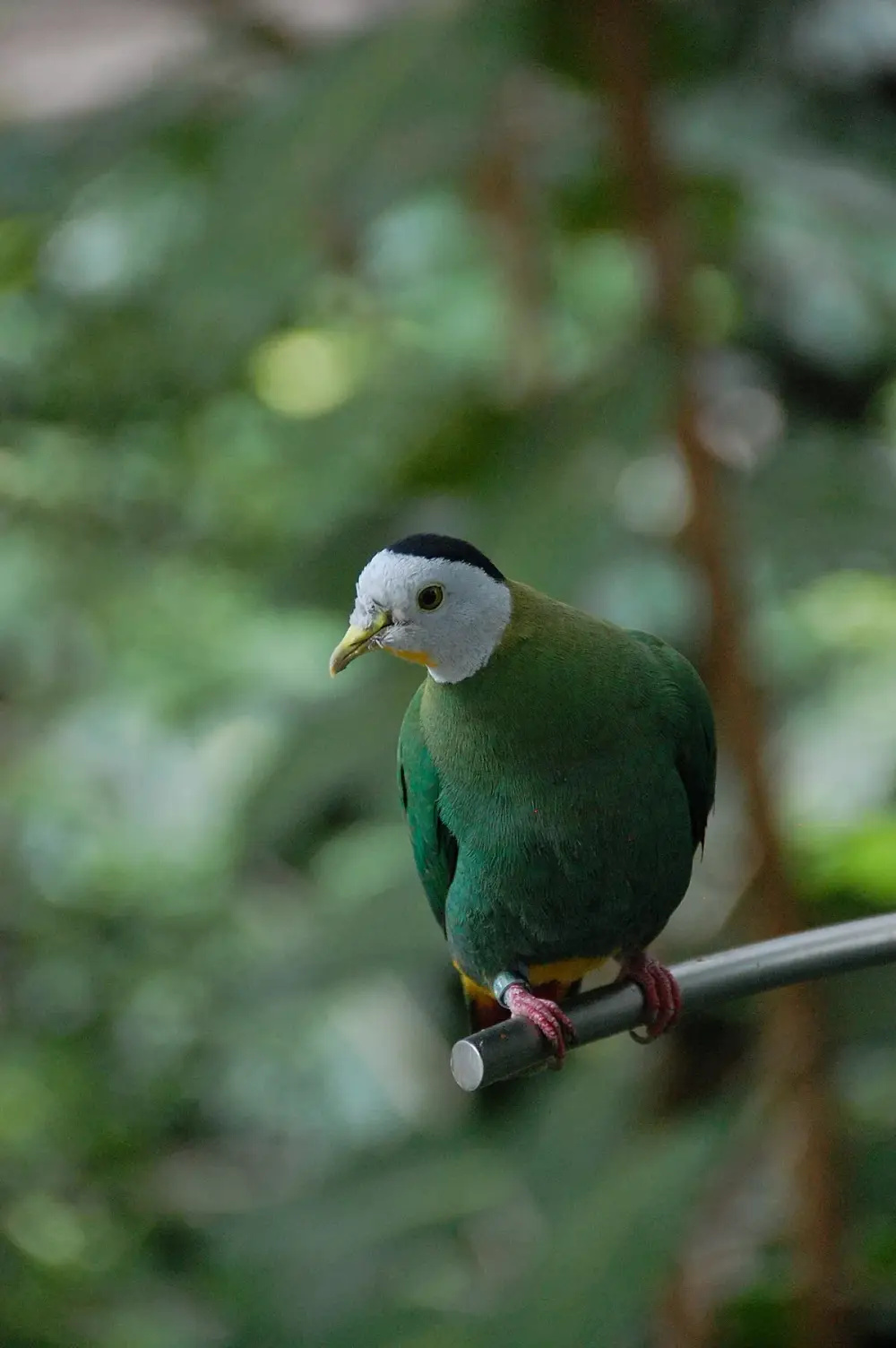
The beautiful fruit dove, also known as the rose-fronted pigeon or crimson-capped fruit dove, is a small, mainly green pigeon about 19 cm (7.5 in) long. It has a red crown, a whitish throat, a greenish-yellow bill, and purplish-red feet. Its underparts carry more color than its back: a blue-grey breast leads into a reddish-purple patch, which in turn gives way to a yellowish-orange belly. Males and females look alike, so the species can't be sexed by eye in the field or in an exhibit.
The species is found in rainforests of New Guinea and on several islands of West Papua, Indonesia — Batanta, Waigeo, Salawati, and Misool — mostly in flat terrain rather than mountainous country. Little else about its breeding biology is documented beyond the fact that a female typically lays a single white egg.
Behavior and diet
Diet
Various fruits from trees, palms, and vines
The beautiful fruit dove's diet is built around fruit taken from trees, palms, and vines. A study of birds in the Port Moresby area found a mixed diet in May: large fruit of Tristiropsis canarioides was taken when available, though the dove gets displaced from fruiting trees by bigger pigeons such as the collared imperial pigeon. Small Endiandra fruit was eaten very often, though it made up only a small share of total food volume. Other recorded foods include Gymnacranthera paniculata, small amounts of Polyalthia fruit, Livistona palm fruit, and occasionally pepper (Piper) berries. Despite its small size, the species can swallow fruit with a volume of about 5 cm³ — roughly 2 cm (0.8 in) across if the fruit is round — which is a substantial mouthful for a bird its size.
Range and habitat
Habitat
Rainforest, primarily flat terrain
The beautiful fruit dove is confined to New Guinea's rainforests and a handful of West Papua islands off its western end — Batanta, Waigeo, Salawati, and Misool — where it favors flat, low-lying terrain rather than upland forest.
Conservation status
The species is evaluated as Least Concern on the IUCN Red List. It is described as widespread and common across its large range, and no threats are noted in the available record.
Where to see beautiful fruit dove in the U.S.
7 zoos across 6 states
Find the closest one
Rank the 7 zoos holding beautiful fruit dove by how far they are from you. Your location is used in your browser to sort this list and is never sent to us.
California· 1
Illinois· 1
Kentucky· 1
Massachusetts· 2
Oklahoma· 1
Oregon· 1
AZAThe Association of Zoos and Aquariums. Accredited members have passed an independent inspection of animal care and welfare, safety, conservation and education, repeated every five years. Many smaller facilities never apply, so “not accredited” isn't a verdict on its own. What accreditation means · How we check this
Built from each zoo's own published animal list.
Beautiful Fruit Dove: common questions
Is the beautiful fruit dove endangered?
No. It's listed as Least Concern and described as widespread and common across its range.
How big does a beautiful fruit dove get?
About 19 cm (7.5 in) long and around 70 g (2.5 oz).
What does a beautiful fruit dove eat?
Fruit from trees, palms, and vines, including Tristiropsis canarioides, Endiandra, Gymnacranthera paniculata, Polyalthia, and Livistona palm fruit, plus occasional pepper berries.
Where do beautiful fruit doves live in the wild?
In rainforest on New Guinea and the West Papua islands of Batanta, Waigeo, Salawati, and Misool, mostly on flat terrain.
Which U.S. zoos have beautiful fruit doves?
Seven zoos in our directory, including Fresno Chaffee Zoo, Lincoln Park Zoo, and the Oregon Zoo.