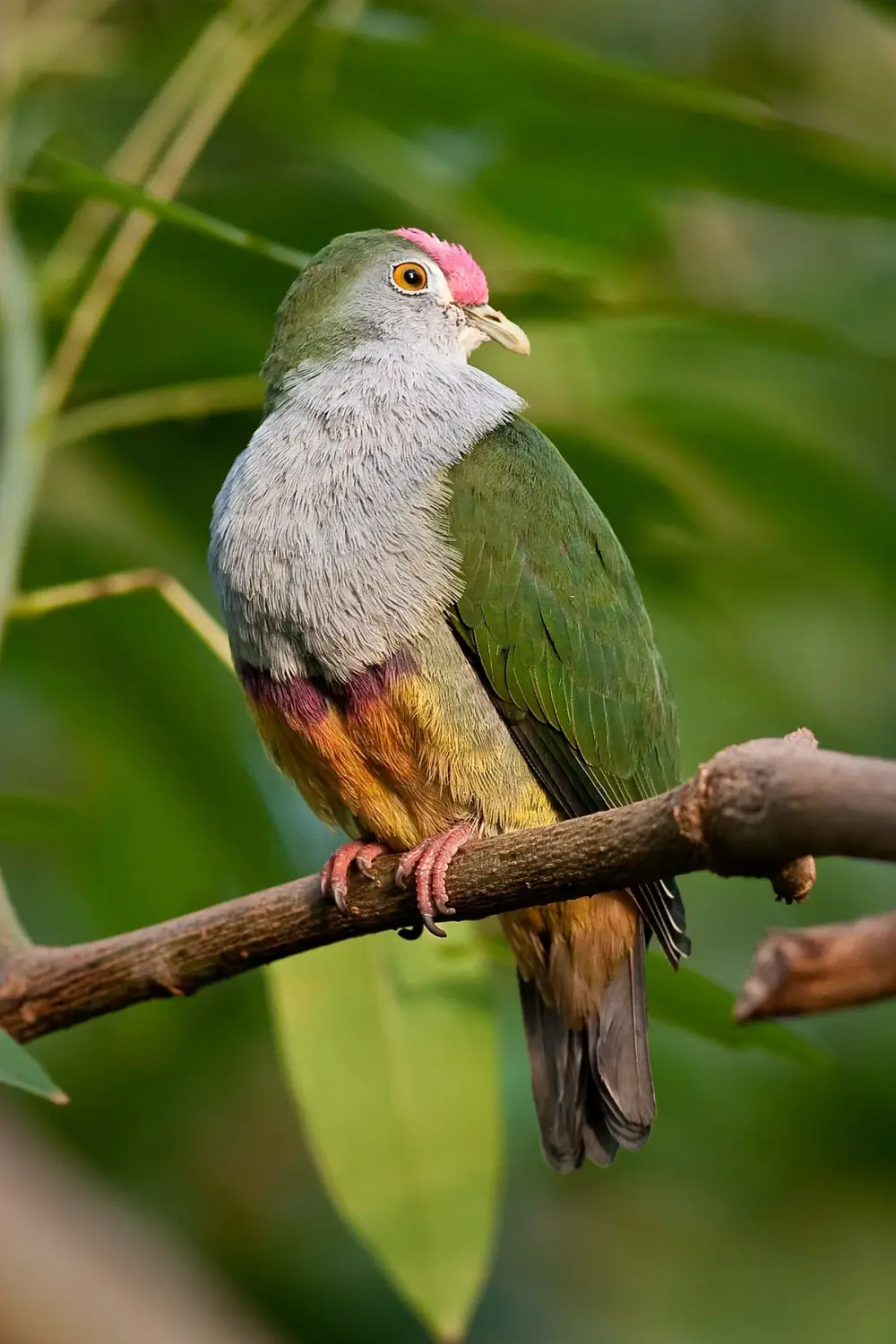
- Where to see one
- 6 U.S. zoos in our directory hold black-naped fruit dove, confirmed against each zoo's own animal list.
- Native range
- Indonesia, Malaysia, and the Philippines
- Size
- Up to 24 cm (9.4 in) long; weighs about 105 g (approximately 3.7 oz)
Conservation status
Least Concernassessed 2024
IUCN Red List category LC — step 1 of 7.
Least Concern (LC), assessed 2024
About the black-naped fruit dove
The black-naped fruit dove, also known as the black-headed fruit dove, is a medium-sized green fruit dove that grows up to 24 cm (9.4 in) long, with a yellowish bill and iris. It weighs around 105 g, or roughly 3.7 oz. The species shows a clear difference between the sexes: the male has a pale grey head with a black patch on the nape, a yellow throat, and golden yellow and pink coverts under the tail, while the plumage of the female and young birds is entirely green.
The species is distributed across Indonesia, Malaysia, and the Philippines. Within Indonesia it occurs on Java, in the Lesser Sunda Islands, and on Sulawesi, where it inhabits lowland and hill forests. It is widespread and common across this large range, which is reflected in its conservation status.
Behavior and diet
Diet
Various fruits, figs, and berries
The black-naped fruit dove feeds mainly on various fruits, figs, and berries, in keeping with its name and its place among the fruit doves. The female typically lays a single white egg.
Range and habitat
Habitat
Lowland and hill forests
The black-naped fruit dove is found in Indonesia, Malaysia, and the Philippines. In Indonesia specifically, it occurs on Java, in the Lesser Sunda Islands, and on Sulawesi, where it lives in lowland and hill forest habitat.
Conservation status
The black-naped fruit dove is listed as Least Concern on the IUCN Red List, based on a 2024 BirdLife International assessment. It is widespread and common throughout its large range, which is the main reason it is not considered at risk of extinction.
Where to see black-naped fruit dove in the U.S.
6 zoos across 5 states
Find the closest one
Rank the 6 zoos holding black-naped fruit dove by how far they are from you. Your location is used in your browser to sort this list and is never sent to us.
Indiana· 1
Massachusetts· 2
Oklahoma· 1
Oregon· 1
Virginia· 1
AZAThe Association of Zoos and Aquariums. Accredited members have passed an independent inspection of animal care and welfare, safety, conservation and education, repeated every five years. Many smaller facilities never apply, so “not accredited” isn't a verdict on its own. What accreditation means · How we check this
Built from each zoo's own published animal list.
Black-naped Fruit Dove: common questions
Is the black-naped fruit dove endangered?
No. It's listed as Least Concern on the IUCN Red List (2024 assessment), reflecting its wide and common distribution.
How big does a black-naped fruit dove get?
Up to 24 cm (9.4 in) long, weighing about 105 g (roughly 3.7 oz).
What does a black-naped fruit dove eat?
Various fruits, figs, and berries.
Where do black-naped fruit doves live in the wild?
In Indonesia, Malaysia, and the Philippines, including Java, the Lesser Sunda Islands, and Sulawesi, in lowland and hill forest.
Which U.S. zoos have black-naped fruit doves?
Seven U.S. zoos list one, including Fort Wayne Zoo, Franklin Park Zoo, and the Oregon Zoo.