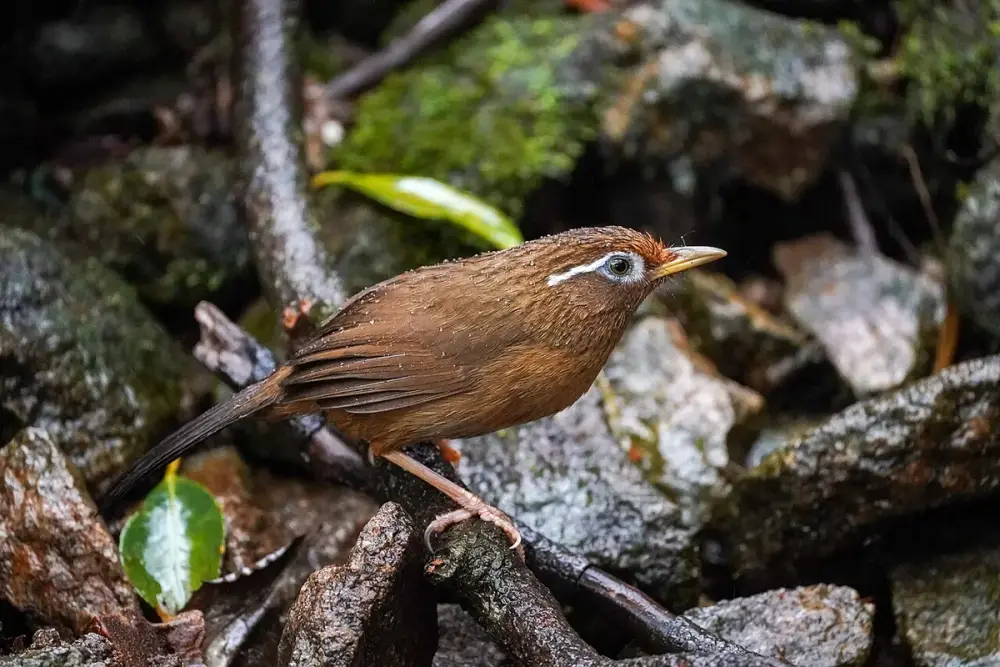
White-crested Laughingthrush
Garrulax leucolophus
Also known as White-Crested Laughing Thrush Least Concern
- Where to see one
- 7 U.S. zoos in our directory hold white-crested laughingthrush, confirmed against each zoo's own animal list.
- Native range
- Himalayan foothills of India, Nepal and Bhutan east through Bangladesh, Myanmar and southern China to Thailand, Laos, Cambodia and Vietnam
- Size
- About 30 cm (12 in) long, including a 13–15 cm (5–6 in) tail
- Lifespan
- Not well documented
- Group size
- Usually flocks of 6 to 12, sometimes up to 40
- Clutch size
- 2 to 6 white eggs, incubated for 13 to 17 days
Conservation status
Least Concernassessed 2016
IUCN Red List category LC — step 1 of 7.
The white-crested laughingthrush is a highly social and vocal bird found in forest and scrub from the Himalayan foothills to Southeast Asia. It has a stocky build, a white hood and raised crest, a broad black eye-mask and rufous-toned back and underparts. It favours dense, moist thickets and the edges and understory of broadleaved secondary forest, coming out of cover mainly to feed on the ground, where it tosses leaf litter aside with its beak to find invertebrates. It is omnivorous, eating beetles, spiders, caterpillars, snails, fruit, seeds and nectar. Flocks usually number 6 to 12 birds.
About the white-crested laughingthrush
The white-crested laughingthrush is a loud, social songbird of South and Southeast Asia, named for its white hood and crest and its cackling calls. It belongs to the laughingthrush family, Leiothrichidae, which was split from the Old World babblers, and it lives in forest and scrub from the Himalayan foothills to Vietnam.
The scientific name, Garrulax leucolophus, describes the bird well. Garrulax comes from the Latin for "to chatter," a nod to how vocal these birds are, and leucolophus combines the Greek words for "white" and "crest." Four subspecies are recognized, spread from northern India and Nepal east to Vietnam and southern China.
Like other members of its genus, it is a stocky bird with strong blackish legs and bill, a rounded tail and full, fluffy plumage. Adults average about 30 cm (12 in) in length, and the tail alone runs 13 to 15 cm (5–6 in).
The head is the giveaway. A bright white hood and raised crest cover the head, throat and upper chest, cut across by a broad black mask that runs through the eye. The nape is light gray. Below the white, the mantle, back and lower underparts are a warm rufous brown, which darkens to olive-brown on the tail and upper wings.
Males and females look almost the same. Females have a slightly smaller crest, a duller mantle and a bit more gray on the nape. Young birds have a shorter crest and tail, a paler mask, a brownish nape and a brighter mantle. The subspecies differ in small ways: some have a darker chestnut back, and the eastern forms show more white extending down onto the belly.
Behavior and diet
Diet
Omnivore: beetles, spiders, caterpillars, snails and other invertebrates, plus fruit, seeds, nectar and small reptiles and frogs
This is a highly social bird. White-crested laughingthrushes usually move in flocks of 6 to 12 birds, and groups of up to 40 have been reported. A flock is hard to miss. One bird starts a call with short syllables, and the rest of the group answers in a loud, often ragged chorus.
That outburst gives the laughingthrush its name. The loud cackling is often followed by quieter chatter and muttering. The birds use four types of vocalizations, from short sounds through repeated phrases and longer "sentences" to subsongs. Most calls serve the group: keeping flock members in touch, warning of danger or intruders, and rallying the flock to mob a threat. These birds can be aggressive toward other flocks and other species.
The white-crested laughingthrush is an omnivore and an opportunist. Most of its diet is invertebrates, including beetles, spiders, flies, caterpillars, snails and even leeches. It also eats fruit, seeds and nectar, and it will take small snakes, lizards and frogs. Birds in Singapore have been seen picking at human food and garbage, and some have even approached people for scraps.
Feeding happens mostly on the ground. Small parties hop through the undergrowth, flicking leaf litter aside with their bills to expose insects and other small animals. The birds usually stay in dense cover and come out mainly to feed.
White-crested laughingthrushes start breeding in their second year and can nest several times between February and September. The nest is a shallow cup of bamboo leaves and grass bound with twigs and stems, placed in a shrub or tree 2 to 6 m (6.5–20 ft) off the ground.
A clutch has 2 to 6 pure white eggs, each about 6.5 g (0.2 oz). Both parents incubate for 13 to 17 days and then share brooding and feeding. The chicks hatch naked and look like small adults within 14 to 16 days.
The species is a cooperative breeder, so the work often goes beyond the parents. Two females may share a nest, and three or more adults may take turns incubating and feeding the young. Some helpers are juveniles from an earlier brood that same year, which help build the nest or feed their younger siblings.
Range and habitat
Habitat
Dense, moist thickets, scrub, bamboo and the edges and understory of broadleaf forest, up to about 1,600 m (5,250 ft)
The white-crested laughingthrush has one of the widest ranges of any laughingthrush. It is native to India, Nepal, Bhutan, Bangladesh, Myanmar, China, Thailand, Laos, Cambodia and Vietnam. The western subspecies lives in northern India, Nepal, Bhutan and southern Tibet, while the eastern form ranges through Myanmar, Thailand, Laos, Cambodia, Vietnam and Yunnan in southern China.
It is a bird of foothill forests up to about 1,600 m (5,250 ft). It favors dense, moist, shady thickets and scrub, along with the edges and understory of broadleaf secondary forest, where it can hide from predators and stay out of the sun. Bamboo is an important part of good habitat, providing both nest sites and cover.
The species is popular as a cage bird, and escaped or released birds are the likely source of populations that appeared in Malaysia and Singapore in the 1970s and 1980s. Some birds were probably released during religious practices. Trapping keeps numbers low in Malaysia, but in Singapore the bird is well established. There it may be crowding out native ground-feeding birds such as Abbott's babbler, which are already under pressure from habitat fragmentation.
Its success as an invader comes from its cooperative social life, dense flocks and ability to use many habitats, including parks, gardens and degraded forest. The cage-bird trade has also brought it to the United Kingdom and the United States, but no wild populations have been reported in either country.
White-crested laughingthrush vs Sumatran laughingthrush
The Sumatran laughingthrush, Garrulax bicolor, was once treated as a subspecies of the white-crested laughingthrush. It is now a separate species, and the two are easy to tell apart.
| Trait | White-crested laughingthrush | Sumatran laughingthrush |
|---|---|---|
| Scientific name | Garrulax leucolophus | Garrulax bicolor |
| Plumage | White hood with rufous body | Blackish-brown and white, no rufous |
| Tail | 13–15 cm (5–6 in) | Shorter |
| Range | Himalayan foothills to Southeast Asia | Highland forest on Sumatra only |
| IUCN status | Least Concern | Endangered |
Conservation status
The white-crested laughingthrush is listed as Least Concern on the IUCN Red List, assessed by BirdLife International in 2016. Its very wide range means it faces little risk of extinction.
Its close relative is in a very different position. The Sumatran laughingthrush is rated Endangered, threatened by habitat loss and by capture for the wildlife trade. Illegal trade continues openly in bird markets on Sumatra and Java despite legal protection in Indonesia, and there have been calls for stronger international protection through CITES.
Where to see white-crested laughingthrush in the U.S.
7 zoos across 5 states
Find the closest one
Rank the 6 zoos holding white-crested laughingthrush by how far they are from you. Your location is used in your browser to sort this list and is never sent to us.
1 more zoo holds white-crested laughingthrush but has no coordinates on file yet, so it isn't ranked here. It's in the full list below.
California· 2
Connecticut· 1
Idaho· 1
Kentucky· 1
Virginia· 2
AZAThe Association of Zoos and Aquariums. Accredited members have passed an independent inspection of animal care and welfare, safety, conservation and education, repeated every five years. Many smaller facilities never apply, so “not accredited” isn't a verdict on its own. What accreditation means · How we check this
Built from each zoo's own published animal list.
White-crested Laughingthrush: common questions
Why is it called a laughingthrush?
Because of its call. Flocks break into loud, cackling outbursts that sound like laughter, often followed by quieter chatter.
What does a white-crested laughingthrush eat?
Mostly insects and other invertebrates, such as beetles, spiders, caterpillars and snails. It also eats fruit, seeds, nectar and small lizards, snakes and frogs.
How big is a white-crested laughingthrush?
About 30 cm (12 in) long, including a tail of 13 to 15 cm (5–6 in).
Where do white-crested laughingthrushes live?
In forest and scrub from the Himalayan foothills of India, Nepal and Bhutan east to Myanmar, southern China, Thailand, Laos, Cambodia and Vietnam. Introduced birds also live in Singapore.
Are white-crested laughingthrushes social?
Yes. They live in flocks of usually 6 to 12 birds and breed cooperatively, with extra adults and juveniles helping to raise the chicks.
Are white-crested laughingthrushes endangered?
No. They are listed as Least Concern and have one of the widest ranges of any laughingthrush.
Are white-crested laughingthrushes kept as pets?
Yes. They are popular cage birds, and escaped or released birds are the likely origin of wild populations in Malaysia and Singapore.