- Where to see one
- 12 U.S. zoos in our directory hold lynx, confirmed against each zoo's own animal list.
- Native range
- Alaska, Canada, and the northern contiguous United States
- Size
- 48–56 cm (19–22 in) tall at the shoulder; 5–17 kg (11–37 lb)
Conservation status
Least Concernassessed 2016
IUCN Red List category LC — step 1 of 7.
About the lynx
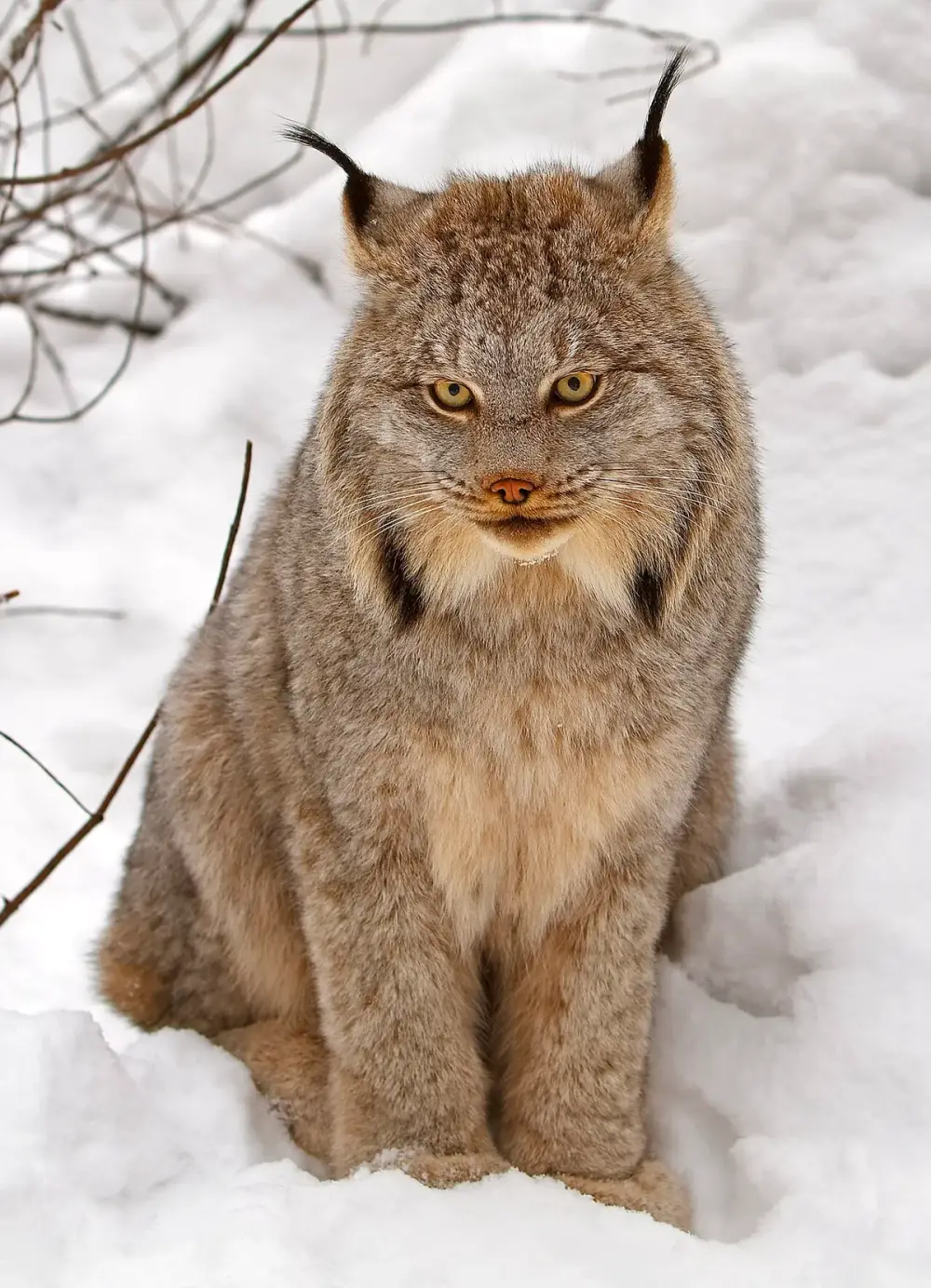
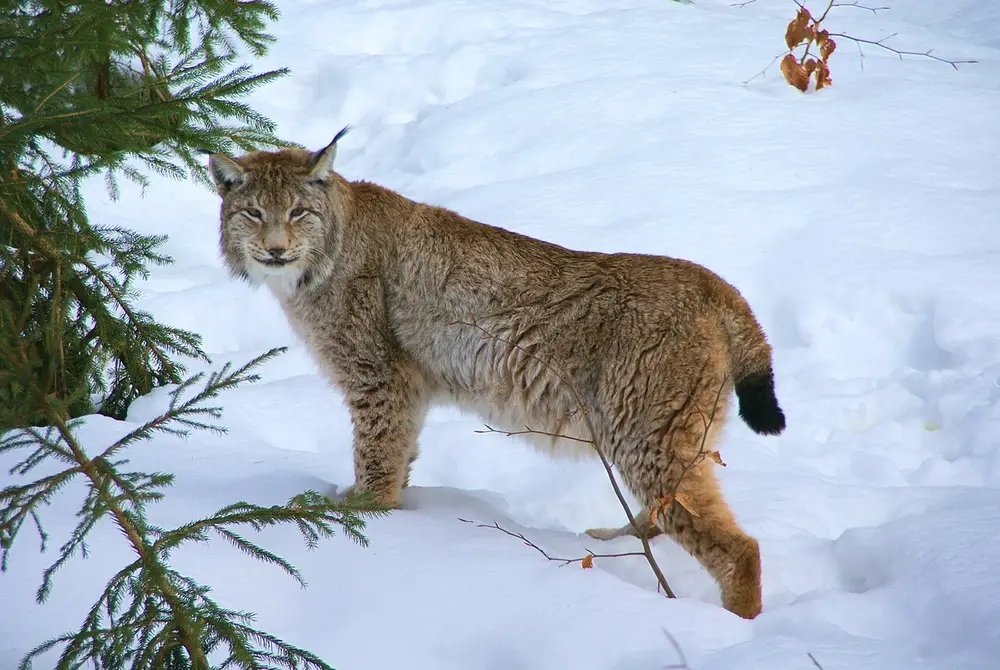
The Canada lynx is one of four living species in the genus Lynx, alongside the bobcat, the Eurasian lynx, and the Iberian lynx. It is a medium-sized wild cat with long, dense fur, triangular ears tipped with black tufts, and broad, snowshoe-like paws that spread as wide as 3.9 in (10 cm) to keep the animal moving easily across soft snow. Its hind limbs are longer than its forelimbs, giving its back a downward slope toward the front. A Canada lynx stands 19 to 22 in (48 to 56 cm) tall at the shoulder, measures 29 to 42 in (73 to 107 cm) in total length, and weighs between 11 and 37 lb (5 to 17 kg), with males generally larger than females; an exceptional male in Pennsylvania weighed 44 lb (20 kg). Its stubby tail, 2 to 5.1 in (5 to 13 cm) long, ends in a solid black tip — one of several features, along with its longer ear tufts, broader paws, longer legs, and less patterned, grayer coat, that separate it from the generally smaller bobcat.
The species was first described by Robert Kerr in 1792, and its taxonomic history has shifted over time; it is now considered a monotypic species, meaning it shows too little variation across its range to be split into valid subspecies, though three had once been proposed for the Canadian mainland, Newfoundland, and Alaska. Its long, thick fur — typically yellowish brown, with white, sometimes lightly spotted underparts — is what insulates the animal through cold winters, when the coat grows noticeably longer and thicker than in summer, and longer hair on the lower cheeks can give the impression of a ruffle covering the throat. Fossil evidence traces the Canada lynx's lineage back to the Eurasian lynx, which reached North America roughly 2.6 million years ago and initially settled in the glacier-free south, where it evolved into the modern bobcat; a second invasion of the continent within the last 200,000 years settled the newly ice-free north and gave rise to the modern Canada lynx.
Behavior and diet
Diet
Primarily snowshoe hare, plus other small prey when hares are scarce
The Canada lynx is a nocturnal, largely solitary hunter that depends heavily on the snowshoe hare, which makes up 35 to 97% of its diet depending on season and local hare abundance. It typically hunts by waiting for hares along known trails or in "ambush beds," then pouncing and killing with a bite to the head, throat, or nape. When hare numbers fall, lynx will turn to other prey such as ducks, grouse, moles, ptarmigan, red squirrels, voles, and young ungulates, including Dall's sheep, mule deer, and boreal woodland caribou — though hares remain the dominant food source even then. This close relationship with hare populations creates a well-documented predator-prey cycle: lynx numbers rise and fall in step with cyclical booms and busts in the snowshoe hare population across Alaska and central Canada, and lynx will relocate to areas with more hares, or produce fewer young, when hares grow scarce locally.
Canada lynx are strong swimmers — one was recorded crossing 2 mi (3.2 km) of the Yukon River — and skilled climbers that will scale trees to escape predators, though they still do all their hunting on the ground. They can travel 5 to 5.6 mi (8 to 9 km) a day at a steady pace in search of prey. Individuals, particularly those of the same sex, tend to avoid one another and maintain separate home ranges that they mark with urine and feces on snow, tree stumps, and other prominent spots; social contact is limited mostly to mothers and their female offspring and to brief pairings during the roughly month-long mating season, which runs from March into early April. After a two-to-three-month gestation, females give birth to a litter of one to eight kittens, which are weaned around 12 weeks of age.
Range and habitat
Habitat
Dense boreal forest
The Canada lynx ranges across Alaska, Canada, and the northern parts of the contiguous United States, closely tracking the range of its primary prey, the snowshoe hare, through dense boreal forest. In the U.S. it is found in the Blue Mountains and Cascade Range of the Pacific Northwest, the Rocky Mountains, the northern Great Lakes region of Minnesota and Michigan's Upper Peninsula, and northern New England, including New Hampshire, Maine, and Vermont; it was successfully reintroduced to Colorado starting in 1999 after being wiped out there in the 1970s. The species is now considered extirpated from New York, Pennsylvania, Massachusetts, Nevada, Indiana, and Ohio, though a 2022 photograph confirmed the first Canada lynx sighting in Wyoming since 2012.
Canada lynx generally avoid open country even where prey is plentiful, and struggle to persist in heavily logged or agricultural land, though they can do well in previously deforested areas that have been allowed to regenerate for at least 15 years. They have been recorded at elevations up to 14,140 ft (4,310 m), and individual home ranges vary enormously depending on prey density and how they are measured, from roughly 3 to 302 sq mi (8 to 783 sq km) across different studies.
Conservation status
The Canada lynx is listed as Least Concern on the IUCN Red List, in a 2016 assessment. It is abundant over its broad range, and legal trade in its fur has not seriously threatened it for centuries.
Populations are lower in the southern half of the range, where the cat is protected from the fur trade. Habitat loss is the main threat in the contiguous United States, while in eastern Canada the lynx faces growing competition from the eastern coyote. It is listed as Endangered in New Brunswick and Nova Scotia, and in 2000 the U.S. Fish and Wildlife Service designated it a Threatened Species in 14 contiguous states. In January 2018 the agency said the lynx no longer needed special protections in the United States, and that its Threatened status may be revoked.
Recovery work has had real results. After an 11-year effort, lynx were successfully reintroduced to Colorado by 2010, with self-sustaining populations across the south-central Colorado Rockies. A 2017 study reported increasing numbers in many parts of the United States, though habitat fragmentation has held back populations in Washington.
Where to see lynx in the U.S.
12 zoos across 9 states
Find the closest one
Rank the 7 zoos holding lynx by how far they are from you. Your location is used in your browser to sort this list and is never sent to us.
5 more zoos hold lynx but have no coordinates on file yet, so they aren't ranked here. They're in the full list below.
Alaska· 1
Florida· 1
Kentucky· 1
Massachusetts· 2
New Jersey· 1
North Carolina· 1
Texas· 1
Washington· 2
Wisconsin· 2
AZAThe Association of Zoos and Aquariums. Accredited members have passed an independent inspection of animal care and welfare, safety, conservation and education, repeated every five years. Many smaller facilities never apply, so “not accredited” isn't a verdict on its own. What accreditation means · How we check this
Built from each zoo's own published animal list.
Lynx: common questions
Is the lynx endangered?
No. The Canada lynx is listed as Least Concern by the IUCN (2016), though it was designated Threatened in 14 contiguous U.S. states in 2000 and is listed as Endangered in New Brunswick and Nova Scotia.
How big does a lynx get?
A Canada lynx stands 19 to 22 in (48 to 56 cm) tall at the shoulder and weighs between 11 and 37 lb (5 to 17 kg), with males larger than females.
What does a lynx eat?
Mainly the snowshoe hare, which makes up 35 to 97% of its diet; when hares are scarce it also takes ducks, grouse, voles, and young ungulates such as mule deer.
Where do lynx live in the wild?
Across Alaska, Canada, and parts of the northern contiguous United States, in dense boreal forest that overlaps closely with snowshoe hare habitat.
How can you tell a lynx from a bobcat?
The Canada lynx has longer ear tufts, broader paws, longer legs, a shorter tail with a fully black tip, and a grayer, less-marked coat than the bobcat.
Which U.S. zoos have lynx?
Five U.S. zoos list them, including the Alaska Wildlife Conservation Center, Franklin Park Zoo, and Cat Tales Zoological Park.