- Where to see one
- 9 U.S. zoos in our directory hold bufflehead, confirmed against each zoo's own animal list.
- Native range
- Breeds in Alaska and Canada; winters across southern North America
- Size
- 32–40 cm (13–16 in) long, averaging 35.5 cm (14.0 in); weighs 270–550 g (9.5–19.4 oz), averaging 370 g (13 oz); wingspan about 55 cm (21.6 in)
Conservation status
Least Concernassessed 2022
IUCN Red List category LC — step 1 of 7.
Least Concern (LC), assessed 2022; stable to increasing
About the bufflehead
The bufflehead is a small sea duck in the genus Bucephala, the goldeneyes, and it rivals the green-winged teal as the smallest duck in America. Carl Linnaeus first described the species in 1758 as Anas albeola, working from a specimen an English naturalist had examined a decade earlier out of Newfoundland; it was moved into the genus Bucephala, alongside two goldeneye species, in 1858. The genus name comes from the Ancient Greek for "bull-headed," a nod to the bufflehead's oddly bulbous head shape, while the species name albeola is a diminutive of the Latin word for white. Linnaeus based his account on what English naturalist George Edwards had called, in 1747, the "little black and white duck," examined from a specimen collected in Newfoundland. No subspecies are recognized today, and a Late Pleistocene fossil population from California once described as its own species is now considered part of the bufflehead.
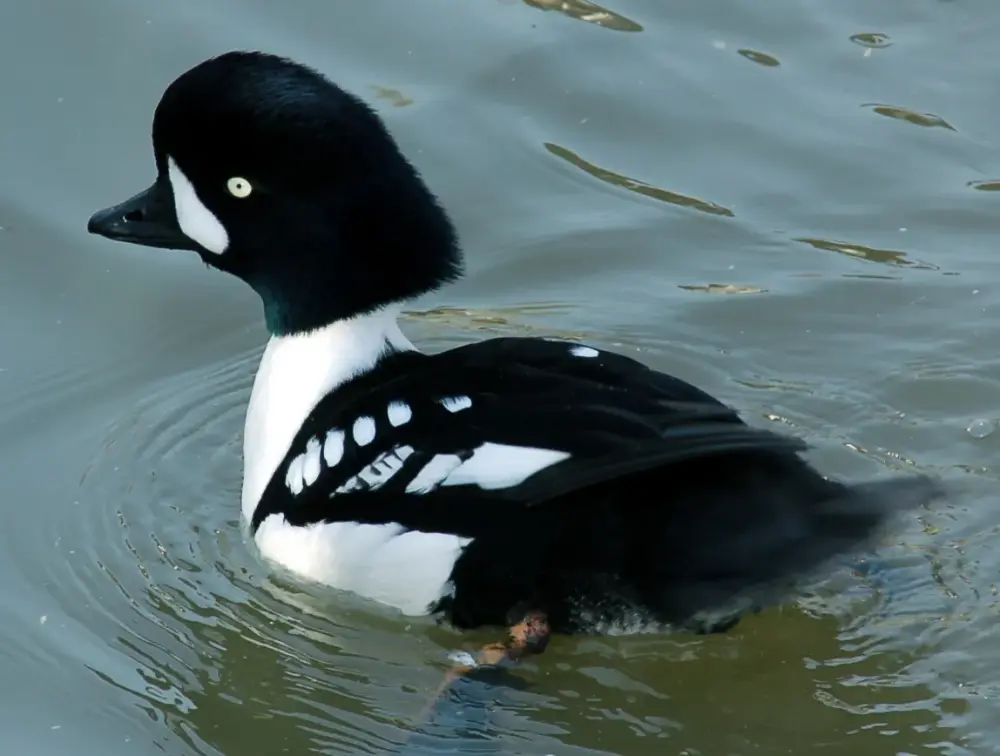
Adult males are strikingly patterned in black and white, with an iridescent green-and-purple head set off by a large white patch behind the eye. Females are more subdued, gray-toned with a smaller white eye patch and a lighter underside. The species ranges from 32 to 40 cm (13 to 16 in) long and averages 35.5 cm (14.0 in), with drakes running larger than females; average weight is about 370 g (13 oz), within a species range of 270 to 550 g (9.5 to 19.4 oz), and the wingspan measures roughly 55 cm (21.6 in).
The bufflehead breeds in wooded lakes and ponds across Alaska and Canada, almost entirely within boreal forest and taiga habitat, and migrates in winter to southern North America. Between 1966 and 2015, its population grew at more than 1.5% a year across its breeding range, a notably better trend than many other sea ducks have shown over the same period.
Behavior and diet
Diet
Insects in freshwater; crustaceans and mollusks in saltwater; also aquatic plants and fish eggs
The bufflehead's small size evolved to match the nesting cavities of its main host, the northern flicker, a woodpecker whose old nest holes the duck relies on for breeding. Because it is so small, it is highly active, diving almost continuously to sustain a high metabolism. Buffleheads generally avoid large flocks, sticking to small groups, and while foraging, one bird typically stands sentry watching for predators while the others dive for food. They are among the last waterfowl to leave their breeding grounds each year and are considered some of the most punctual migrants in the world, arriving on their wintering grounds within a narrow window of time.
Buffleheads are monogamous and nest in tree cavities, mainly in aspens or poplars, usually reusing old flicker nests within about 25 meters (82 ft) of water; they favor smaller cavities than the larger goldeneyes to reduce competition over nest sites. Competitors for those cavities include the mountain bluebird, tree swallow, and European starling, and nesting females face real risk from predators such as foxes, weasels, and mink, as well as occasional violence from competing goldeneyes — one record describes a female Barrow's goldeneye killing a bufflehead female and her brood. A typical clutch holds nine eggs, ranging from six to 11, each averaging 50.5 by 36.3 mm (1.99 by 1.43 in), and incubation lasts about 30 days with a notably high nest success rate of 79% in one study. A day after the last duckling hatches, the whole brood leaps from the nest cavity together, and young fledge at 50 to 55 days old. Adult buffleheads face predation from peregrine falcons, snowy owls, bald eagles, golden eagles, red-tailed hawks, great horned owls, and Cooper's hawks.
Foraging birds dive underwater, generally in water 1.2 to 4.5 m (3.9 to 14.8 ft) deep. In freshwater, the diet is mostly insects; in saltwater, crustaceans and mollusks dominate, with aquatic plants and fish eggs sometimes an important supplementary food source.
Range and habitat
Habitat
Wooded lakes and ponds in boreal forest and taiga for breeding; protected coastal waters, open inland waters, and the Great Lakes in winter
Buffleheads breed in wooded lakes and ponds across Alaska and Canada, in habitat almost entirely contained within the boreal forest and taiga zones. In winter they migrate to protected coastal waters and open inland waters on the east and west coasts of North America and across the southern United States, and they are also regularly seen wintering on the Great Lakes. The species is an extremely rare vagrant to western Europe and an occasional vagrant to the Caribbean, with records from Cuba, the Bahamas, Jamaica, Puerto Rico, the U.S. Virgin Islands, Saint Martin, and Curaçao.
Conservation status
The bufflehead is listed as Least Concern on the IUCN Red List, based on a 2022 BirdLife International assessment. Unlike many other sea ducks, which have declined over recent decades, bufflehead numbers have stayed relatively stable, and the species actually saw yearly population growth of more than 1.5% across its breeding range between 1966 and 2015. Buffleheads are also hunted as a gamebird.
The species has a real fondness among people who watch it: its striking plumage, high activity level, and tendency to turn up close to waterfront homes make it a favorite among birdwatchers. It is also known as the "spirit duck," and the bufflehead was added to the coat of arms of Sidney, British Columbia, in 1995.
Where to see bufflehead in the U.S.
9 zoos across 7 states
Find the closest one
Rank the 8 zoos holding bufflehead by how far they are from you. Your location is used in your browser to sort this list and is never sent to us.
1 more zoo holds bufflehead but has no coordinates on file yet, so it isn't ranked here. It's in the full list below.
California· 1
Connecticut· 1
District of Columbia· 1
Massachusetts· 3
Missouri· 1
Oregon· 1
Wisconsin· 1
AZAThe Association of Zoos and Aquariums. Accredited members have passed an independent inspection of animal care and welfare, safety, conservation and education, repeated every five years. Many smaller facilities never apply, so “not accredited” isn't a verdict on its own. What accreditation means · How we check this
Built from each zoo's own published animal list.
Bufflehead: common questions
Is the bufflehead endangered?
No. It is listed as Least Concern on the IUCN Red List (2022 assessment), and its population has remained relatively stable while many other sea ducks have declined.
How big does a bufflehead get?
It ranges from 32 to 40 cm (13 to 16 in) long, averaging 35.5 cm (14.0 in), and weighs 270 to 550 g (9.5 to 19.4 oz), averaging about 370 g (13 oz).
What does a bufflehead eat?
It eats mainly insects in freshwater and crustaceans and mollusks in saltwater, along with aquatic plants and fish eggs.
Where do buffleheads live in the wild?
They breed in boreal forest and taiga lakes and ponds in Alaska and Canada, then winter across southern North America, including coastal waters and the Great Lakes.
Which U.S. zoos have buffleheads?
Six U.S. zoos list them, including the Los Angeles Zoo, Saint Louis Zoo, and Oregon Zoo.