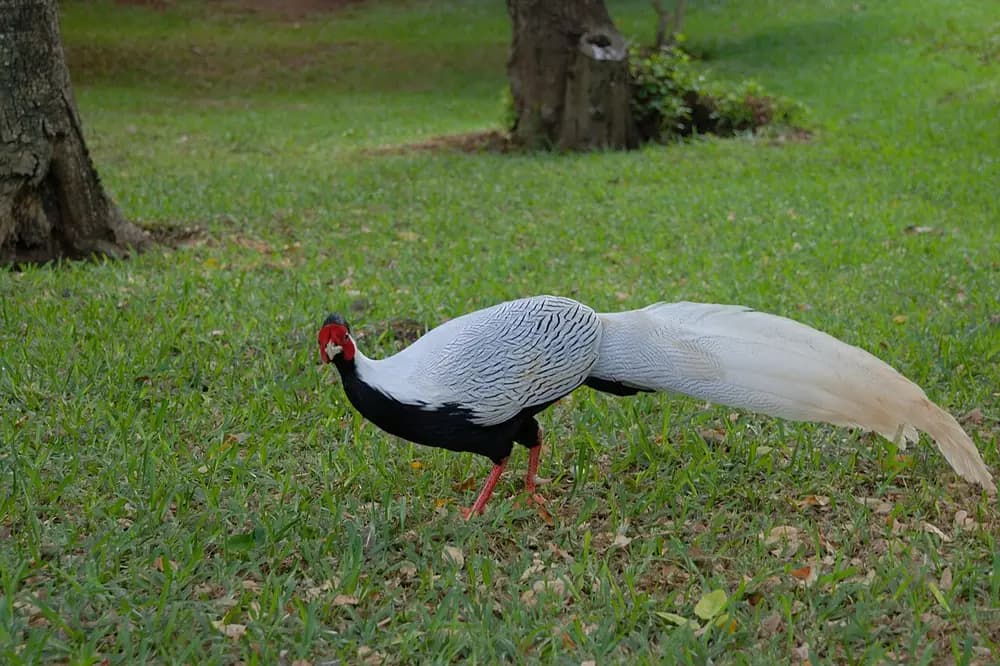
- Where to see one
- 4 U.S. zoos in our directory hold edwards's pheasant, confirmed against each zoo's own animal list.
Conservation status
Not Evaluated
This species has not been assessed for the IUCN Red List, so it sits outside the threat scale entirely.
About the edwards's pheasant
Edwards's pheasant is a forest bird endemic to the seasonal tropical forests of central Vietnam, first described to science in 1896 and named after French ornithologist Alphonse Milne-Edwards. It measures 58 to 65 cm in length, with red legs and facial skin. The male is blue-black with a crest, while the female is a drab chestnut brown without one. It lives in evergreen forest with palms and bamboo patches, often hiding in low vegetation, and females hide nests dug into the ground. Breeding runs from March to May, with females laying four to seven eggs. There have been no confirmed sightings of a living bird in the wild since 2000, and it breeds well in captivity.
Edwards's Pheasant facts
- The Imperial pheasant, once thought a separate species, proved to be a hybrid of this bird and the silver pheasant.
- Defoliants used during the Vietnam War damaged its forest habitat.
- A 2018 photograph of a dead female was the first evidence of a wild bird in almost two decades.
- The alarm call is a repeated puk-puk-puk.
Where to see edwards's pheasant in the U.S.
4 zoos across 4 states
Find the closest one
Rank the 3 zoos holding edwards's pheasant by how far they are from you. Your location is used in your browser to sort this list and is never sent to us.
1 more zoo holds edwards's pheasant but has no coordinates on file yet, so it isn't ranked here. It's in the full list below.
Connecticut· 1
Kansas· 1
Missouri· 1
Ohio· 1
AZAThe Association of Zoos and Aquariums. Accredited members have passed an independent inspection of animal care and welfare, safety, conservation and education, repeated every five years. Many smaller facilities never apply, so “not accredited” isn't a verdict on its own. What accreditation means · How we check this
Built from each zoo's own published animal list.