
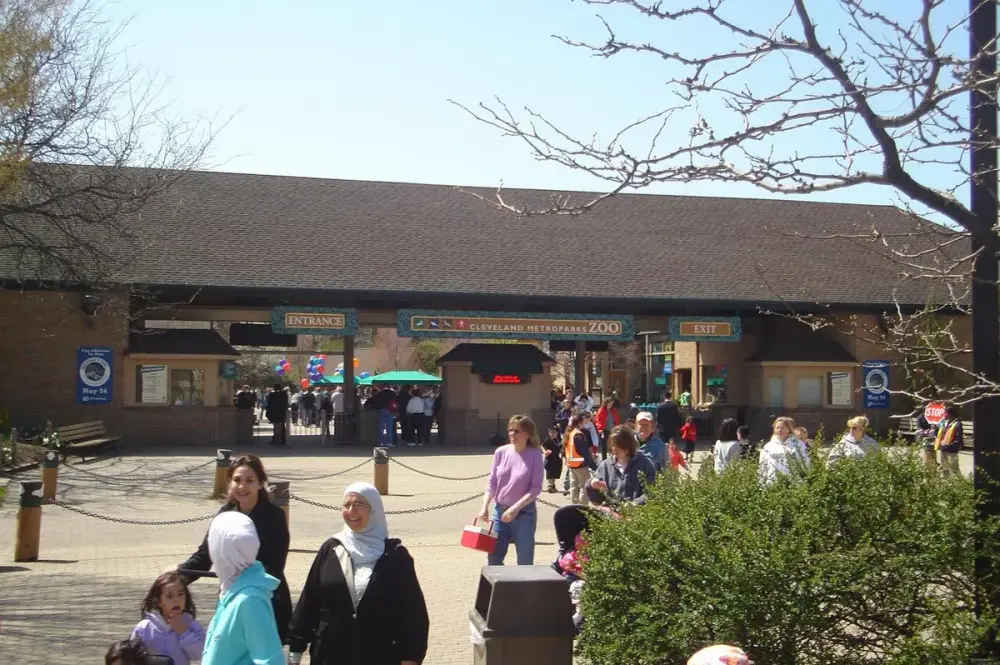
- Admission
- $22.50–$23.50
- Size
- 183 acres
- Opened
- 1882
- Accreditation
- AZA
varies by day of the week
Association of Zoos and Aquariums
Everything below is directory information drawn from public sources and the zoo's own site.
Animals at Cleveland Metroparks Zoo
We haven't confirmed this zoo's animal list yet.
Feathers & Fangs from visitors
What people who've been to Cleveland Metroparks Zoo say
A Feather is something this zoo does well; a Fang is something it gets wrong. Left by people who've been, and read by us before they appear.
Loading…
About Cleveland Metroparks Zoo
Cleveland Metroparks Zoo covers 183 acres at 3900 Wildlife Way in Cleveland, Ohio, and is part of the larger Cleveland Metroparks park system. The zoo was founded in 1882, making it one of Ohio's older zoos, and it is accredited by the Association of Zoos and Aquariums. It draws well over a million visitors a year — 1,227,593 by one recent count, and 1.32 million in 2023 by another — making it one of the most popular year-round attractions in Northeast Ohio.
The zoo's official website describes roughly 3,000 animal residents representing more than 600 different species, spread across bio-thematic areas including Australian Adventure, African Savanna, Northern Wilderness Trek, the Primate, Cat & Aquatics Building, Waterfowl Lake, Asian Highlands, and the newer Susie's Bear Hollow. It also holds one of the largest primate collections in North America. Ohio has been nicknamed a "Zoo State" for the number of reputable zoos it supports, and Cleveland Metroparks Zoo is one of five city zoos in the state.
The zoo has grown through a long series of exhibit openings and closures, most recently the 2024 closure of its long-running RainForest building to make way for a larger, multi-story Primate Forest habitat for gorillas and orangutans, planned to open in 2026.
History
The zoo originally opened in 1882 as the Cleveland Zoological Park at Wade Park, on the site now occupied by the Cleveland Museum of Art, and for years held only animals of local origin. In 1907, the city of Cleveland moved the zoo to its current Old Brooklyn location and acquired its first elephant; for decades afterward it was informally known as Brookside Zoo. Construction of Monkey Island, sea lion pools, and a moated bear exhibit began in 1910, and the Cleveland Museum of Natural History took over management of the zoo in 1940.
Flooding from Big Creek destroyed the zoo's reptile collection and several buildings in January 1959; it would be more than thirty years, with the 1992 opening of the RainForest, before the zoo had a permanent reptile collection again. Management passed to Cleveland Metroparks in 1975, and a sustained building program followed: the Primate & Cat Building opened that year (with an Aquatics wing added in 1985), followed by the RainForest in 1992, Wolf Wilderness in 1997, Australian Adventure in 2000, and the Sarah Allison Steffee Center for Zoological Medicine in 2004. African Elephant Crossing opened in 2011, the Ben Gogolick Giraffe Encounter in 2015, Rosebrough Tiger Passage in 2016, Asian Highlands in 2018, Rhino Reserve in 2020, and Susie's Bear Hollow in 2023. The RainForest closed permanently in September 2024 to be rebuilt as a 140,000-square-foot Primate Forest, scheduled to open in 2026.
The zoo has also had its share of public incidents over the decades, including a 1938 episode in which a polar bear named Silver pulled a young WPA artist into its enclosure, and a 2015 case in which a toddler was dropped into a cheetah exhibit and safely retrieved by his parents.
Exhibits and habitats
The RainForest, before its 2024 closure, was one of the zoo's signature exhibits: a two-story building with more than 2 acres of floor space, over 10,000 plants, and more than 600 animals from the tropical regions of Australasia, Africa, and the Americas, including Bornean orangutans, binturongs, giant anteaters, capybaras, clouded leopards, and Asian small-clawed otters. Its replacement, Primate Forest, is being built to house gorillas and orangutans across multiple stories and is expected to open in 2026.
African Savanna, near the park entrance, holds African lions, flamingos, Masai giraffes, Hartmann's mountain zebras, bontebok, and eastern black rhinos, along with the Ben Gogolick Giraffe Encounter, where visitors can purchase leaves to feed the giraffes. African Elephant Crossing, a $25 million exhibit opened in 2011, quadrupled the zoo's elephant living space and increased its African elephant herd from three animals to eight or ten, with deep pools for swimming and heated areas for winter. Australian Adventure is an 8-acre exhibit modeled on the outback, home to free-roaming wallaroos, kangaroos, and wallabies in Wallaby Walkabout, dingoes, aviaries with keas, cockatoos, and kookaburras, and a Gum Leaf Hideout housing koalas and Matschie's tree-kangaroos.
Wilderness Trek houses cold-climate species including Siberian tigers, grizzly bears, tufted deer, reindeer, and American bison, plus a large collection of bear species — grizzly, Andean, Malayan sun, North American black, and sloth bears among them. Within it, Wolf Wilderness centers on a 3,000-square-foot Wolf Lodge with viewing rooms onto Mexican gray wolves, a Canadian beaver habitat, a 65,000-gallon freshwater pond, and bald eagles. Rosebrough Tiger Passage, opened in 2016, gives the zoo's Amur tigers four interconnected habitat areas linked by elevated overhead pathways, while Asian Highlands, opened in 2018, holds snow leopards, Amur leopards, red pandas, and Sichuan takins. Susie's Bear Hollow, opened in 2023, replaced 1960s-era enclosures with modern habitats for the zoo's sloth bears and spectacled bear.
The Primate, Cat & Aquatics Building, dating to 1975, houses one of the largest primate collections in North America, including western lowland gorillas, Müller's gibbons, golden-bellied mangabeys, black howler monkeys, and several lemur species, plus a nocturnal section with aye-ayes and pygmy slow lorises. Its Aquatics wing, added in 1985 from the donated collection of the closed Cleveland Aquarium, includes 35 salt- and freshwater exhibits with Australian lungfish, a giant Pacific octopus, and electric eels. Waterfowl Lake, home to Chilean flamingos, black swans, and trumpeter swans, also holds flight cages for Andean condors and Steller's sea eagles and sits beside Wade Hall, one of the oldest zoo buildings in North America, now operating as an ice cream parlor.
Animal highlights
The zoo's official website describes at least 600 species listed, spread across roughly 3,000 individual animals — one of the largest collections of any zoo in the region. Notable residents past and present include Timmy, a western lowland gorilla who went on to sire more than 13 offspring after a breeding loan to the Bronx Zoo, and Blackie, a Nile hippopotamus who lived at the zoo from 1955 until his death in 2014 at around 60 years old, among the longest-lived male hippos ever recorded in North American care. The zoo also cares for a pair of Aldabra giant tortoises both more than 100 years old. Beyond its large primate and bear collections, the zoo holds African elephants, Amur tigers, snow leopards, Masai giraffes, and eastern black rhinos, along with the preserved remains of Balto, the Alaskan husky famed for the 1925 serum run to Nome, displayed by the affiliated Cleveland Museum of Natural History.
Conservation and programs
Cleveland Metroparks Zoo and its Zoological Society fund conservation research and field projects widely: in 2011 alone they awarded grants to more than 90 field conservation projects across 39 countries, and over the past decade the zoo has supported more than 600 conservation projects in nearly 100 countries, including elephant conservation in southern Africa, gorilla ecology research in central Africa, and anti-poaching work for Asiatic freshwater turtles. Current initiatives include a Quarters for Conservation program and efforts to raise awareness of the palm oil crisis affecting habitat in Malaysia and Indonesia. The zoo is also part of Miami University's Advanced Inquiry Program, offering graduate-level biology and teaching degrees combining online coursework with hands-on experience at the zoo, and it runs a "Keeper for a Day" shadowing program for students considering animal care careers.
Planning your visit
As listed on the zoo's website, Cleveland Metroparks Zoo is open from 10 a.m. to 5 p.m., the same hours kept by its gift shops. Visitors can move between the Welcome Plaza and the Primate, Cat & Aquatics Building via the ZooTram. Giraffe feeding is available seasonally at the Ben Gogolick Giraffe Encounter for a small per-leaf fee, and a free-flight budgie aviary, Outback Aviary, operates seasonally within Australian Adventure with an optional paid feeding add-on. Accessibility accommodations should be requested at least two weeks in advance and no later than 72 hours before a visit; the Greater Cleveland Regional Transit Authority provides paratransit service to several Cleveland Metroparks locations, and the Cleveland Metroparks website is built to conform to WCAG 2.1 Level AA. Because admission pricing, seasonal exhibit availability, and accessibility arrangements can change, confirm current details on the official Cleveland Metroparks Zoo website before visiting.
What we haven't confirmed
Everything above came from public sources. These specifics we haven't stood behind yet:
- Current ticket prices
- Parking fees
- Time needed for a typical visit
- Stroller and wheelchair rental availability
- Phone number for zoo-specific visitor questions
Cleveland Metroparks Zoo compared with nearby zoos
How Cleveland Metroparks Zoo lines up against the closest zoos we have details for — useful if you're deciding between them for the same day out.
| Zoo | Distance | Admission | Hours | Size | AZA |
|---|---|---|---|---|---|
| Cleveland Metroparks ZooThis zooCleveland, OH | — | $22.50–$23.50 | 10am – 5pm | 183 acres | Yes |
| Akron ZooAkron, OH | 27 mi | $11–$21 | 10 am – 5 pm | 77 acres | Yes |
| The Farm at Walnut CreekSugarcreek, OH | 64 mi | $15 | April – October: Monday – Saturday 8:30 AM – 6:00 PM; closed Sundays. November – March: closed (FAQ: by appointment only; call). Always closed Sundays. | — | No |
| Pymatuning Deer ParkJamestown, PA | 67 mi | $12 | Closed for the season (closed October through April). Closed October through April. | — | No |
Distances are straight-line. A dash means we haven't confirmed that detail yet, not that the zoo lacks it.
AZAThe Association of Zoos and Aquariums. Accredited members have passed an independent inspection of animal care and welfare, safety, conservation and education, repeated every five years. Many smaller facilities never apply, so “not accredited” isn't a verdict on its own. What accreditation means · How we check this
Cleveland Metroparks Zoo: common questions
Is Cleveland Metroparks Zoo AZA accredited?
Yes, it is accredited by the Association of Zoos and Aquariums.
How big is the zoo?
It covers 183 acres.
When did it open?
In 1882, originally as the Cleveland Zoological Park at Wade Park.
How many animals and species can you see?
The zoo's website describes roughly 3,000 animals representing more than 600 species.
How many people visit each year?
Recent figures put annual attendance at over 1.2 million visitors.
Is there a way to get between exhibit areas without walking the whole zoo?
Yes, the ZooTram shuttles visitors between the Welcome Plaza and the Primate, Cat & Aquatics Building.
Can I request an accessibility accommodation?
Yes, though requests should be made at least two weeks, and no later than 72 hours, before your visit.
Something wrong here? Tell us — we correct in place, with a dated note.