
- Admission
- $29
- Opened
- 2000
- Accreditation
- AZA
Association of Zoos and Aquariums
Everything below is directory information drawn from public sources and the zoo's own site.
Animals at Shark Reef at Mandalay Bay
We haven't confirmed this zoo's animal list yet.
Feathers & Fangs from visitors
What people who've been to Shark Reef at Mandalay Bay say
A Feather is something this zoo does well; a Fang is something it gets wrong. Left by people who've been, and read by us before they appear.
Loading…
About Shark Reef at Mandalay Bay
Shark Reef Aquarium is a public aquarium at 3950 Las Vegas Blvd. South, on the Las Vegas Strip in Paradise, Nevada, owned and operated by the Mandalay Bay resort. The attraction opened on June 20, 2000, and is accredited by the Association of Zoos and Aquariums, a status it earned in 2003. The facility covers 105,000 square feet and was developed in consultation with the Vancouver Aquarium at a construction cost of $40 million.
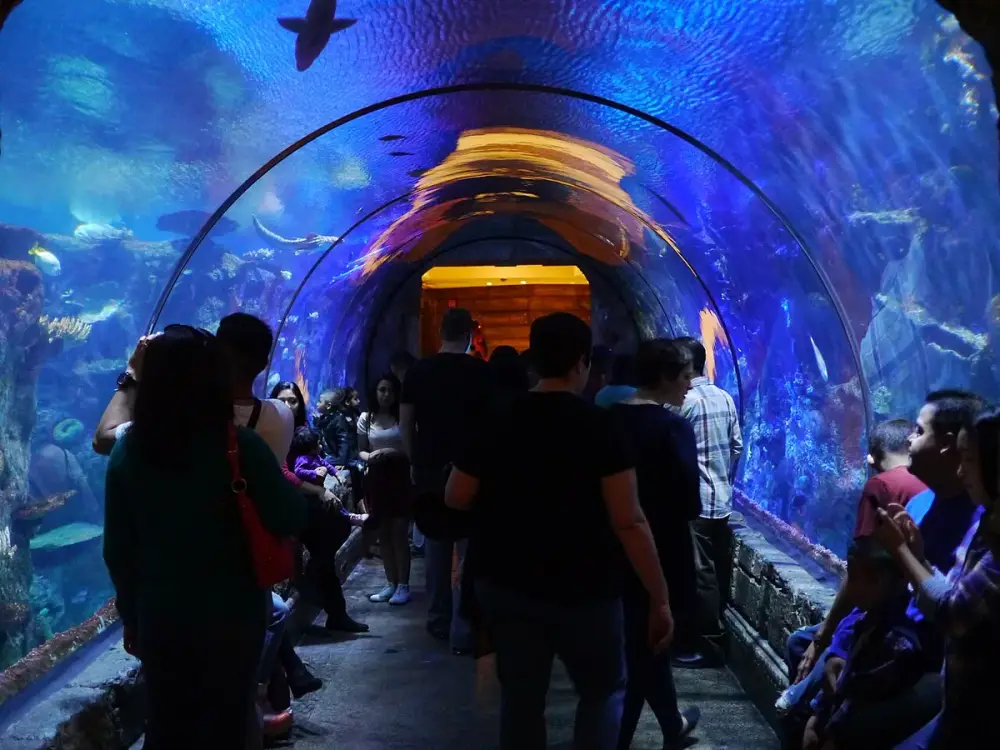
Its centerpiece is a main tank holding 1,300,000 US gallons, described as one of the largest aquarium tanks in North America and the largest on the Las Vegas Strip. The aquarium displays numerous species of sharks, rays, fish, reptiles, and marine invertebrates, and its layout includes a walk-through shark tunnel and a viewing area built to resemble the interior of a sunken ship. As of 2017, the facility employed about 80 workers, including 35 aquarists, and drew an average of roughly 900,000 visitors a year.
History
Shark Reef opened to the public on June 20, 2000, after being built with guidance from the Vancouver Aquarium. It reached its one millionth visitor in May 2001, and by that point had generated $10 million in revenue. The Association of Zoos and Aquariums accredited the facility in 2003. Over the years the aquarium's collection and programming steadily expanded: by 2007 it held 15 types of sharks, and by 2015 that had grown to 16 shark species represented by roughly 100 individual animals, spread across 14 exhibits. In 2020, Shark Reef opened a 36-seat virtual reality theater showing short films about aquatic life, a project it had announced earlier that year.
Exhibits and habitats
The aquarium is designed to resemble a sinking ancient temple, and its largest feature is the 1,300,000-gallon shipwreck tank, touted at the time of an early description as the third largest of its kind in North America. That tank is home to several endangered and threatened marine species, including green sea turtles, Galapagos sharks, blacktip reef sharks, sand tiger sharks, and green sawfish. When Shark Reef opened, it included the only indoor shark exhibit on the U.S. West Coast, featuring ten shark species at the time.
Other animals that have been part of the collection include small stingrays, horseshoe crabs, moon jellyfish, and water monitors. In 2008, Shark Reef received a Komodo dragon from the Miami Zoo, with additional Komodo dragons introduced in 2013. By that same period the aquarium had also introduced a diving program that lets guests swim with the sharks, along with a separate guest feeding program launched in 2013. In 2015, the aquarium added two scalloped hammerhead sharks, making it one of only three aquariums in the United States to feature the species at the time, and later that year it opened an additional exhibit featuring aquatic animals preserved through plastination.
Two notable long-term exhibits focus on individual species. One holds Devils Hole pupfish: in May 2006, two adult males were moved to Shark Reef from Devils Hole itself, while two adult females were relocated from a refuge at Hoover Dam, in an effort to help sustain the population. As of mid-2020, these pupfish could still be found in a small exhibit near the start of the aquarium, and Shark Reef also maintains a breeding program for the species, with more than 200 individuals held at a sister facility.
Animal highlights
As of 2005, Shark Reef held more than 2,000 aquatic animals and reptiles, cared for at that time by 65 total employees, including one staff member dedicated to preparing food; the facility was spending about $150,000 a year on food, equivalent to roughly 500 pounds per week. Sharks in the main tank generally do not hunt the aquarium's other fish because they are kept well fed, with large overhead lights used to signal feeding time. No current published species list or overall animal count was available for this page, so the figures here reflect the most recent documented counts rather than the exhibit as it stands today; visitors wanting an up-to-date species list should check the aquarium's website directly.
One especially documented animal was a great hammerhead shark exhibited starting in 2003. Shark Reef was the first closed-system aquarium in North America to display the species. The shark, a juvenile female under four feet long when she was accidentally caught off the coast of Florida, was flown to Mandalay Bay in August 2001 on a 16-hour flight in a transport tank built specifically for her. She spent two and a half years in a private quarantine tank before being judged large enough to avoid being preyed upon by the aquarium's other sharks, and was introduced into the main 1,300,000-gallon tank for public exhibition on November 3, 2003, at six feet long. She died suddenly on December 16, 2004; a necropsy attributed her death to an intestinal infection, and she measured 6.5 feet and weighed 95 pounds at the time.
Conservation and programs
Shark Reef staff take part in the "Adopt-a-Cove" program, which supports clean-up efforts at nearby Lake Mead. The aquarium's role in the Devils Hole pupfish recovery effort, described above, is one of its more significant conservation contributions: it has held rescued individuals on site since 2006 and supports a breeding population of more than 200 fish at a sister site.
Planning your visit
Current operating hours, ticket prices, and parking information for Shark Reef at Mandalay Bay were not available for this page. The aquarium is located at 3950 Las Vegas Blvd. South, inside the Mandalay Bay resort on the Las Vegas Strip, which typically means visitors can expect resort parking and Strip-adjacent accessibility, though those specifics could not be confirmed here. Given the venue's location inside a large casino resort, visitors should check the official Shark Reef website for current hours, admission pricing, and any accessibility services before planning a visit.
What we haven't confirmed
Everything above came from public sources. These specifics we haven't stood behind yet:
- Hours
- Ticket prices
- Parking
- Current animal count and species list
- Acreage
Shark Reef at Mandalay Bay compared with nearby zoos
How Shark Reef at Mandalay Bay lines up against the closest zoos we have details for — useful if you're deciding between them for the same day out.
| Zoo | Distance | Admission | Hours | Size | AZA |
|---|---|---|---|---|---|
| Shark Reef at Mandalay BayThis zooLas Vegas, NV | — | $29 | Daily 10:00 AM – 8:00 PM; last admission 7:00 PM. Box office 9:30 AM – 7:30 PM. | — | Yes |
| Keepers of the WildValentine, AZ | 98 mi | — | Wednesday–Monday 9:00 AM – 5:00 PM Arizona time; closed Tuesdays. Closed Tuesdays; Thanksgiving Day; Christmas Day. | — | No |
| Big Bear Alpine ZooBig Bear Lake, CA | 160 mi | $17 | 10am – 5pm | — | No |
| Living Desert Zoo and GardensPalm Desert, CA | 179 mi | from $44.95 | 7:00am – 1:30pm | 1200 acres | Yes |
Distances are straight-line. A dash means we haven't confirmed that detail yet, not that the zoo lacks it.
AZAThe Association of Zoos and Aquariums. Accredited members have passed an independent inspection of animal care and welfare, safety, conservation and education, repeated every five years. Many smaller facilities never apply, so “not accredited” isn't a verdict on its own. What accreditation means · How we check this
Shark Reef at Mandalay Bay: common questions
Is Shark Reef at Mandalay Bay AZA accredited?
Yes, it has been accredited by the Association of Zoos and Aquariums since 2003.
When did Shark Reef open?
It opened to the public on June 20, 2000.
How big is the main tank?
The main tank holds 1,300,000 US gallons, making it one of the largest aquarium tanks in North America.
What animals can you see there?
Documented exhibits have included sharks such as blacktip reef, sand tiger, and Galapagos sharks, green sea turtles, green sawfish, Komodo dragons, Devils Hole pupfish, and a range of rays, jellyfish, and marine invertebrates.
Has Shark Reef ever exhibited a great hammerhead shark?
Yes. It was the first closed-system aquarium in North America to display a great hammerhead, exhibiting one from 2003 until the animal's death in 2004.
Does Shark Reef have any conservation programs?
Yes. Staff participate in the Adopt-a-Cove Lake Mead clean-up program, and the aquarium has supported a Devils Hole pupfish rescue and breeding effort since 2006.
Something wrong here? Tell us — we correct in place, with a dated note.