
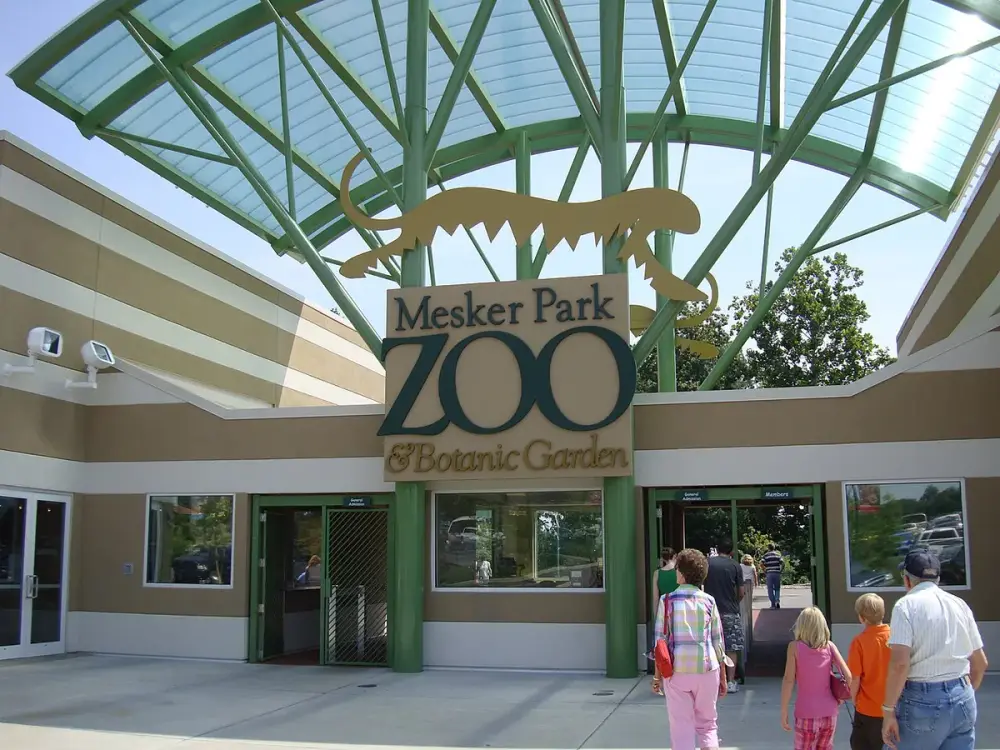
- Admission
- $9–$11
- Opened
- 1928
- Accreditation
- AZA
varies by season
Association of Zoos and Aquariums
Everything below is directory information drawn from public sources and the zoo's own site.
Animals at Mesker Park Zoo
We haven't confirmed this zoo's animal list yet.
Feathers & Fangs from visitors
What people who've been to Mesker Park Zoo say
A Feather is something this zoo does well; a Fang is something it gets wrong. Left by people who've been, and read by us before they appear.
Loading…
About Mesker Park Zoo
Mesker Park Zoo and Botanic Garden sits on 45 scenic acres at 2421 Bement Avenue in Mesker Park, on Evansville, Indiana's northwest side. It opened in 1928 and is run by the City of Evansville. The zoo is accredited by the Association of Zoos and Aquariums, which evaluates member institutions on animal care, veterinary programs, conservation, education, safety, guest services, and finances.
The grounds are organized into geographic regions rather than a single continuous path: a South American rainforest area, an African section split across two exhibits, a North American area, and an Asia and Australia section. The zoo is open 365 days a year. Lake Victoria, the largest lake on the property, sits at the center of the grounds and was the feature the zoo was originally built around.
History
Mesker Park Zoo was founded in 1928 by Gilmore M. Haynie and other local business leaders, with the idea popularized locally by Karl Kae Knecht, a cartoonist for the Evansville Courier & Press. It opened with two lion cubs, some antelope, and an elephant. In 1933, a 1:3-scale replica of the Santa Maria opened as a monkey exhibit, the "Monkey Ship," which over the years housed rhesus macaques, then capuchin monkeys, lemurs, and juvenile American alligators; the exhibit closed in 1991 when its animals moved to more naturalistic habitats, and the ship and pool were later restored as a children's bumper boat attraction.
In 2008 the zoo completed a major expansion built around a $15 million tropical rainforest exhibit, Amazonia, along with a new entry complex; the new exhibit drew more than 38,000 visitors in its first month and added more than 150 animals to the zoo, and one of the park's two original lakes was filled in to make room for it. In 2017 the zoo added the Engelbrecht Carousel — its second carousel, after the original historic one moved to Carowinds in 1979 — with an adjacent bird aviary following in 2018, at a combined cost of $3 million. Penguins of Patagonia, home to more than a dozen Humboldt penguins, opened in late October 2021. Mesker Park was also one of the first U.S. zoos to use a moat system for naturalistic exhibits, and it plans to revamp its African Rift area when funding allows.
Exhibits and habitats
Amazonia, opened in 2008, recreates a Central and South American rainforest with living plants maintained by the zoo's grounds crew. It houses jaguars, Baird's tapir, bats, black howler monkeys, squirrel monkeys, prehensile-tailed porcupines, Arrau turtles, and Cuvier's dwarf caiman, and its open spaces double as a free-flight aviary for more than ten bird species. Penguins of Patagonia is an outdoor Humboldt penguin exhibit, while North America centers on a large Mexican gray wolf enclosure.
The Discovery Center, an indoor-outdoor exhibit on conservation and education, also houses the zoo's education department. It holds Francois' langur, red pandas, ring-tailed lemurs, and ocelots, plus a hellbender salamander exhibit tied to a statewide conservation program with Purdue University and the Indiana Department of Natural Resources. Lemur Forest, opened in 1999, holds ring-tailed lemurs, red ruffed lemurs, and Coquerel's sifaka. African Rift holds reticulated giraffes, Grant's zebras, sitatunga, and white storks; a 10-month-old giraffe named Clementine arrived there in July 2018.
The Kley Building, built in the 1950s, has a nocturnal exhibit and a reptile hall with the rhinoceros iguana and Komodo dragon upstairs, and an indoor Indian rhinoceros exhibit downstairs — a space that once held Donna, formerly the world's oldest living captive hippopotamus, euthanized in 2012 at age 60 and now honored with a small statue near the zoo's Panorama playground. Asia and Australia adds outdoor space for the Indian rhinoceros, Bactrian camels, Siberian tigers, Müller's gibbons, Sichuan takin, and emu. The Children's Enchanted Forest combines playground elements and a seasonal petting zoo with river otters, colobus monkeys, and scarlet macaws, near the Engelbrecht Carousel.
Lake Victoria, the zoo's largest lake, is home to resident and migrating wild birds, turtles, and fish; visitors can walk two sides of the lake or rent paddle boats in warmer months. African Panorama surrounds a large savanna exhibit with Abyssinian ground hornbills, ostriches, greater kudu, and sitatunga, plus smaller enclosures for a giant anteater, Patagonian mara, and blue duikers. The grounds also include gardens grown for the visitor experience and plants cultivated to feed zoo animals, harvested by zookeepers throughout the year, alongside an annual February orchid display and a spring plant sale fundraiser.
Animal highlights
Mesker Park Zoo does not publish a single overall species count in the source material, but its exhibits name dozens of species across continents. South American residents include jaguars, Baird's tapir, black howler monkeys, and Cuvier's dwarf caiman; Africa is represented by reticulated giraffes, Grant's zebras, sitatunga, and Abyssinian ground hornbills; Asia and Australia bring Siberian tigers, Bactrian camels, and Sichuan takin; and North America is represented chiefly by Mexican gray wolves. Lemurs, including ring-tailed lemurs, red ruffed lemurs, and Coquerel's sifaka, share Lemur Forest, while the Discovery Center adds Francois' langur, red pandas, ocelots, and eastern hellbender salamanders as part of an active breeding and release program.
Conservation and programs
As an AZA-accredited institution, Mesker Park Zoo participates in Species Survival Plans coordinated with other accredited zoos, and recent births attributed to those programs include Francois' langur, sitatunga, takin, African crested porcupine, colobus monkey, and lesser tenrec. The zoo currently houses four Mexican gray wolves, a critically endangered species, and works with the U.S. Fish and Wildlife Service on that species' recovery plan, including cross-fostering wolf pups born at the zoo into wild dens to strengthen the wild population's genetic diversity.
The zoo also operates Indiana's first artificial stream dedicated to breeding and rearing eastern hellbender larvae, with Purdue University and the Indiana Department of Natural Resources; larvae are "head-started" at the zoo before release into southern Indiana's Blue River. In 2020, Mesker Park Zoo became the first facility where eastern hellbenders bred naturally under human care, which its curators attribute to adjustments in the stream's water parameters and salamander sex ratio. This work is supported in part by the Evansville Zoological Society, the Pittsburgh Zoo & PPG Aquarium's PPG Conservation and Sustainability Fund, and the AZA's Amphibian Taxon Advisory Group Small Grant Program.
Planning your visit
The zoo is open 365 days a year. Its visitor page describes grounds as open until 5:00 pm with last admittance at 4:00 pm, though a separate listing on the same website gives hours of 11:00 am to 3:00 pm — confirm current hours directly with the zoo before visiting.
As listed on the zoo's website, admission for children ages 3 to 12 is $10.00 (dropping to $8.00 from November through February), with children age 2 and under admitted free; general adult admission is listed at $11.00. Vanderburgh County residents receive a $2.00 discount with proof of residency. Same-day admission can be applied toward a membership upgrade if purchased before the membership office closes at 4:00 pm.
A number of attractions run on a token system at $1 per token: Penguin Feeding, a seasonal Budgie Walkabout, Giraffe Feeding, Engelbrecht Carousel rides (one chariot is handicap accessible), the handicap-accessible Zoo Tram (free for members), and seasonal paddleboats on Lake Victoria. The Rainforest Grill, open daily from 10 am to 4 pm, serves food and alcohol for adults, with a 10 percent member discount excluding alcohol; the Wild Rivers Trading Co. gift shop is also on site. Amenities include restrooms, a nursing station, water fountains, an ATM near the entrance, first aid stations, and a Lost & Found. Free sensory bags with sound-dampening headphones and a weighted lap blanket can be checked out at the front gate with a photo ID. Service animals are excluded from specific areas where zoo animals are their natural predator or prey.
Check Mesker Park Zoo's official website for current hours, admission prices, and token costs before visiting.
What we haven't confirmed
Everything above came from public sources. These specifics we haven't stood behind yet:
- Exact current hours (the source material lists two different hour ranges)
- Total animal and species count
- Parking cost and location details
- Phone number
- General stroller and wheelchair accessibility beyond the tram and carousel
- Time needed for a full visit
Mesker Park Zoo compared with nearby zoos
How Mesker Park Zoo lines up against the closest zoos we have details for — useful if you're deciding between them for the same day out.
| Zoo | Distance | Admission | Hours | Size | AZA |
|---|---|---|---|---|---|
| Mesker Park ZooThis zooEvansville, IN | — | $9–$11 | 11:00am – 3:00pm | — | Yes |
| Louisville ZooLouisville, KY | 104 mi | $15.75–$31 | 10 am – 5 pm | 134 acres | Yes |
| Kentucky Down Under Adventure ZooHorse Cave, KY | 107 mi | $25.95 | Daily 9:00 AM – 5:00 PM Central. Closed Thanksgiving, Christmas. | — | No |
| Nashville Zoo at GrassmereNashville, TN | 140 mi | $19.25–$28 | 9:00 am – 6:00 pm | 188 acres | Yes |
Distances are straight-line. A dash means we haven't confirmed that detail yet, not that the zoo lacks it.
AZAThe Association of Zoos and Aquariums. Accredited members have passed an independent inspection of animal care and welfare, safety, conservation and education, repeated every five years. Many smaller facilities never apply, so “not accredited” isn't a verdict on its own. What accreditation means · How we check this
Mesker Park Zoo: common questions
Is Mesker Park Zoo AZA accredited?
Yes, it is accredited by the Association of Zoos and Aquariums.
How big is Mesker Park Zoo, and when did it open?
It covers 45 acres and opened in 1928.
What does admission cost?
As listed on the zoo's website, children ages 3-12 pay $10.00 ($8.00 from November through February), children 2 and under are free, and general adult admission is listed at $11.00; Vanderburgh County residents get a $2.00 discount.
What are the zoo's hours?
Its visitor page lists grounds open until 5:00 pm with last admittance at 4:00 pm, though a separate page on the same site lists 11:00 am to 3:00 pm — confirm current hours before visiting.
Is the zoo accessible for wheelchairs or strollers?
The Zoo Tram and one Engelbrecht Carousel chariot are handicap accessible; general stroller or wheelchair access beyond these attractions is not described in the source material.
Is there food available inside the zoo?
Yes, the Rainforest Grill serves food and alcohol for adults daily from 10 am to 4 pm.
What animals can visitors see?
Highlights include jaguars, Mexican gray wolves, reticulated giraffes, Siberian tigers, Komodo dragons, Indian rhinoceros, and several lemur species, spread across exhibits organized by continent.
Something wrong here? Tell us — we correct in place, with a dated note.