
- Admission
- —
- Opened
- 1989
- Accreditation
- None listed
not accredited by the Association of Zoos and Aquariums
Everything below is directory information drawn from public sources and the zoo's own site.
Animals at Lubee Bat Conservancy
4 confirmed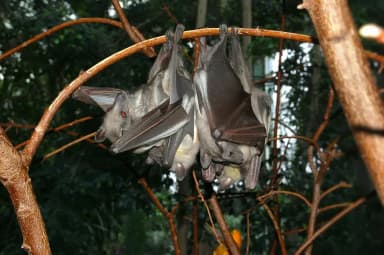
Feathers & Fangs from visitors
What people who've been to Lubee Bat Conservancy say
A Feather is something this zoo does well; a Fang is something it gets wrong. Left by people who've been, and read by us before they appear.
Loading…
About Lubee Bat Conservancy
Lubee Bat Conservancy is a nonprofit organization based on a 110-acre ranch about 10 miles north of Gainesville, Florida. Founded in 1989 as a broader center for the research, conservation, and breeding of endangered animals, it narrowed its focus over time to bats, and today concentrates specifically on Old World fruit bats, or megabats, along with a small number of other bat species. Lubee is a USDA-registered facility. It is not accredited by the Association of Zoos and Aquariums, though its own materials describe it as an AZA-certified institution.
The property is built around the practical needs of captive bats rather than public exhibit space in the usual sense: temperature-controlled areas for roosting, outdoor flight enclosures, and a medical suite that includes an examination room equipped for anesthesia, isolation areas, and a recovery room. Lubee is home to more than 200 bats, the majority of them megabats across roughly ten species, many of whom are non-releasable and receive lifelong care on site.
Access to the property is limited to scheduled guided tours rather than open walk-in visits, reflecting Lubee's identity as a working conservation and research facility that also welcomes the public on its own terms.
History
Lubee's roots trace to 1989, when Luis F. Bacardi, of the Bacardi spirits family, founded the Lubee Foundation, Inc. — a name derived from "Luis Bacardi." In its early years the foundation was home to a range of species beyond bats, including parrots, monkeys, and ostriches, and it was also used as a temporary holding facility for animals on their way to Disney's Animal Kingdom. The Bacardi family had a long-standing interest in bats, which had inspired the company's own logo. When Luis Bacardi died on September 12, 1991, the foundation shifted its focus to bats and rehomed its non-bat species.
One of the organization's first major milestones came in 1990, when it supported an international conference that produced the Pacific Island Flying Fox Declaration, calling for safeguards against the over-exploitation of flying foxes and the destruction of the rainforest ecosystems they depend on. That early work set the direction for Lubee's later international conservation programs. In early 2018, following the dissolution of the Organization for Bat Conservation, Lubee took in 17 of that organization's bats, including two microbat species new to its collection, the big brown bat and the evening bat.
Exhibits and facilities
Visits to Lubee are structured entirely around scheduled 75-minute VIP Private Tours, offered at 11 am and 1:30 pm; the facility does not accommodate unscheduled walk-in visitors. A tour includes close-up interaction with several of Lubee's Education Ambassador bats, a kabob feeding session, and background on bat biology, history, and current conservation issues, with time afterward to continue exploring the property for up to two hours total.
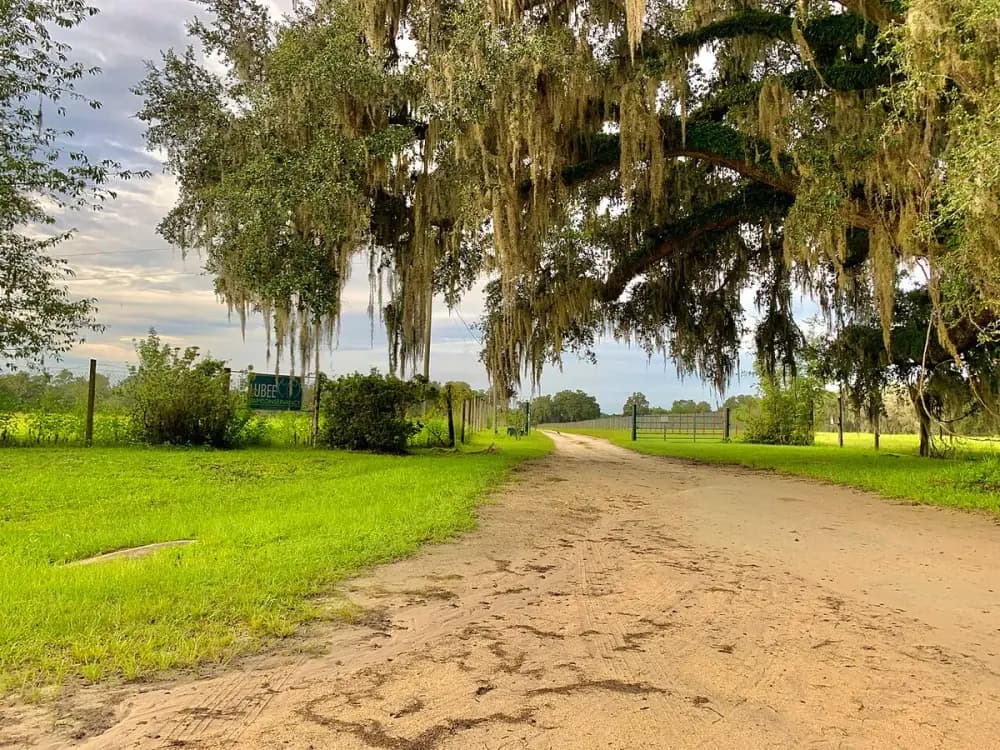
The property itself is an open, hard-packed grass field rather than a paved zoo layout, and tour guides retain discretion to adjust the experience for weather, animal emergencies, or the makeup of a given group. Mobility devices such as wheelchairs, rollators, and scooters can navigate the grounds with little to no difficulty, though the surface can be uneven; the distance from the front office to the bat viewing area is about 300 feet, and guests who prefer to skip that stretch can drive directly to the viewing area after check-in.
Animal highlights
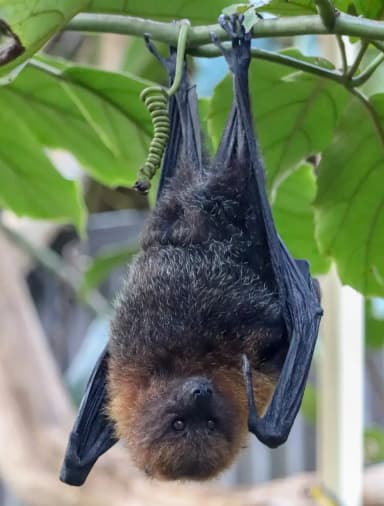
Lubee's collection is built around megabats, also known as Old World fruit bats. Species housed on site include the straw-colored fruit bat, Egyptian fruit bat, gray-headed flying fox, Indian flying fox, small flying fox, large flying fox, lesser short-nosed fruit bat, little golden-mantled flying fox, Rodrigues flying fox, and spectacled flying fox — together accounting for the more than 200 individual bats at the facility. In 2018, Lubee added two microbat species, the big brown bat and the evening bat, when it took on animals from the dissolved Organization for Bat Conservation. No published total for every species held is available beyond this list.
Conservation and programs
Lubee describes itself as the only bat conservation organization in the world that both houses endangered bats on site and runs active, ongoing field conservation and education programs. Its field projects span more than 25 countries and address threats including habitat loss, the bushmeat trade, and emerging infectious disease, while its Florida-based education programs reach more than 30,000 people annually, with a particular focus on children and community outreach.
Specific field projects described in Lubee's own materials include the construction and installation of 140 bat houses across Georgia and Florida; support for Zaira Village's efforts to protect its forests through legal appeals against logging; community-led monitoring of the Endangered Bougainville Monkey-Faced Bat and the Critically Endangered Greater Monkey-Faced Bat, which documented at least four roosts between 2016 and 2021; the Rodrigues Environmental Education Project, which has helped the Rodrigues fruit bat population grow from about 70 individuals in the 1970s to more than 20,000 today; and ongoing survey and protection work for threatened bats across Fiji, New Caledonia, and the Hildegarde's Tomb Bat's range. Surveys for the New Caledonia Long-eared Bat, last confirmed sighted in May 1991, have not yet reconfirmed the species, though unidentified acoustic calls in the region remain under study.
Planning your visit
All visits to Lubee are by scheduled VIP Private Tour only; the source material is explicit that showing up without a booking will result in being turned away. A tour donation is $250 for up to five guests, with each additional guest costing $50, up to a maximum of ten guests; tours run at 11 am and 1:30 pm and should be booked roughly 48 hours in advance, subject to availability, by contacting the conservancy directly. Adult Large Group Tours for 15 to 50 guests are also offered for clubs, professional organizations, and similar groups.
The tour is recommended for guests age four and older, and strollers are advised for younger children; all guests, including small children, must wear masks while inside the bat enclosures, and touching or holding the bats is not permitted for the animals' safety. Pets and emotional support animals are not allowed on the property during tours or events; licensed service dogs are welcome during general events but are not permitted in the bat viewing area during tours, since dogs can trigger erratic, injury-causing flight from the bats. Comfortable closed-toed shoes and insect repellent are recommended, since the property is an open grass field. Cancellations made two or more weeks in advance receive a full refund; those made within one week receive a 50 percent refund; cancellations, no-shows, or unnotified absences within a week of the tour receive no refund, though rescheduling within the same year is available.
Confirm current tour times, pricing, and availability on Lubee's official website before booking.
What we haven't confirmed
Everything above came from public sources. These specifics we haven't stood behind yet:
- General visiting hours beyond tour times
- Exact total species count
- Parking details
- Phone number for tour bookings
- Food or dining options on site
Lubee Bat Conservancy compared with nearby zoos
How Lubee Bat Conservancy lines up against the closest zoos we have details for — useful if you're deciding between them for the same day out.
| Zoo | Distance | Admission | Hours | Size | AZA |
|---|---|---|---|---|---|
| Lubee Bat ConservancyThis zooGainesville, FL | — | — | No walk-ins. Visits by scheduled 75-minute VIP Private Tour only, starting at 11:00 AM or 1:30 PM (allow up to 2 hours on site). Book at least 48 hours ahead. No tours the last 2 weeks of December and the first week of January. | — | No |
| Santa Fe College Teaching ZooGainesville, FL | 12 mi | $10 | 9 am – 3 pm | 10 acres | Yes |
| St. Augustine Wild ReserveSt. Augustine, FL | 50 mi | $35 | Tours by appointment only: Mon & Wed 2:00 PM, Fri 11:00 AM (VIP), Sat 11:00 AM. | — | No |
| Jacksonville Zoo and GardensJacksonville, FL | 58 mi | $45.95–$51.95 | 9 am – 5 pm | 122 acres | Yes |
Distances are straight-line. A dash means we haven't confirmed that detail yet, not that the zoo lacks it.
AZAThe Association of Zoos and Aquariums. Accredited members have passed an independent inspection of animal care and welfare, safety, conservation and education, repeated every five years. Many smaller facilities never apply, so “not accredited” isn't a verdict on its own. What accreditation means · How we check this
Lubee Bat Conservancy: common questions
Is Lubee Bat Conservancy AZA accredited?
No, it is not AZA-accredited, though its own materials describe it as an AZA-certified institution.
When was Lubee founded?
In 1989, by Luis F. Bacardi, initially as a broader conservation and breeding center before narrowing its focus to bats after his death in 1991.
How many bats does Lubee house, and what species?
More than 200 bats, mostly megabats across roughly ten species, including several flying fox species, plus two microbat species added in 2018.
Can I just show up and tour the facility?
No. Lubee only accommodates guests with a scheduled VIP Private Tour; unscheduled walk-ins are turned away.
How much does a tour cost?
A VIP Private Tour donation is $250 for up to five guests, with each additional guest costing $50, up to a maximum of ten guests.
Is Lubee wheelchair accessible?
Yes. Mobility devices can navigate the grassy grounds with little to no difficulty, and guests can drive directly to the bat viewing area if they prefer to skip the walk from the front office.
Are pets allowed?
No. Pets and emotional support animals are not permitted on the property during tours, and service dogs are excluded from the bat viewing area specifically.
Something wrong here? Tell us — we correct in place, with a dated note.