
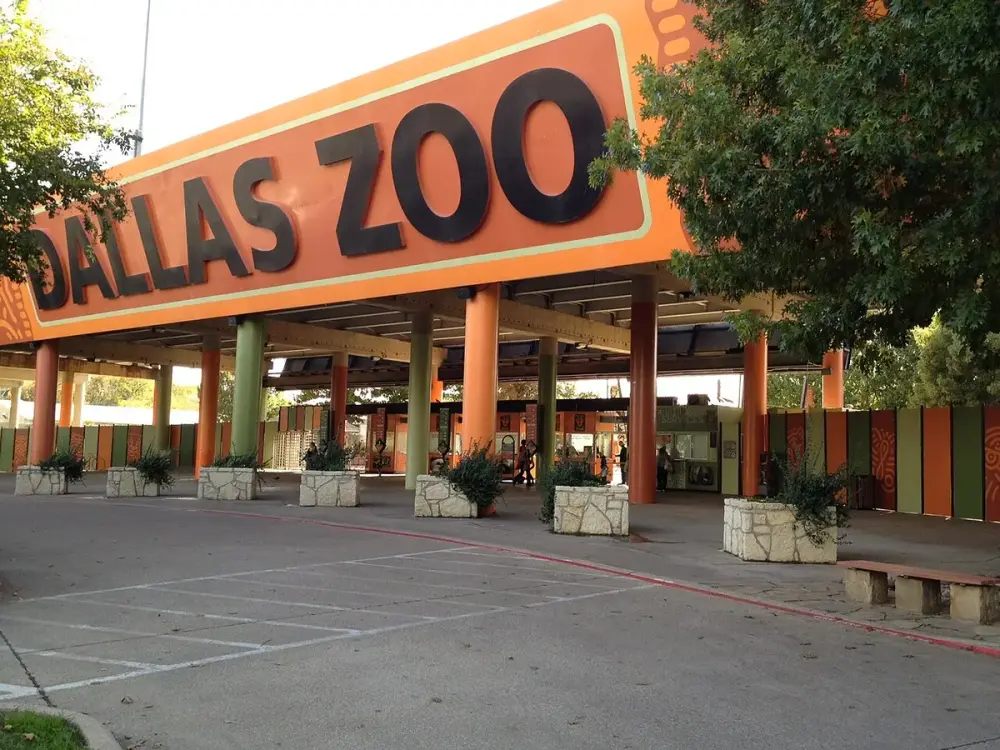
- Admission
- from $18
- Size
- 106 acres
- Animals
- 2,000
- Opened
- 1888
- Accreditation
- AZA
set by date and demand
Association of Zoos and Aquariums
Everything below is directory information drawn from public sources and the zoo's own site.
Animals at Dallas Zoo
We haven't confirmed this zoo's animal list yet.
Feathers & Fangs from visitors
What people who've been to Dallas Zoo say
A Feather is something this zoo does well; a Fang is something it gets wrong. Left by people who've been, and read by us before they appear.
Loading…
About Dallas Zoo
Dallas Zoo occupies 106 acres in Marsalis Park, about three miles south of downtown Dallas, Texas. Established in 1888, it is the oldest and largest zoological park in the state, home to more than 2,000 animals representing 406 species. The zoo is accredited by the Association of Zoos and Aquariums and holds membership in the World Association of Zoos and Aquariums.
The nonprofit Dallas Zoological Society manages the zoo under a contract with the City of Dallas, handling fundraising, membership, special events, food service, retail, volunteer programs, marketing and public relations. That arrangement dates to 2009, when the Dallas City Council voted to privatize the zoo's operations. The Society is supported by more than 25,500 membership households, and the zoo now provides nearly 1,800 jobs annually. Attendance surged past one million visitors for the first time in 2015.
The zoo is organized into two major regions connected by a tunnel beneath Clarendon Drive: ZooNorth, the original and oldest section, and the Wilds of Africa, which opened decades later and groups African species by habitat type — rainforest, mountain, woodland, river, desert and bush. A free zoo app, available in both English and Spanish, helps visitors navigate hours, admission, parking, animals, membership and events.
History
The zoo's first purchase, in 1888, was two deer and two mountain lions bought for $60 from a private seller in Colorado City, Colorado. The animals went on display in City Park. Through the 1890s, the Dallas City Council funded further acquisitions. The zoo moved to Fair Park in 1910, then to 36 acres in Marsalis Park in 1912 — land the city had purchased in 1909 — and expanded from there to its current footprint. Under Zoo Commissioner William H. Atwell, the collection grew further in the 1920s with animals acquired from game hunter and trapper Frank Buck. During the Depression, Works Progress Administration funding paid for extensive renovations.
The Dallas Zoological Society was established in 1955 to support the zoo. By the 1960s the zoo was a popular, profit-driven attraction displaying more than 500 species by 1966. Attitudes shifted in the 1980s toward scientific research and humane treatment, in line with AZA standards emphasizing endangered-species breeding; the zoo was accredited in 1985. Around the same time, director Warren J. Iliff proposed the Wilds of Africa addition, designed by New York architect Herbert W. Reimer around a "zoogeographic grouping" of African animals, complete with a slow-moving monorail. Two bond measures totaling $30.4 million funded the project from its 1983 approval to its June 1990 opening.
Rail and bus service arrived at the zoo on June 14, 1996, with the opening of the Dallas Zoo station on DART's Red Line. The Kimberly-Clark Chimpanzee Forest, a 19,000-square-foot exhibit, opened in 1997. The 2-acre, $4.5 million ExxonMobil Endangered Tiger Habitat followed on May 8, 1999. In 2008, an $5 million donation from Harold Simmons — the largest gift in the zoo's 120-year history at the time — helped fast-track construction of the Giants of the Savanna habitat, which opened to national acclaim on May 28, 2010, following the zoo's 2009 transition to private management. A Dinosaur exhibit featuring more than 20 animatronic dinosaurs opened April 1, 2015.
Exhibits and habitats
ZooNorth features the Wildlife Amphitheater, home to a flight show called SOAR!, along with Primate Place, which houses monkeys from Africa and South America, and the Pierre A. Fontaine Bird & Reptile Building, focused on endangered species education. The Lacerte Family Children's Zoo includes the Nature Exchange, the JC Penney Discovery House, the UnderZone, a petting zoo, pony rides and a splash-friendly artificial creek. BUG U! teaches visitors about the zoo's invertebrate collection, including a termite colony, honey bee colony, leafcutter ants and venomous spiders.
The Wilds of Africa, opened in 1990, covers the continent's major habitat types. The Nature Trail winds past two naturalistic gorilla habitats, Nile crocodiles, wattled cranes and the Forest Aviary before reaching the Kopje, home to klipspringers, and a rainforest watering hole shared by hippopotamus and okapi — the zoo has a notable breeding and research history with okapi, with about 20 percent of the species' U.S. and Japanese zoo population tracing lineage back to Dallas. Penguin Cove holds about a dozen African penguins visible above and below water.
The Kimberly-Clark Chimpanzee Forest gives chimpanzees a waterfall, stream, climbing structures and a termite mound rigged for tool-use foraging. The Gorilla Research Center, a 2-acre habitat first opened in 1990 and renovated in 2006, hosts two gorilla troops — a bachelor troop and a family troop — viewable from the floor-to-ceiling windows of the Gorilla Research Station. Crocodile Isle lets visitors watch Nile crocodiles behind glass, and the Forest Aviary showcases African bird species amid rock cliffs and a stream.
Giants of the Savanna, an 11-acre expansion that opened in 2010, mixes African bush elephants, reticulated giraffes, African lions, cheetahs, impala, ostriches, warthogs, red river hogs and African wild dogs in a shared landscape — the first exhibit in North America to combine elephants with giraffes, zebras, ostriches, impala and guineafowl. Five of its eleven acres are dedicated to the elephant herd. A Predator Encounter area sits between the lion and painted dog exhibits for keeper talks, and the Serengeti Grill restaurant looks directly into the lion habitat through a floor-to-ceiling window. Simmons Hippo Outpost, a 3.5-acre habitat that opened in spring 2017, brought hippos back to the zoo after a 15-year absence.
Animal highlights
Dallas Zoo lists at least 406 species on its website — a floor, not a ceiling — with more than 2,000 individual animals in its care. Notable residents named in zoo materials include Sumatran and Malayan tigers in the Endangered Tiger Habitat; western lowland gorillas including silverback Marcus and a bachelor troop; African bush elephants such as Jenny, Gypsy, Kamba, Congo, Tendaji, Mlilo, Zola and Okubili, along with newer calf Matope; Nile hippopotamuses Gus, Boipelo, Addy and Kalo; African lions, cheetahs and African wild dogs in Giants of the Savanna; and okapi, a species the zoo has bred with particular success.
The gorilla population has changed over the years through transfers among AZA-accredited institutions, and the zoo's giraffe herd has included both births and, in a cluster of 2021 deaths, notable losses that an investigation found were unrelated to one another. Bird species include African penguins and wattled cranes, and reptile displays include Nile crocodiles.
Conservation and programs
Dallas Zoo participates in more than 40 Species Survival Plans through the AZA. It supports conservation projects including Okapi Conservation at the Epulu Research Station in what the zoo's materials refer to as Zaire, the International Rhino Foundation, Chimp Haven, the Bushmeat Crisis Task Force, work with the Gray's monitor lizard in the Philippines, Bowling For Rhinos and the Thailand Hornbill Project's Adopt A Hornbill Nest initiative.
The zoo also runs a cell phone recycling program with ECO-CELL aimed at reducing coltan mining, which contributes to habitat loss for gorillas, elephants and okapi in the Democratic Republic of the Congo; each recycled phone generates a donation to the zoo's conservation fund. On the sustainability side, the zoo grows bamboo and cabbage as landscaping that is later harvested as food for its herbivores.
Planning your visit
Hours listed on the zoo's website for the day checked were 10 a.m. to 2 p.m., though hours vary seasonally, so confirm before visiting. Membership includes free daily admission and parking as one of its stated benefits, a hint that standard visits involve separate admission and parking costs — check the official site for current ticket prices, as none were published in the material available here.
The zoo is accessible via the Dallas Zoo DART Red Line station and bus routes 19, 515 and 522; on Mondays and Tuesdays from March through December, visitors who present a same-day DART pass at the ticket booth receive $2 off admission. The Serengeti Grill offers dining with a view directly into the lion habitat, and the zoo hosts recurring events including Safari Nights, an outdoor concert series on eight consecutive summer Saturdays; Zoo To Do, an annual fundraising gala; Dollar Day, held once each in July and November with $1 admission; and Zoo Lights, a holiday drive-through trail featuring more than a million lights.
Confirm current hours, admission prices and any closures on the zoo's official website before planning your trip.
What we haven't confirmed
Everything above came from public sources. These specifics we haven't stood behind yet:
- Current hours (seasonal variation)
- Ticket prices
- Parking details and cost
- Accessibility and stroller/wheelchair rental specifics
- Acreage and species count for individual sub-exhibits
- Time needed for a full visit
- Phone number
Dallas Zoo compared with nearby zoos
How Dallas Zoo lines up against the closest zoos we have details for — useful if you're deciding between them for the same day out.
| Zoo | Distance | Admission | Hours | Size | AZA |
|---|---|---|---|---|---|
| Dallas ZooThis zooDallas, TX | — | from $18 | 10 am – 2 pm | 106 acres | Yes |
| Fort Worth ZooFort Worth, TX | 32 mi | $22 | 10:00 am – 5:00 pm | — | Yes |
| Frank Buck ZooGainesville, TX | 64 mi | $9 | Daily 9:00 AM – 3:30 PM; last tickets and entry 2:30 PM. | 30 acres | No |
| Cameron Park ZooWaco, TX | 83 mi | $18 | 9 am – 5 pm | 52 acres | Yes |
Distances are straight-line. A dash means we haven't confirmed that detail yet, not that the zoo lacks it.
AZAThe Association of Zoos and Aquariums. Accredited members have passed an independent inspection of animal care and welfare, safety, conservation and education, repeated every five years. Many smaller facilities never apply, so “not accredited” isn't a verdict on its own. What accreditation means · How we check this
Dallas Zoo: common questions
Is Dallas Zoo AZA accredited?
Yes, and it also holds membership in the World Association of Zoos and Aquariums.
How big is Dallas Zoo?
The zoo spans 106 acres in Marsalis Park, making it the largest zoological park in Texas.
When did Dallas Zoo open?
It was established in 1888, making it the oldest zoo in Texas.
How many animals can you see at Dallas Zoo?
At least 406 species are listed on the zoo's website, among more than 2,000 individual animals.
Is there public transit to Dallas Zoo?
Yes, the zoo has its own DART Red Line station, plus bus routes 19, 515 and 522.
Is there food inside the zoo?
Yes, including the Serengeti Grill, which overlooks the lion habitat through a glass wall.
What is the Giants of the Savanna exhibit?
An 11-acre, multi-species African savanna habitat that opened in 2010, combining elephants, giraffes, lions, cheetahs and other species in one landscape.
Something wrong here? Tell us — we correct in place, with a dated note.