
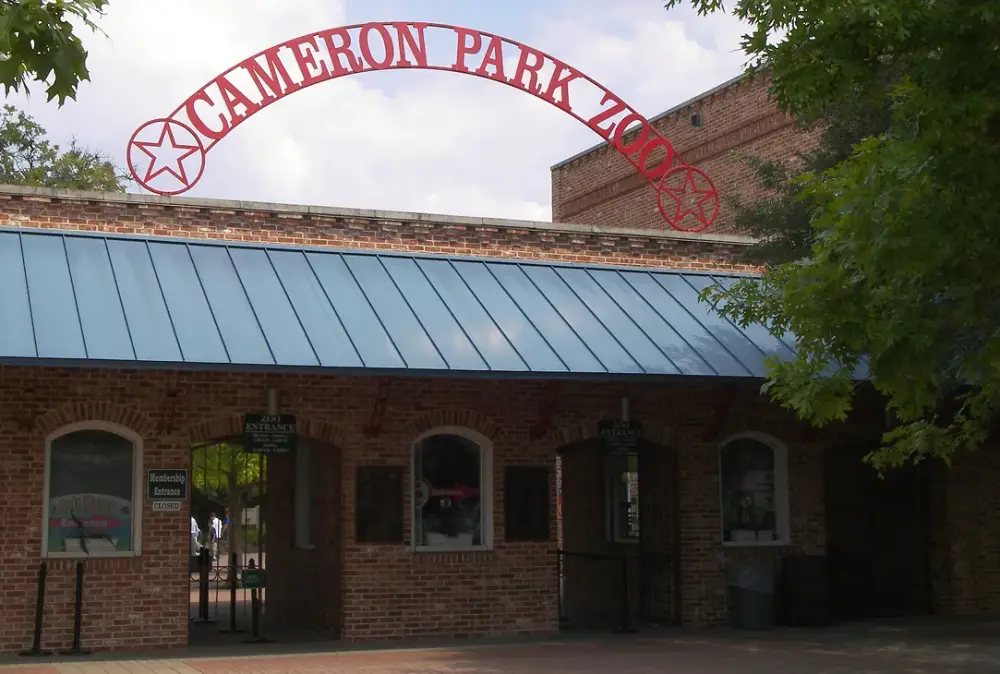
- Admission
- $18
- Size
- 52 acres
- Animals
- 1,731
- Opened
- 1955
- Accreditation
- AZA
Association of Zoos and Aquariums
Everything below is directory information drawn from public sources and the zoo's own site.
Animals at Cameron Park Zoo
We haven't confirmed this zoo's animal list yet.
Feathers & Fangs from visitors
What people who've been to Cameron Park Zoo say
A Feather is something this zoo does well; a Fang is something it gets wrong. Left by people who've been, and read by us before they appear.
Loading…
About Cameron Park Zoo
Cameron Park Zoo occupies 52 acres inside Cameron Park in Waco, Texas, next to the Brazos River, with native vegetation surrounding waterfalls, a lake, and ponds. The zoo opened to the public on July 18, 1993, and now houses more than 1,700 animals — the zoo's own count puts the figure at 1,731 — representing 300 species from across North and South America, Africa, Asia, and Europe. It is accredited by the Association of Zoos and Aquariums and holds membership in the World Association of Zoos and Aquariums, and it is run day to day by a zoo director and deputy director alongside a staff veterinarian and curators, with the nonprofit Cameron Park Zoological & Botanical Society providing fundraising and membership support.
Cameron Park itself, the surrounding municipal parkland, covers 416 acres and ranks among the largest undeveloped municipal parks in Texas, sitting at the confluence of the Bosque and Brazos rivers. The zoo's setting takes advantage of that landscape directly: lush native vegetation, limestone cliffs, and views over Waco surround the exhibits rather than a built, park-style entrance.
The zoo is organized loosely by continent and habitat type, and it keeps a single female African savanna elephant named Tembo, born in the wild in 1977 and living at the zoo since January 15, 1979 — making her one of its longest-tenured residents and a fixture of the collection since well before the current zoo site even opened.
History
Cameron Park Zoo has its origins in 1955, when a group of wildlife enthusiasts established the Central Texas Zoological Park with the aim of creating a space for recreation and education. A master plan for expanding the zoo was drawn up in 1981, and in 1989 a countywide bond funded the redevelopment of a 52-acre section of Cameron Park into what would become the current Cameron Park Zoo. That project closed the old zoo and opened the new one to the public on July 18, 1993.
Expansion continued after opening. In 2005, the zoo added Brazos River Country, a large new area built around a 50,000-gallon saltwater reef aquarium, a swampland habitat, and other native Texas-type habitats featuring species found within the state; the addition nearly doubled both the zoo's animal population and its overall footprint. In August 2009, the zoo opened the Asian Forest, adding critically endangered orangutans and Komodo dragons to a section that already held Sumatran tigers.
Exhibits and habitats
The zoo's collection spans exhibits built around continent and habitat rather than a single organizing theme. Its reptile house is described as large, and a dedicated African lion display sits alongside Lemur Island, an open habitat for lemurs. Brazos River Country, opened in 2005, centers on a 50,000-gallon saltwater reef aquarium and a large swampland habitat, supplemented by other exhibits built around native Texas species.
The Asian Forest, added in 2009, groups critically endangered orangutans and Komodo dragons together with the zoo's existing Sumatran tigers, forming one of the zoo's more recently built sections. Because the whole zoo sits inside the larger 416-acre Cameron Park along the Brazos River, its habitats make use of existing waterfalls, a lake, ponds, and nearby limestone cliffs rather than relying solely on constructed enclosures.
Animal highlights
Cameron Park Zoo's own materials describe a collection of more than 1,700 animals — 1,731 by its published count — representing 300 species. Notable individual animals include Tembo, the zoo's female African savanna elephant, born in the wild in 1977 and resident at the zoo since 1979, and the Asian Forest's orangutans, Sumatran tigers, and Komodo dragons, all described as critically endangered or endangered species. The zoo also keeps African lions and a lemur troop on Lemur Island.
Beyond its marquee species, the zoo highlights ten animals through its "10 to Protect" conservation program: African penguins, orangutans, Sumatran tigers, southern white rhinos, giraffes, stingrays, turtles and tortoises, Jamaican iguanas, sloths, and the American paddlefish. Each of these ten is presented as both a resident of the zoo and an ambassador for a global conservation effort tied to its wild counterparts.
Conservation and programs
Cameron Park Zoo frames conservation as a defining part of its mission, with staff contributing to international efforts including orangutan and reptile research, habitat restoration, and the relocation of at-risk animals. Its "10 to Protect" program spotlights ten species in its care and channels support toward the global organizations working to protect them in the wild, including the Borneo Orangutan Survival Foundation, the AZA's Species Survival Plan for tigers, the International Rhino Foundation, Save Giraffes Now, the Turtle Survival Alliance, the International Iguana Foundation, the Sloth Conservation Foundation, and the Caddo Lake Institute's paddlefish restoration work.
A restricted conservation fund at the zoo is used exclusively for wildlife conservation rather than general zoo operations, supporting education, conservation partners, and species and ecosystem protection more broadly. The zoo describes the animals in its collection as ambassadors for their wild counterparts, using the "10 to Protect" species specifically to connect zoo visits with real-world field conservation work happening from Sumatra to Cuba.
Planning your visit
As listed on the zoo's website, Cameron Park Zoo is open Monday through Sunday from 9 a.m. to 5 p.m., with last entrance at 4:30 p.m., and it closes on Thanksgiving Day, Christmas Day, and New Year's Day. Listed admission for children ages 3 to 12 is $14.00, with children 2 and under admitted free; online ticket purchases do not carry additional discounts, and a household membership is listed at $110 per year for unlimited visits. Group discounts are available for parties of 15 or more scheduled in advance for field trips, birthday parties, or other outings. Prices and hours should be confirmed on the official website, since the zoo notes ticket prices are subject to change and its listed rates are point-in-time figures.
Outside food and drinks, including reusable water bottles, are allowed inside the zoo, and a gift shop near the entrance and an on-site café supplement what visitors bring themselves; café hours vary seasonally and should be checked at admissions. Parking is free, with no charge listed for any vehicle. A limited number of manual wheelchairs and Scooterbug electric carts are available for rental through admissions on a first-come, first-served basis, and single and double strollers can be rented through the gift shop under the same limited-inventory terms — the zoo recommends arriving early to secure one. Service dogs are permitted on a leash; other pets are not allowed on zoo grounds. Members of zoos that participate in a reciprocal program with Cameron Park Zoo can receive discounted general admission with a membership card. Confirm current hours, pricing, and accessibility rentals on the official website before visiting.
What we haven't confirmed
Everything above came from public sources. These specifics we haven't stood behind yet:
- Total zoo acreage confirmation beyond the 52-acre figure
- Annual visitor numbers
- Adult and senior ticket prices
- Time needed for a full visit
- Best entrance or transit information
- Phone number for group bookings
Cameron Park Zoo compared with nearby zoos
How Cameron Park Zoo lines up against the closest zoos we have details for — useful if you're deciding between them for the same day out.
| Zoo | Distance | Admission | Hours | Size | AZA |
|---|---|---|---|---|---|
| Cameron Park ZooThis zooWaco, TX | — | $18 | 9 am – 5 pm | 52 acres | Yes |
| Fort Worth ZooFort Worth, TX | 81 mi | $22 | 10:00 am – 5:00 pm | — | Yes |
| Dallas ZooDallas, TX | 83 mi | from $18 | 10 am – 2 pm | 106 acres | Yes |
| Austin Nature & Science CenterAustin, TX | 97 mi | Free | Mon–Sat 9:00 AM – 5:00 PM; Sun 12:00 PM – 5:00 PM. CLOSED Sep 28 – Oct 11, 2026 (maintenance week / ACL Fest); reopens Oct 12. Closed Sep 28–Oct 11, 2026 (maintenance/ACL); Nov 27–28 (Thanksgiving); Dec 24–26 (Christmas); Jul 3–4. | — | No |
Distances are straight-line. A dash means we haven't confirmed that detail yet, not that the zoo lacks it.
AZAThe Association of Zoos and Aquariums. Accredited members have passed an independent inspection of animal care and welfare, safety, conservation and education, repeated every five years. Many smaller facilities never apply, so “not accredited” isn't a verdict on its own. What accreditation means · How we check this
Cameron Park Zoo: common questions
Is Cameron Park Zoo AZA accredited?
Yes, and it is also a member of the World Association of Zoos and Aquariums.
How big is the zoo?
It covers 52 acres inside the larger, 416-acre Cameron Park in Waco, Texas.
When did the zoo open?
The current zoo opened on July 18, 1993, though its predecessor, the Central Texas Zoological Park, dates to 1955.
How many animals and species does the zoo have?
The zoo's own count lists 1,731 animals representing 300 species.
Is there parking, and does it cost anything?
Yes, and parking is free according to the zoo's FAQ.
Are strollers and wheelchairs available?
Yes, both are available to rent on a first-come, first-served basis, along with electric scooter carts.
Is there food inside the zoo?
Yes, a café and gift shop operate on site, and outside food and drinks are also permitted.
Something wrong here? Tell us — we correct in place, with a dated note.