
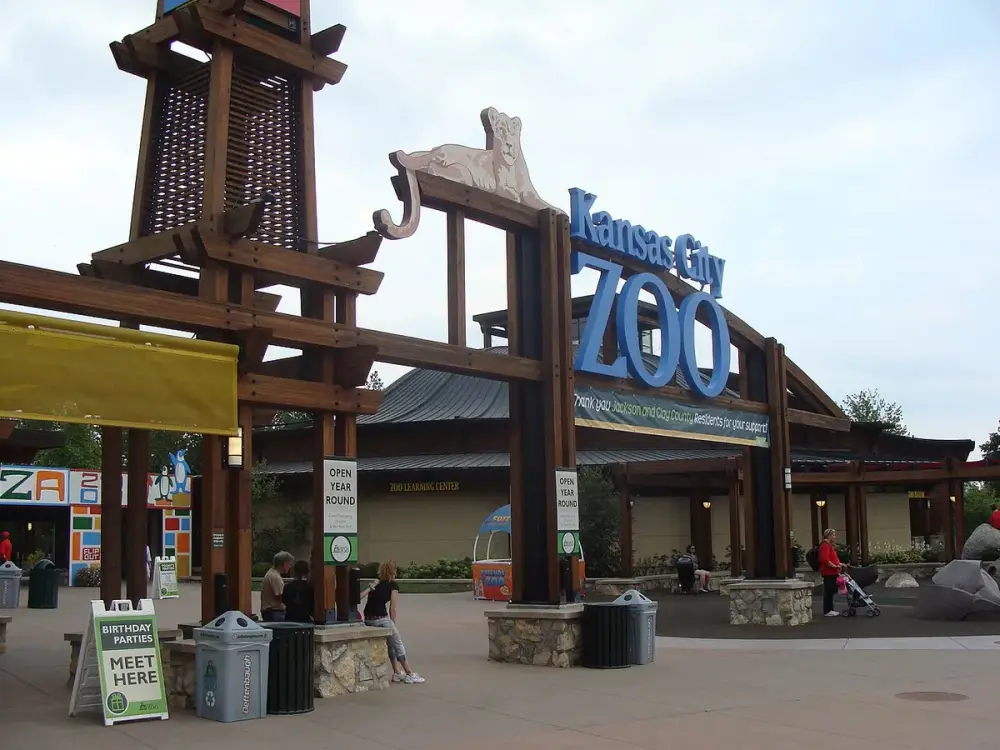
- Admission
- $22–$24
- Size
- 202 acres
- Animals
- 1,700
- Opened
- 1909
- Accreditation
- AZA
set by date and demand
Association of Zoos and Aquariums
Everything below is directory information drawn from public sources and the zoo's own site.
Animals at Kansas City Zoo
We haven't confirmed this zoo's animal list yet.
Feathers & Fangs from visitors
What people who've been to Kansas City Zoo say
A Feather is something this zoo does well; a Fang is something it gets wrong. Left by people who've been, and read by us before they appear.
Loading…
About Kansas City Zoo
The Kansas City Zoo & Aquarium sits on 202 acres inside Swope Park in Kansas City, Missouri, at 6800 Zoo Drive. It opened in December 1909 and is accredited by the Association of Zoos and Aquariums. The zoo is a private non-profit organization operated in agreement with the Kansas City, MO, Board of Parks and Recreation Commissioners, and it is partially funded by the Zoological District. A volunteer Board of Directors, Friends of the Zoo, oversees its operations, while the Zoological District Commissioners administer and manage the funds collected through the district that support the zoo.
The zoo describes its mission as connecting people to each other and to the natural world, to promote understanding, appreciation, and conservation. It houses roughly 1,700 animals across a collection organized loosely by geography, with African, Australian, and tropical sections alongside newer additions built around specific species. According to the zoo, the facility was ranked among the top 60 zoos in the country in "America's Best Zoos 2008," and was ranked No. 1 in the nation that year for African animals and exhibits, with top-10 rankings for Australian animals and exhibits and for pachyderms. Primatologist Jane Goodall is quoted by the zoo as calling its chimpanzee exhibit one of the finest in North America, and the same 2008 ranking listed the zoo as No. 1 in the country to see both chimpanzees and kangaroos.
Now a 202-acre site the zoo calls a nature sanctuary, it functions as a regional resource for bringing families into contact with animals and habitats from around the world, combining exhibit space with education programs and conservation partnerships.
History
The zoo's origins trace to 1907, when city activists pushed for a zoological garden to rival any in the country, settling on Swope Park as the site. Thomas Swope, a real estate speculator, had donated the land to Kansas City in 1896, and businessman Barron Fradenburg argued that a city the size of Kansas City needed a zoological garden. A Zoological Society formed to make it happen, and the Kansas City Zoological Gardens opened in December 1909 with four lions, three monkeys, a wolf, a fox, a coyote, a badger, a lynx, an eagle, and other birds.
The zoo's first expansion came in 1912, the same year it became largely self-sufficient by producing most of its animal feed from gardens on the grounds. In 1948, nearly forty years after opening, the zoo launched a children's area called Touchtown, featuring a petting zoo with goats, sheep, rabbits, and tortoises, plus walk-through structures including a Noah's Ark, the Old Woman's Shoe, the Great Blue Whale, and a hollow fabricated lion kids could enter and poke their heads out of. Hallmark donated the "Birthday Pavilion" in 1961, and a puppet theater opened in Touchtown in 1964, later remodeled into the Education building.
In 2002, Friends of the Zoo, Inc. took over operation of the zoo with a focus on improving facilities, animals, and education programs. Randy Wisthoff, previously of the Henry Doorly Zoo in Omaha, became executive director in 2003 and worked with the Zoo Board, the mayor, and community leaders on a bond package that set the stage for further growth. Since 2007, the zoo says it has invested significant capital in projects, including the Discovery Barn, the Zoo Learning Center, river otter and trumpeter swan habitats, an Endangered Species Carousel, Polar Bear Passage, the African Sky Safari, Tiger Terrace, Orangutan Canopy, the Tuxedo Grill, and Helzberg Penguin Plaza. The original building was also converted into Tropics, offering close-up views of primates, otters, birds, and tropical plants.
Exhibits and habitats
The zoo's newest project is Giraffe Crossing, a habitat in the Africa section designed by TESSERE and built by JE Dunn Construction. It replaces a layout that separated the giraffe barn from the outdoor savanna by a quarter mile, a distance that made daily viewing dependent on weather and the time it took to move the herd. The new complex attaches an indoor habitat directly to the outdoor yards, so giraffes can move between them regardless of weather, and it adds feeding stations both inside the barn and on the savanna where guests can hand-feed the animals. The project also brings ADA-accessible restrooms with a universal changing table, a mother's room, and a new concessions area along the Africa loop.
Tropics, built inside the zoo's original structure, provides close-up views of primates, otters, birds, and tropical plants. The African Plains area includes a safari boat ride across a lake where visitors can see zebra, giraffe, and other hoofstock. Other named areas include Polar Bear Passage, Tiger Terrace, Orangutan Canopy, the African Sky Safari, and Helzberg Penguin Plaza. The zoo also runs a Sea Lion Show, Keeper Chats, and elephant painting demonstrations as regular guest activities, alongside an Australia section.
Animal highlights
The zoo is home to roughly 1,700 animals, at least 1,700 individuals listed on the zoo's website across its exhibit areas. Species named across the zoo's own materials include African lions, Masai giraffes, orangutans, tigers at Tiger Terrace, penguins at Helzberg Penguin Plaza, polar bears, chimpanzees, kangaroos, river otters, trumpeter swans, and hoofstock such as zebra visible from the African Plains boat ride. The zoo's chimpanzees and kangaroos were specifically singled out in a national 2008 ranking.
Conservation and programs
Conservation runs through several of the zoo's newer projects. The Giraffe Crossing habitat is tied to work supporting the Masai giraffe, listed as endangered by the International Union for Conservation of Nature; the zoo states the Masai giraffe population has fallen by about half over the past thirty years due to habitat loss and illegal hunting. The zoo partners with Save Giraffes Now on a project in Kenya studying how giraffe herds use wildlife underpasses built beneath roads, and a zoo staff member traveled to Kenya to help install cameras and collect data for that project. Since 2017, the zoo has also supported the Black Mambas, a predominantly female anti-poaching unit based in the Balule Nature Reserve within the Greater Kruger National Park in South Africa, helping fund their base camps, vehicles, and patrol equipment, as well as an educational program in local schools. The zoo participates in the AZA Species Survival Plan for giraffes, which coordinates transfers and breeding across accredited institutions for genetic diversity.
Beyond giraffes, the zoo lists a wide range of field and research projects its staff take part in, including an African elephant reproductive conservation initiative, a kelp restoration project with the Catalina Island Marine Institute, anti-poaching and monitoring work in Zambia, a freshwater mussel reintroduction program, work on grey crowned cranes in East Africa, sea turtle recovery and rehabilitation programs, a marine mammal rescue project, chimpanzee protection work in Sierra Leone, a Puerto Rican Amazon parrot education initiative, a North American songbird program, a habitat corridor restoration project, trumpeter swan restoration, and a captive breeding program for the Wyoming toad.
Planning your visit
As listed on the zoo's website, hours run 9:30 am to 4 pm; confirm current hours before visiting, since they can change seasonally. Tickets can be purchased online in advance, with entry shown at the gate on a mobile device; children age 2 and under are always free, and discounted online pricing is available for Jackson and Clay County residents and for Friends of the Zoo members. Annual memberships include unlimited admission, discounts on concessions and retail, a quarterly newsletter, and discounts on select zoo events.
Dining options are spread throughout the grounds, including the Tuxedo Grill (cashless only), Bluey's in the Australia section, the Rafiki Restaurant in Africa, Safari Snacks in the African Market area, and the Beastro Café near the entrance. Guests may bring their own food and drinks for outdoor picnic areas, though glass containers and alcohol are not allowed; visitors can also return to their car for a forgotten lunch and re-enter the same day after getting a hand stamp at the gate.
For accessibility, the zoo offers wheelchair and ECV rentals, sensory bags with noise-canceling headphones and weighted blankets at Guest Relations, universal changing tables, and family restrooms with toddler seats throughout the grounds. Alternate Access Passes are available for guests needing accommodations, and an accessible playground built with Variety KC, in the Africa section, includes golf cart transport from the entrance on request. Maps are available in English and Spanish. Confirm hours, pricing, and any closures on the zoo's official website before your visit.
What we haven't confirmed
Everything above came from public sources. These specifics we haven't stood behind yet:
- Ticket prices
- Parking details and fees
- Total species count
- Annual attendance figures
- Time needed for a full visit
- Phone number
Kansas City Zoo compared with nearby zoos
How Kansas City Zoo lines up against the closest zoos we have details for — useful if you're deciding between them for the same day out.
| Zoo | Distance | Admission | Hours | Size | AZA |
|---|---|---|---|---|---|
| Kansas City ZooThis zooKansas City, MO | — | $22–$24 | 9:30 am – 4 pm | 202 acres | Yes |
| Topeka ZooTopeka, KS | 64 mi | $10 | 9am – 3pm | — | Yes |
| David Traylor Zoo of EmporiaEmporia, KS | 99 mi | Free | Daily 10:00 AM – 4:30 PM. | — | Yes |
| Sunset ZooManhattan, KS | 111 mi | $11 | 9:30 AM – 5:00 PM | — | Yes |
Distances are straight-line. A dash means we haven't confirmed that detail yet, not that the zoo lacks it.
AZAThe Association of Zoos and Aquariums. Accredited members have passed an independent inspection of animal care and welfare, safety, conservation and education, repeated every five years. Many smaller facilities never apply, so “not accredited” isn't a verdict on its own. What accreditation means · How we check this
Kansas City Zoo: common questions
Is the Kansas City Zoo AZA accredited?
Yes, it is accredited by the Association of Zoos and Aquariums.
How big is the Kansas City Zoo?
It covers 202 acres inside Swope Park.
When did the Kansas City Zoo open?
It opened in December 1909, following an effort that began in 1907.
How many animals live at the zoo?
The zoo lists roughly 1,700 animals across its exhibits.
Is there a giraffe feeding experience?
Yes. The new Giraffe Crossing habitat includes feeding stations both inside the barn and on the outdoor savanna.
Can I bring my own food?
Yes, food and non-alcoholic beverages in non-glass containers are allowed at the zoo's outdoor picnic areas.
Is the zoo wheelchair accessible?
Yes, wheelchair and ECV rentals are available, along with accessible restrooms and an accessible playground.
Something wrong here? Tell us — we correct in place, with a dated note.