
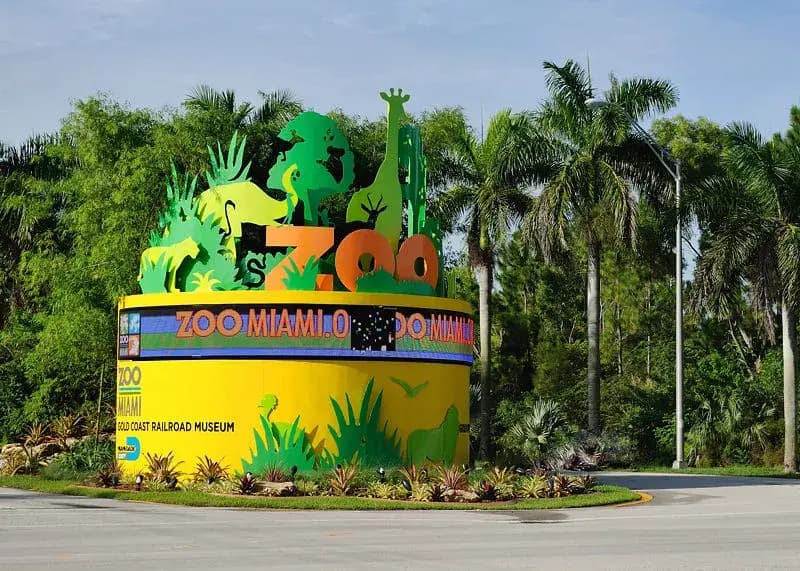
- Admission
- $25.95
- Size
- 750 acres
- Animals
- 3,000
- Opened
- 1948
- Accreditation
- AZA
Association of Zoos and Aquariums
Everything below is directory information drawn from public sources and the zoo's own site.
Animals at Zoo Miami
We haven't confirmed this zoo's animal list yet.
Feathers & Fangs from visitors
What people who've been to Zoo Miami say
A Feather is something this zoo does well; a Fang is something it gets wrong. Left by people who've been, and read by us before they appear.
Loading…
About Zoo Miami
The Miami-Dade Zoological Park and Gardens, known as Zoo Miami, is the largest zoo in Florida and the only tropical zoo in the continental United States. It sits on almost 750 acres in unincorporated Miami-Dade County, southwest of Miami, on the former site of the Naval Air Station Richmond, with 324 acres currently developed. The zoo houses over 3,000 animals of around 500 species across more than 100 exhibits, and its walking path measures about 4 miles around. Zoo Miami is accredited by the Association of Zoos and Aquariums, and its communications director is longtime zookeeper Ron Magill.
Zoo Miami was originally established in 1948 at Crandon Park on Key Biscayne before relocating to its current location in 1980 as Miami MetroZoo. The zoo is organized around five main geographic sections: Florida's own Everglades, Asia, Africa, Amazon and Beyond, and Australia, connected by a large lake called Lake Iguana and anchored by an indoor Conservation Action Center focused on wildlife preservation.
History
Zoo Miami's origin story starts small: in 1948, a stranded traveling road show near Miami traded three monkeys, a goat, and two black bears for about $270 worth of truck repairs, and those six animals became the founding collection of the Crandon Park Zoo on Key Biscayne. The zoo also received stranded circus animals, including lions, an elephant, and a rhinoceros, plus tortoises, monkeys, and pheasants from the Matheson plantation. By 1967, the Crandon Park Zoo had grown past 1,200 animals and ranked among the top 25 zoos in the country, adding a white Bengal tiger in 1968.
Hurricane Betsy devastated the zoo in 1965, killing 250 animals, and talk of relocation eventually led Dade County to apply for 600 acres at the former Naval Air Station Richmond property in December 1970. Construction began in 1975, and the zoo opened on July 4, 1980, as Miami MetroZoo with a preview section of 12 exhibits; its first major exhibit, Asia, opened in December 1981, bringing the total to 38 exhibits across 200 acres. Expansion continued through the 1980s with new African hoofed-mammal exhibits, a monorail in 1984 built from repurposed 1984 Louisiana World Exposition vehicles, the Wings of Asia aviary in December 1984, and new Australian and children's petting zoo sections by 1989.
Hurricane Andrew struck in August 1992, toppling more than 5,000 trees, destroying the original Wings of Asia aviary, and killing roughly 100 of its 300 resident birds, though only five animals total died from debris or contaminated water despite most animals remaining outdoors throughout the storm. The zoo reopened that December, renaming its tiger exhibit in honor of Naomi Browning, a 12-year-old volunteer killed in the storm, and by mid-1993 had replanted more than 7,000 trees and returned animals sent to other institutions during reconstruction. Further incidents followed: stray dogs killed seven gazelles in 1994, and a 1996 brush fire burned 100 acres of undeveloped zoo land, forcing the evacuation of nearly 30 animals.
New exhibits kept arriving through the 1990s and 2000s, including the Komodo Dragon Encounter in 1996, Andean condors in 1999, meerkats in 2000, and Cuban crocodiles and squirrel monkeys in 2001, alongside a rebuilt Wings of Asia in 2003. On July 4, 2010, marking its 30th anniversary, the zoo was renamed the Miami-Dade Zoological Park and Gardens, or Zoo Miami, and broke ground on a $43 million project that produced a new Everglades exhibit, opened December 10, 2016, and an updated entryway. Hurricane Irma struck in September 2017, damaging the Amazon and Beyond exhibit and reportedly contributing to the deaths of a flamingo, a Great hornbill, and several other birds; the zoo closed until October. In May 2023, footage of a kiwi named Paora being handled by visitors in daylight drew international criticism, and the zoo apologized and ended the practice.
Exhibits and habitats
Florida: Mission Everglades, a $33 million project, showcases native Florida species including American alligators, American crocodiles, North American river otters, bobcats, American black bears, and Florida panthers, and features Lostman's River Ride, a gentle airboat attraction. The Asia section houses Bornean orangutans, Asian elephants, Indian rhinoceroses, Sumatran tigers, Malayan tapirs, sloth bears, and Komodo dragons, alongside non-Asian species like African lions and spotted hyenas; its now-defunct Asian River Life Experience once replicated an Asian river brook. The American Banker's Family Aviary, Wings of Asia, is a 54,000-square-foot walkthrough home to roughly 300 rare birds representing about 70 species, making it the largest open-air Asian aviary in the Western Hemisphere.
The African loop features reticulated giraffes, pygmy hippos, African bush elephants, eastern black rhinoceroses, and one of the most diverse hoofed-stock collections in the United States, including greater kudus, nyalas, and giant elands. Amazon and Beyond, opened December 6, 2008 in the zoo's northwest corner, spans 27 acres across four zones, Village Plaza, Cloud Forest, Amazon Flooded Forest, and Atlantic Forest, home to giant otters, jaguars, giant anteaters, Hoffmann's two-toed sloths, and harpy eagles. The Australia section showcases koalas, southern cassowaries, southern hairy-nosed wombats, and Matschie's tree-kangaroos near the 800-seat Sami Family Amphitheater, which in late 2024 added rotating animal-ambassador exhibits for cheetahs, servals, and vultures. From 1984 to 2022, an air-conditioned monorail with four stations carried visitors around the grounds before being decommissioned due to maintenance costs.
Animal highlights
Zoo Miami houses over 3,000 animals representing around 500 species, making it home to one of the most diverse hoofed-stock collections in the country. Long-resident animals have included Nonja, a Sumatran orangutan widely believed to be the oldest of her species until her 2007 death, and Carlita, a white Bengal tiger who lived at the zoo from 1994 until 2013. The zoo's Asian elephant herd includes an elderly female named Nellie and a young male named Ongard, following a lineage that traces back to Dalip, a bull who arrived at the old Crandon Park Zoo in 1967 and lived at Zoo Miami until his death in 2022. Other notable residents have included giraffe Pongo, at sixteen feet the tallest in the zoo before his 2021 death, and a female Andean bear received from the National Zoo in June 2025 who made her public debut in September that year. A baby koala born in May 2019 and named Hope, after emerging from her mother's pouch in January 2020, drew national attention.
Conservation and programs
Zoo Miami was a founding member of the AZA's Butterfly Conservation Initiative, which brings together government and non-government agencies to help recover vulnerable, threatened, and endangered butterfly populations across North America. Through the Zoo Miami Conservation Fund, the zoo has provided financial support to upgrade captive-breeding facilities in Thailand for endangered clouded leopards and fishing cats, extending its conservation reach well beyond its own grounds.
Planning your visit
Zoo Miami's website does not currently list specific hours or ticket prices in the material available for this page; check the zoo's official website for current admission, hours, and any special event schedules before planning your trip. The zoo's walking path runs about 4 miles around, so budget several hours to see all five main sections. Its size and the loss of the internal monorail in 2022 mean a visit now relies on walking or personal mobility devices to move between the Everglades, Asia, Africa, Amazon and Beyond, and Australia sections.
The Conservation Action Center near the junction of the zoo's main pathways offers indoor, air-conditioned exhibits themed around conservation and wildlife preservation, a useful stop to break up a hot Miami day. As with any zoo, confirm current hours, ticket prices, and accessibility accommodations on Zoo Miami's official website before visiting.
What we haven't confirmed
Everything above came from public sources. These specifics we haven't stood behind yet:
- Current hours
- Ticket prices
- Parking details
- Time typically needed for a visit
- Stroller and wheelchair accessibility specifics
- Phone number
Zoo Miami compared with nearby zoos
How Zoo Miami lines up against the closest zoos we have details for — useful if you're deciding between them for the same day out.
| Zoo | Distance | Admission | Hours | Size | AZA |
|---|---|---|---|---|---|
| Zoo MiamiThis zooMiami, FL | — | $25.95 | Daily 10:00 AM – 5:00 PM; last ticket sold 4:00 PM. Open every day. Thanksgiving 10 AM–3 PM; Christmas Day 12–5 PM. Closes 4 PM (last ticket 3 PM) on Oct 3 and Oct 17, 2026 and on select holiday night-event dates. | 750 acres | Yes |
| Zoological Wildlife FoundationMiami, FL | 4 mi | — | Guided tours by reservation only, Monday–Sunday 10:00 AM – 6:00 PM; must pre-book at least 24 hours ahead (same-day by phone 305-969-3696). Office 9 AM – 6 PM. December 25 (Dec 24 open 9 AM – 2 PM). | — | No |
| Jungle IslandMiami, FL | 19 mi | $29.95 | — | — | No |
| Flamingo GardensFort Lauderdale, FL | 32 mi | $24 | 9:30AM – 5:00PM | 60 acres | No |
Distances are straight-line. A dash means we haven't confirmed that detail yet, not that the zoo lacks it.
AZAThe Association of Zoos and Aquariums. Accredited members have passed an independent inspection of animal care and welfare, safety, conservation and education, repeated every five years. Many smaller facilities never apply, so “not accredited” isn't a verdict on its own. What accreditation means · How we check this
Zoo Miami: common questions
Is Zoo Miami AZA accredited?
Yes, Zoo Miami is accredited by the Association of Zoos and Aquariums.
How big is Zoo Miami?
The zoo spans almost 750 acres, with 324 acres currently developed, making it the largest zoo in Florida.
When did Zoo Miami open?
It was originally established in 1948 at Crandon Park and relocated to its current site in 1980.
How many animals and species does Zoo Miami have?
The zoo houses over 3,000 animals representing around 500 species across more than 100 exhibits.
What makes Zoo Miami unique?
It is the only tropical zoo in the continental United States.
Is there still a monorail at the zoo?
No, the monorail that operated from 1984 to 2022 was decommissioned due to maintenance costs.
What sections is the zoo divided into?
Five main sections: Florida's Mission Everglades, Asia, Africa, Amazon and Beyond, and Australia.
Something wrong here? Tell us — we correct in place, with a dated note.